



Healthcare Automations
12 mins
Top 12 Healthcare Interoperability Vendors in 2026
Summary
Your Competitors Are Embracing AI – Are You Falling Behind?
Healthcare interoperability vendors build the platforms, APIs, and integration engines that enable patient data to flow between electronic health records, billing systems, labs, pharmacies, payers, and public health registries.
The category spans API-based data exchange platforms, traditional integration engines, health information exchange networks, FHIR-native cloud platforms, and no-code workflow automation tools.
The challenge isn't finding a healthcare interoperability company. It's finding one that connects to your specific EHR, meets HIPAA requirements, supports the standards your trading partners use, and deploys without six months of custom engineering.
We evaluated 12 healthcare interoperability vendors across six criteria: integration breadth, standards support (FHIR, HL7, C-CDA), compliance and security, deployment speed, pricing transparency, and production scale.
| Platform | Best For |
|---|---|
| Keragon | No-Code Workflow Automation |
| Redox | API Platform for Health Tech |
| Rhapsody | Integration Engine |
| Health Gorilla | Clinical Data Access |
| InterSystems | Enterprise Health Systems |
Healthcare Interoperability Companies: Comparison Table
| Vendor | Best For | Standards | HIPAA | Pricing | G2/Cap | Score | Key Differentiator |
|---|---|---|---|---|---|---|---|
| Keragon | No-code workflows | FHIR, HL7 | Yes + SOC2 | From $99/mo | 4.8/5 | 9.2/10 | 400+ healthcare connectors |
| Redox | Health tech vendors | FHIR, HL7 | Yes | Custom | 4.5/5 | 9.0/10 | 12,000+ connected orgs |
| Rhapsody | Integration engine | HL7, FHIR, X12 | Yes | Enterprise | N/A | 8.8/10 | #1 KLAS 15 consecutive years |
| Health Gorilla | Clinical data access | FHIR, HIE | Yes | Custom | N/A | 8.4/10 | Nationwide lab + clinical data |
| InterSystems | Enterprise platforms | HL7, FHIR, X12 | Yes | Enterprise | 4.4/5 | 8.4/10 | HealthShare, 80+ countries |
| 1upHealth | FHIR-native platform | FHIR | Yes | Custom | N/A | 8.0/10 | Payer + provider FHIR hub |
| Smile Digital | FHIR data platform | FHIR | Yes | Enterprise | N/A | 7.8/10 | Open-source FHIR server |
| Innovaccer | Data unification | FHIR, HL7 | Yes | Enterprise | 4.3/5 | 7.8/10 | Healthcare intelligence cloud |
| Datavant | Data connectivity | FHIR, custom | Yes | Custom | N/A | 7.6/10 | De-identification + linking |
| Particle Health | Payer data access | FHIR, HIE | Yes | Custom | N/A | 7.4/10 | Clinical data for payers |
| MuleSoft | Enterprise iPaaS | FHIR, HL7 | Yes* | From $1,750/mo | 4.5/5 | 7.2/10 | Salesforce ecosystem |
| Zus Health | Point-of-care data | FHIR | Yes | Custom | N/A | 7.0/10 | Shared data at point of care |
The Growing Need for Interoperability in Healthcare
Healthcare organizations can no longer operate with siloed data. Federal regulations, starting with the 21st Century Cures Act, now prohibit information blocking and require standardized API access to patient data.
The Trusted Exchange Framework and Common Agreement (TEFCA) is building a national infrastructure for health data exchange, with nearly 500 million records exchanged as of early 2026.
At the same time, the operational cost of poor interoperability continues to mount. According to a JAMA study (2019), administrative complexity accounts for $265.6 billion in annual waste across U.S. healthcare.
Much of this waste stems from manual data re-entry, faxed records, phone-based referrals, and disconnected billing workflows that interoperability would eliminate. For a deeper look at the fundamentals, see our guide to interoperability in healthcare.
12 Top Healthcare Interoperability Vendors in 2026
Here we'll take a look at the top 12 interoperability vendors for healthcare, looking at integration breadth, standards support (FHIR, HL7, C-CDA), compliance and security, deployment speed, pricing transparency, and production scale.
#1. Keragon: Best No-Code Interoperability Platform for Healthcare

Score: 9.2/10. Highest marks for integration breadth (10/10), compliance (10/10), and deployment speed (10/10). Scored lower on enterprise data platform depth (6/10).
Keragon is a HIPAA-compliant, no-code workflow automation platform that connects 400+ healthcare tools, including EHRs, billing platforms, scheduling systems, CRMs, and communication tools.
Where traditional interoperability vendors focus on data exchange infrastructure, Keragon focuses on what happens with the data after it arrives: routing it to the right system, triggering downstream workflows, and ensuring every handoff is automated and compliant.
Best for healthcare organizations that need to connect and automate workflows across EHRs, billing, scheduling, and communication tools without custom engineering or HIPAA risk.
Product Overview
Pain 1: Traditional interoperability platforms require engineering teams.
Most interoperability vendors (Redox, Rhapsody, InterSystems) are built for developers and IT teams. They provide powerful APIs and integration engines but require technical expertise to configure, deploy, and maintain.
Keragon's no-code builder lets clinical and operations teams build integrations without writing code, connecting systems like Athenahealth, DrChrono, Elation Health, Healthie, and ModMed in days, not months.
Pain 2: Compliance is an afterthought on generic platforms.
Zapier, Make, and n8n are not HIPAA-compliant. Even enterprise iPaaS platforms (MuleSoft) require specific healthcare configurations for HIPAA compliance.
Keragon is SOC 2 Type II certified and HIPAA compliant by design, with encryption, audit logging, BAAs, and a 7-day data retention policy built into the architecture.
Pricing
- Free 14-day trial. Paid plans from $99/month. Volume-based.
Tradeoffs
- Not a data exchange platform for cross-organizational HIE-level interoperability. Best for internal system-to-system workflow automation.
- Fewer enterprise data pipeline features than InterSystems or Innovaccer. Deepest strength is connecting healthcare operational tools.
Case Study
The Autism Center of Illinois deployed Keragon to automate intake workflows across IntakeQ, Google Drive, Slack, and Monday.com. Result: 10 hours/week reclaimed, 2-3 days faster onboarding, full HIPAA compliance.
Pre-built templates. HIPAA compliant. No developers needed. Start your free trial today.
#2. Redox: Best Interoperability API Platform for Health Tech Vendors

Score: 9.0/10. Highest for API standardization (10/10) and network scale (10/10). Lower on no-code accessibility (4/10).
Redox is the leading healthcare interoperability company for digital health vendors that need to connect their applications to health system EHRs. Its single standardized API works across 95+ EHR systems and connects 280+ software vendors with over 12,000 healthcare delivery organizations.
Redox and Kno2's strategic alliance (announced late 2025) transacts over 40 billion annual transactions, representing 75% of U.S. health systems.
Best for digital health companies and health tech vendors that need rapid EHR connectivity through a single API.
Tradeoffs
- Developer-focused. Not designed for non-technical healthcare operations teams.
- Primarily serves health tech vendors connecting to health systems, not internal health system integration.
#3. Rhapsody: Best Healthcare Integration Engine
Score: 8.8/10. Highest for integration engine reliability (10/10) and standards coverage (10/10). Lower on modern UI (5/10).
Rhapsody (formerly Lyniate) has been the #1 KLAS-rated integration engine for 15 consecutive years. Its Corepoint Integration Engine handles complex, multi-system healthcare data routing across HL7, FHIR, X12, C-CDA, and custom formats.
Deployed across 1,900+ healthcare organizations globally. Rhapsody's integration suite also includes terminology management and data quality tools.
Best for hospitals and health systems requiring enterprise-grade integration infrastructure with deep standards coverage.
Tradeoffs
- Traditional integration engine. Requires technical expertise to configure and maintain.
- Enterprise pricing. Not suited for smaller practices or quick-deploy use cases.
#4. Health Gorilla: Best for Nationwide Clinical Data Access

Score: 8.4/10. Strong for clinical data network breadth (9/10). Lower on workflow automation (4/10).
Health Gorilla operates a nationwide clinical data network that enables real-time access to patient records, lab results, and clinical documents from across the U.S. healthcare ecosystem. Its products include EHR data access, lab data automation, and clinical document exchange.
Health Gorilla's network connects digital health companies, EHR vendors, payers, and providers to shared clinical data.
Best for digital health companies and payers needing broad access to clinical data from multiple sources.
Tradeoffs
- Data access network, not a workflow automation platform. Does not handle downstream workflow execution.
#5. InterSystems: Best Enterprise Health Data Platform
Score: 8.4/10. Highest for enterprise scale (10/10) and data platform depth (9/10). Lower on deployment speed (4/10).
InterSystems provides HealthShare, a comprehensive health data platform deployed across 80+ countries. It supports unified health records, health information exchange, care community management, and analytics.
InterSystems is the infrastructure behind many national and regional health data exchanges globally. One of the most established healthcare interoperability companies in the market.
Best for large health systems, government health agencies, and regional HIEs needing enterprise-scale data platform infrastructure.
Tradeoffs
- Enterprise complexity and pricing. Not suited for small or mid-size organizations.
- Implementation timelines can be long. Requires dedicated IT resources.
#6. 1upHealth: Best FHIR-Native Platform for Payers and Providers
Score: 8.0/10. Strong for FHIR compliance (9/10) and regulatory alignment (9/10). Lower on integration breadth (5/10).
1upHealth provides a FHIR-enabled platform for claims and clinical data acquisition, exchange, and analysis. It helps payers, providers, and digital health companies meet CMS interoperability requirements (Patient Access API, Provider Directory API, Payer-to-Payer API) through a single platform.
Strong alignment with regulatory compliance requirements.
Best for payers and providers meeting CMS FHIR-based interoperability mandates.
Tradeoffs
- FHIR-focused. Limited support for legacy HL7 v2 or X12 standards.
#7. Smile Digital Health: Best Open-Source FHIR Server

Score: 7.8/10. Strong for FHIR depth (9/10). Lower on out-of-the-box usability (5/10).
Smile Digital Health (formerly Simpatico Intelligent Systems) provides a FHIR-based health data platform built on HAPI FHIR, the most widely adopted open-source FHIR server implementation.
The platform serves healthcare organizations, insurers, providers, and government agencies with data interoperability and compliance solutions.
Best for organizations that want a FHIR-native data platform with open-source foundations and flexibility.
Tradeoffs
- Requires technical expertise. Open-source FHIR server means more configuration work than managed platforms.
#8. Innovaccer: Best for Healthcare Data Unification and Analytics

Score: 7.8/10. Strong for analytics (8/10) and value-based care (8/10). Lower on integration speed (5/10).
Innovaccer's healthcare intelligence cloud unifies data from disparate sources (EHRs, claims, labs, pharmacies) into a single longitudinal patient record. It supports value-based care analytics, population health management, risk stratification, and care coordination.
More of a data analytics platform than a pure interoperability vendor, but data unification is foundational to its offering.
Best for health systems and payers pursuing value-based care with unified data and population health analytics.
Tradeoffs
- Enterprise-focused with complex implementation. Not designed for quick-deploy workflow automation.
#9. Datavant: Best for Healthcare Data Connectivity and De-Identification

Score: 7.6/10. Strong for data linking (9/10) and privacy (9/10). Lower on real-time interoperability (5/10).
Datavant specializes in connecting healthcare data across organizations while preserving patient privacy through de-identification and tokenization. Its platform links patient records across disparate datasets without exposing PHI, enabling analytics, research, and real-world evidence generation.
A healthcare interoperability company focused on the data science and analytics layer rather than clinical workflow integration.
Best for life sciences, payers, and health systems needing de-identified data linking for research and analytics.
Tradeoffs
- Focused on data connectivity and de-identification, not real-time clinical interoperability or workflow automation.
#10. Particle Health: Best for Payer Clinical Data Access
Score: 7.4/10. Strong for payer data access (8/10). Lower on provider-side features (4/10).
Particle Health provides a clinical data platform that gives payers, developers, and digital health companies access to patient medical records through HIE networks and direct EHR connections.
Its API aggregates clinical data from multiple sources into a unified view for care management, utilization review, and risk adjustment.
Best for payers and risk-bearing entities needing aggregated clinical data for care management.
Tradeoffs
- Primarily serves the payer side. Limited provider-facing features.
#11. MuleSoft (Salesforce): Best Enterprise iPaaS with Healthcare Capabilities

Score: 7.2/10. Strong for enterprise breadth (9/10). Lower on healthcare-specific design (5/10).
MuleSoft is a general-purpose integration platform (iPaaS) within the Salesforce ecosystem that includes healthcare accelerators for FHIR and HL7 integration. Its Anypoint Platform supports API-led connectivity for complex enterprise integrations.
MuleSoft is the choice for large health systems already invested in Salesforce that need enterprise-grade integration across clinical and non-clinical systems.
Best for large health systems within the Salesforce ecosystem needing enterprise iPaaS with healthcare adapters.
Pricing
From $1,750/month (Gold plan). Enterprise pricing custom.
Tradeoffs
- Not healthcare-specific. Requires Salesforce ecosystem investment. HIPAA compliance requires specific configuration.
- Significantly more expensive than healthcare-specific platforms for pure healthcare integration use cases.
#12. Zus Health: Best for Shared Health Data at Point of Care
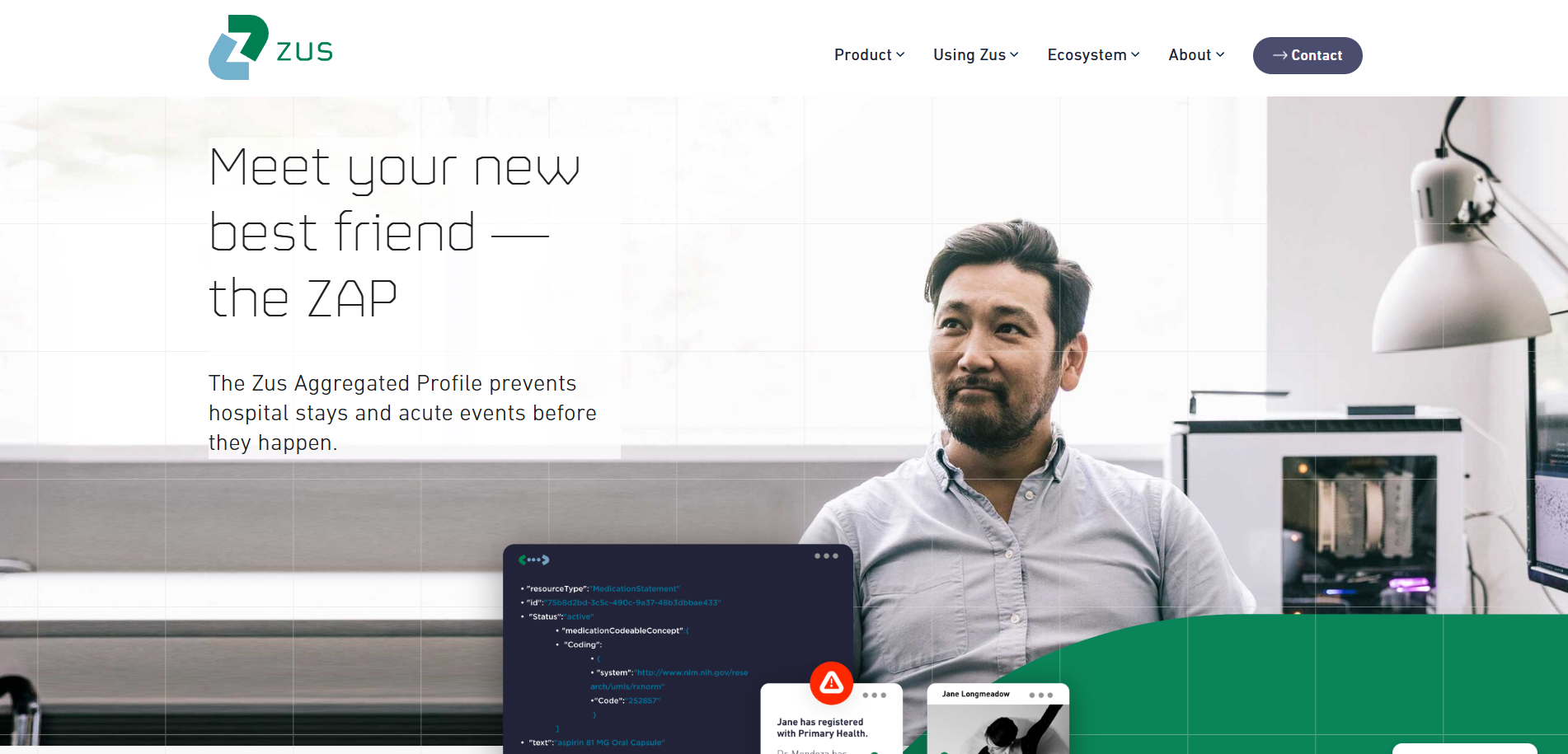
Score: 7.0/10. Strong for point-of-care data delivery (8/10). Lower on breadth and track record (5/10).
Zus Health provides a shared health data platform that delivers patient data at the point of care through APIs, embedded components, and direct EHR integrations.
Its platform aggregates data from multiple sources and makes it available to clinicians within their existing workflow, rather than requiring them to access a separate system.
Best for digital health companies and providers needing embedded patient data within their existing clinical applications.
Tradeoffs
- Newer company with less production track record than established vendors. Limited public reviews.
How to Choose the Best Healthcare Interoperability Vendor
Choosing the best healthcare interoperability vendor for your organization can be made more efficient by following these steps:
1. Define Your Use Case
Are you connecting internal systems within your organization (workflow automation)? Building a health tech product that needs EHR connectivity (API platform)? Operating a health system that needs enterprise data infrastructure (integration engine/data platform)? Exchanging data with payers or external organizations (HIE/data network)?
Your use case determines which category of vendor is right.
2. Verify Standards Support
Ensure the vendor supports the specific standards your trading partners and systems use.
FHIR is becoming the default, but many health systems still rely heavily on HL7 v2, X12, and C-CDA. A vendor that only supports FHIR may not connect to your legacy systems.
3. Assess HIPAA Compliance Architecture
Healthcare-first vendors (Keragon, Redox, Rhapsody) build HIPAA compliance into their architecture. General-purpose platforms (MuleSoft) require additional configuration.
Always verify BAA availability, encryption, and audit logging. See our guide to HIPAA-compliant workflow automation software.
4. Evaluate Deployment Speed
No-code platforms (Keragon) deploy in days. API platforms (Redox) deploy in weeks. Enterprise integration engines (Rhapsody, InterSystems) deploy in months.
Match the deployment timeline to your urgency and available resources.
5. Plan to Avoid Vendor Lock-In
Choose vendors that use open standards (FHIR, HL7) and allow data export. Avoid platforms that store data in proprietary formats or require expensive migration to switch.
Open-source foundations (Smile Digital Health) provide maximum flexibility.
Which Healthcare Interoperability Vendor Is Right for You?
Assess your priorities when deciding on the right healthcare interoperability vendor for your organization:
- Need to connect and automate internal workflows across EHRs, billing, and scheduling: Keragon. No-code, HIPAA-compliant, 300+ integrations.
- Building a health tech product that needs EHR connectivity: Redox. Single API, 12,000+ connected organizations.
- Need enterprise-grade integration engine for a hospital or health system: Rhapsody. #1 KLAS for 15 years.
- Need nationwide clinical data access: Health Gorilla (clinical/lab data) or Particle Health (payer data).
- Need enterprise health data platform at national scale: InterSystems. HealthShare, 80+ countries.
- Need FHIR-native platform for CMS compliance: 1upHealth (managed platform) or Smile Digital Health (open-source).
- Need unified data for value-based care analytics: Innovaccer. Healthcare intelligence cloud.
- Need de-identified data linking for research: Datavant.
- Need enterprise iPaaS within Salesforce ecosystem: MuleSoft. Powerful but expensive and not healthcare-specific.
Key Takeaways
Healthcare interoperability vendors serve fundamentally different use cases, from no-code workflow automation to enterprise data platforms to nationwide data networks. The right vendor depends on whether you’re connecting internal systems, building a health tech product, operating a health system, or exchanging data with external organizations.
For most healthcare organizations looking to solve immediate operational pain (disconnected EHRs, manual data entry, siloed billing), the fastest path is a no-code integration platform that connects your existing tools without custom engineering.
Keragon provides that layer with 300+ healthcare integrations, HIPAA + SOC 2 Type II compliance, and pre-built workflow templates for common healthcare automation patterns.
Start with a free 14-day trial to test integrations with your actual systems.
Frequently Asked Questions
What should you look for when evaluating a healthcare interoperability vendor?
Prioritize HIPAA compliance architecture (BAA, encryption, audit logging), support for the specific standards your systems use (FHIR, HL7, C-CDA), pre-built connectors for your EHR and operational tools, deployment speed, scalability, pricing transparency, and the vendor's track record in healthcare.
Healthcare-first platforms provide deeper compliance and connector coverage than general-purpose integration tools. For more on evaluating interoperability solutions, see our guide to interoperability in healthcare.
How do you avoid vendor lock-in when choosing an interoperability solution?
Choose vendors that use open standards (FHIR, HL7) rather than proprietary data formats. Verify that you can export your data, workflows, and configurations if you switch vendors.
Prefer vendors with open-source foundations (like Smile Digital Health's HAPI FHIR) or standards-based APIs. Avoid platforms that charge excessive fees for data migration or require proprietary connectors.
Build integrations using industry-standard protocols so your data exchange logic is portable.
What is the difference between an integration engine and an interoperability platform?
An integration engine (Rhapsody, InterSystems) processes and routes healthcare data between systems using standards like HL7 and FHIR. It requires technical expertise to configure.
An interoperability platform is a broader term that includes integration engines, API platforms (Redox), data networks (Health Gorilla), and workflow automation tools (Keragon).
The distinction matters because organizations often need multiple layers of interoperability infrastructure working together.
Which healthcare interoperability vendors support FHIR?
All 12 vendors in this guide support FHIR to varying degrees. The most FHIR-native platforms are 1upHealth, Smile Digital Health, and Zus Health. Redox, Keragon, and Health Gorilla support FHIR alongside other standards. Rhapsody and InterSystems support FHIR as part of comprehensive multi-standard integration engines.
How much do healthcare interoperability solutions cost?
Pricing varies enormously. Keragon starts at $99/month for no-code workflow automation. MuleSoft starts at $1,750/month. Enterprise platforms (Rhapsody, InterSystems, Innovaccer) use custom pricing based on volume and organizational scale. API platforms (Redox, Health Gorilla, 1upHealth) typically price per transaction or API call.
Factor in implementation, integration, training, and ongoing maintenance costs alongside the subscription.
Can smaller healthcare organizations afford interoperability solutions?
Yes. No-code platforms like Keragon (from $99/month) make interoperability accessible to practices of all sizes. FHIR-native platforms like 1upHealth offer usage-based pricing.
The key is choosing a platform that doesn’t require dedicated engineering resources for deployment and maintenance.
Enterprise integration engines (Rhapsody, InterSystems) are typically not cost-effective for smaller organizations.
Related Articles

_%20Use%20Cases%20%26%20Benefits.png)

Related Articles


