Healthcare Automations
15 mins
7 Notable Alternatives in 2026: Top Picks for Healthcare Automation & Patient Access
Summary
Your Competitors Are Embracing AI – Are You Falling Behind?
Notable is a well-funded AI platform whose agents automate patient access, intake, scheduling, prior authorization, and revenue-cycle tasks on top of the EHR. It is built for large health systems, and that is exactly why many teams look for Notable alternatives: it can be expensive, enterprise-only, and weighted toward front-office workflows, which leaves smaller practices, specialty groups, and teams with specific needs searching for a better fit. If you are comparing Notable alternatives, the right pick depends on whether you want flexible automation, conversational AI, patient engagement, revenue-cycle depth, or simple intake.
This guide compares the seven strongest Notable competitors in 2026, ranked by fit for the most common reasons teams evaluate a switch. We lead with Keragon, the HIPAA-compliant automation platform that lets teams build their own workflows without an enterprise contract, then cover the conversational AI, patient-access, communication, and revenue-cycle tools most often shortlisted against Notable. Each entry includes a product overview, pros and cons, pricing, setup expectations, and the tradeoffs to weigh.
Notable Alternatives Comparison & Ratings Chart
The table below summarizes the seven best Notable alternatives we cover, weighing core capability, ideal user, and pricing. Ratings are drawn from G2 and Capterra as of mid-2026 and are approximate, since several enterprise tools carry limited public consumer reviews.
| Software | Key Features | Best For | Pros | Cons | Pricing | Ratings |
|---|---|---|---|---|---|---|
| Keragon | No-code automation, 400+ integrations, AI agents | Flexible healthcare automation | HIPAA, fast, affordable | Not a packaged agent suite | From ~$99/mo | 4.8 |
| Hyro | Conversational AI for calls, chat, SMS | Call & conversation automation | Strong voice AI, EHR-aware | Enterprise cost | Enterprise (custom) | Few reviews |
| Luma Health | Self-scheduling, reminders, rebooking | Patient access & engagement | Great UX, strong EHR sync | Add-on to your scheduler | From ~$250/mo | 4.8 |
| Artera | AI virtual agents, voice & text communications | AI patient communication | Top-rated, multilingual | Communications-focused, custom pricing | Enterprise (custom) | 4.9 |
| Thoughtful AI | Autonomous RCM agents, ROI guarantees | Revenue cycle automation | Deep RCM expertise, accountable ROI | RCM-only focus, newer vendor | Custom (ROI-based) | ~4.6 |
| Phreesia | Intake, registration, payments | Patient intake & registration | Proven intake platform at scale | Implementation can be heavy | From ~$250/mo | 4.1 |
| Infinitus | AI voice agents for payer calls | Prior authorization & benefit verification | Automates payer phone calls | Narrow use case, enterprise-focused | Enterprise (custom) | Few reviews |
7 Best Notable Alternatives in 2026
Below are the seven best Notable alternatives we recommend evaluating in 2026, ordered by fit for the most common use cases teams consider when they move off or rule out Notable. Each is broken into a product overview, pros and cons, pricing, setup time, and the tradeoffs to weigh.
1. Keragon
Best Overall
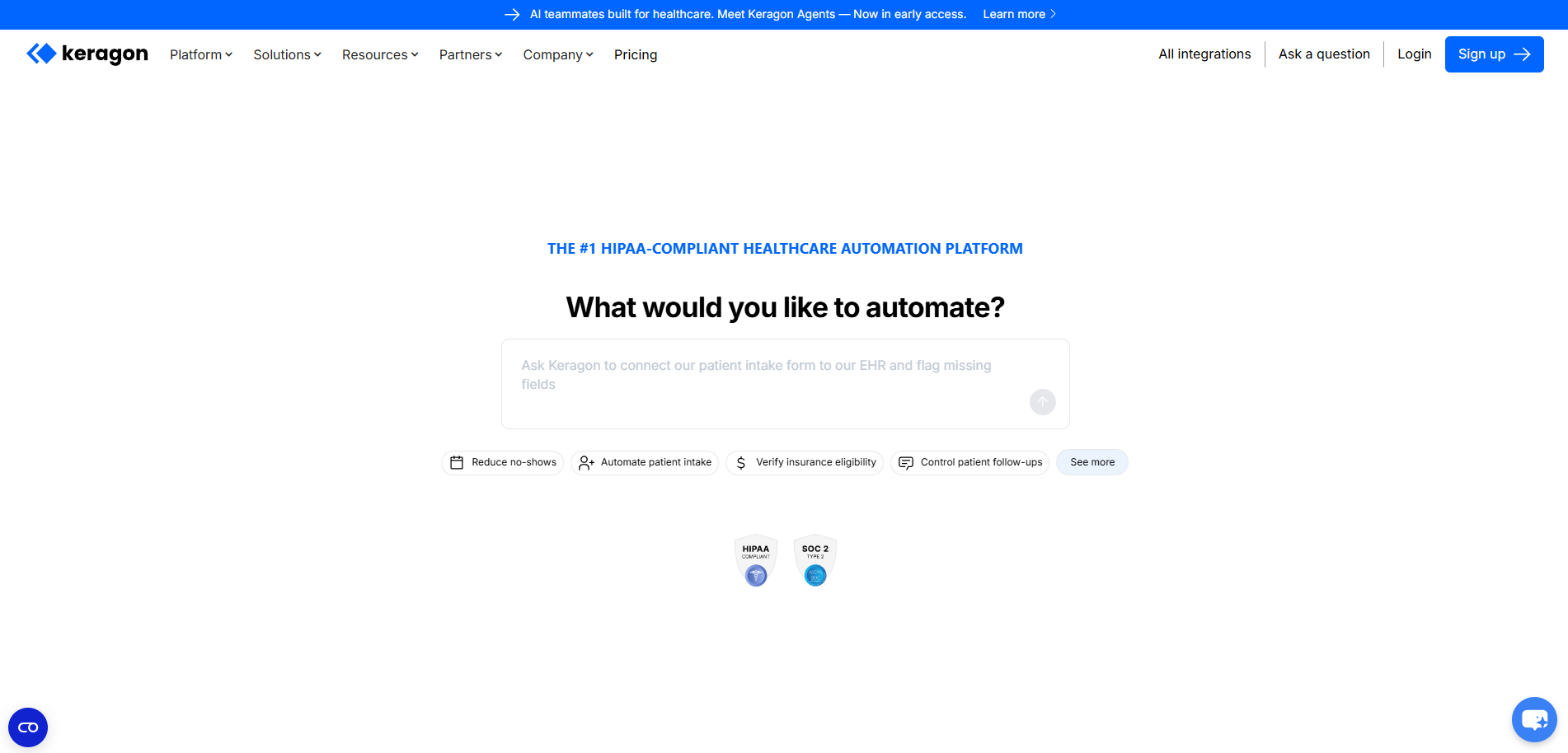
Keragon is a HIPAA-compliant healthcare automation platform that lets teams build and run their own automations across the systems they already use, without an enterprise deployment. Where Notable ships packaged AI agents aimed at large health systems, Keragon gives you a no-code canvas and an AI layer to automate patient access, intake, scheduling handoffs, reminders, and data syncing your way, connecting your EHR, PMS, CRM, and communication tools. It is the best fit for practices and growing groups that want Notable-style automation with more flexibility, faster setup, and far lower cost.
Product Overview
Keragon is a no-code automation builder with 400+ healthcare integrations and an AI layer (including early-access Keragon Agents) running on HIPAA-compliant infrastructure. Teams connect their systems and build multi-step workflows that move data and trigger actions automatically, from intake to follow-up.
Pros & Cons
• Pro: HIPAA-compliant and SOC 2 Type II certified, with a signed BAA and zero AI data retention.
• Pro: No-code builder and 400+ integrations get teams live in an afternoon, at a fraction of enterprise cost.
• Con: It is a flexible automation platform you configure, not a pre-packaged, vendor-managed agent suite for a single workflow.
Pricing
Keragon offers tiered, run-based plans with a free trial: Starter from around $99 per month (up to 3 active workflows), Professional (up to 15), Scale Up (up to 100), and custom Enterprise pricing. Confirm current prices on the Keragon pricing page.
Setup
Setup is fast: most customers ship their first production workflow within an afternoon, and full rollouts take days rather than the months typical of enterprise agent platforms. Integrations connect through guided flows, not custom development.
Tradeoffs
Keragon is the strongest overall pick when you want flexible, affordable, compliant automation you can own and extend across many workflows. The tradeoff is that you build and configure automations rather than buying a turnkey, fully managed agent for one process, so teams that want a vendor to run a single high-volume workflow end to end may pair Keragon with a specialist tool.
Pre-built templates. HIPAA compliant. No developers needed. Start your free trial today.
2. Hyro
Best for call & conversation automation
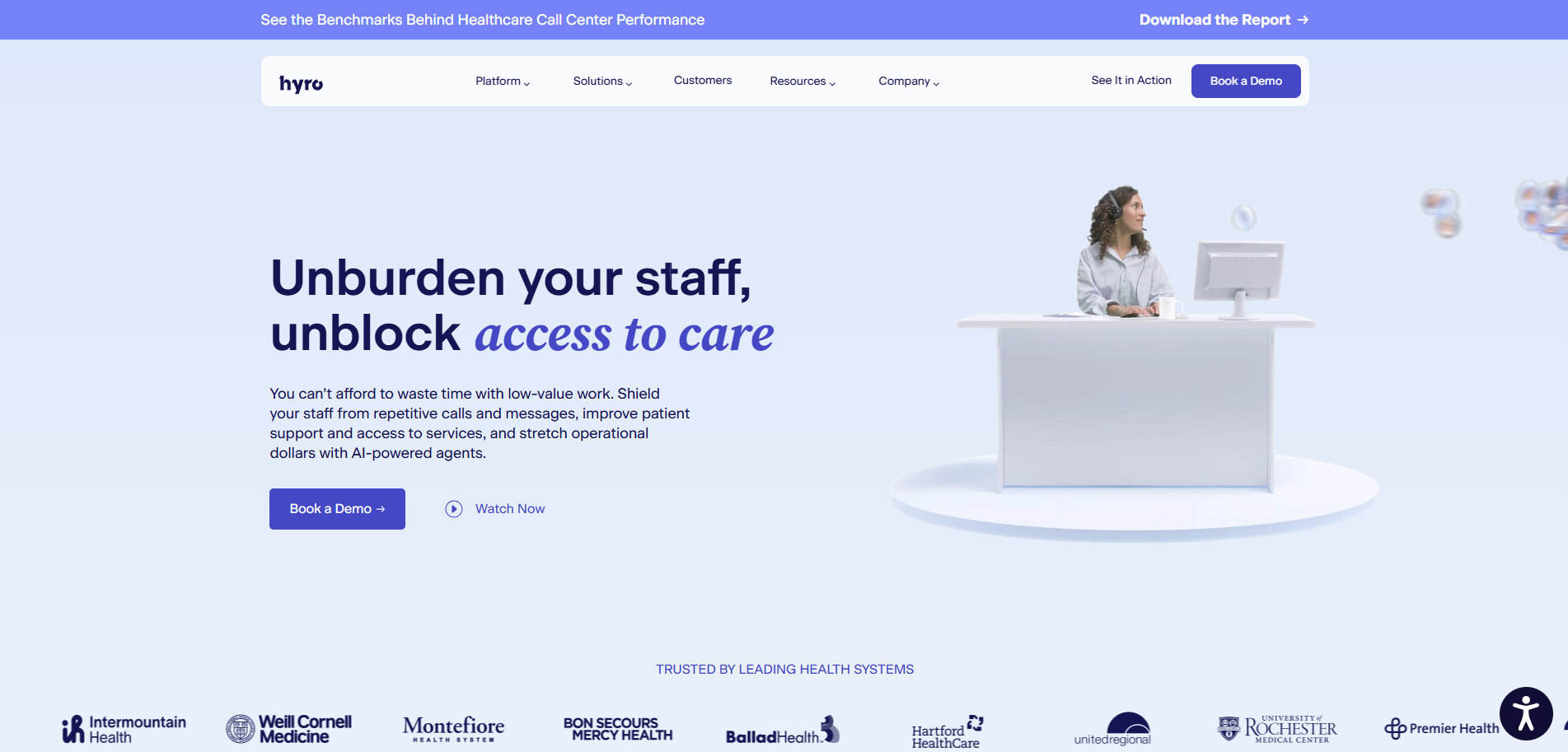
Hyro is a healthcare-focused conversational AI platform that automates calls, web chat, and SMS for health systems, with EHR awareness and HIPAA compliance. Where Notable automates structured workflows, Hyro automates the conversations themselves, handling scheduling, prescription refills, and routine questions across the call center and digital channels. It is a fit for organizations whose biggest burden is inbound communication volume.
Product Overview
Hyro deploys AI assistants that understand natural language across phone, chat, and text, integrate with EHR and other systems, and resolve or route patient interactions without staff, reducing call-center load at scale.
Pros & Cons
• Pro: Strong conversational AI across voice and digital channels, built for healthcare.
• Pro: EHR-aware and HIPAA-compliant, with deflection of high call volumes.
• Con: Enterprise pricing and a sales-led rollout make it a larger commitment than self-serve tools.
Pricing
Hyro uses custom enterprise pricing, commonly reported starting around $10,000 per month depending on volume and channels. There is no public self-serve plan.
Setup
Implementation typically runs several weeks to a few months, including integration with telephony and the EHR and tuning of conversation flows.
Tradeoffs
Hyro is the right pick when inbound call and conversation volume is your dominant problem and you want AI to handle it across channels. The tradeoffs are cost and setup time; smaller practices or teams needing broad workflow automation rather than conversation handling will find it heavier than necessary.
3. Luma Health
Best for patient access & engagement
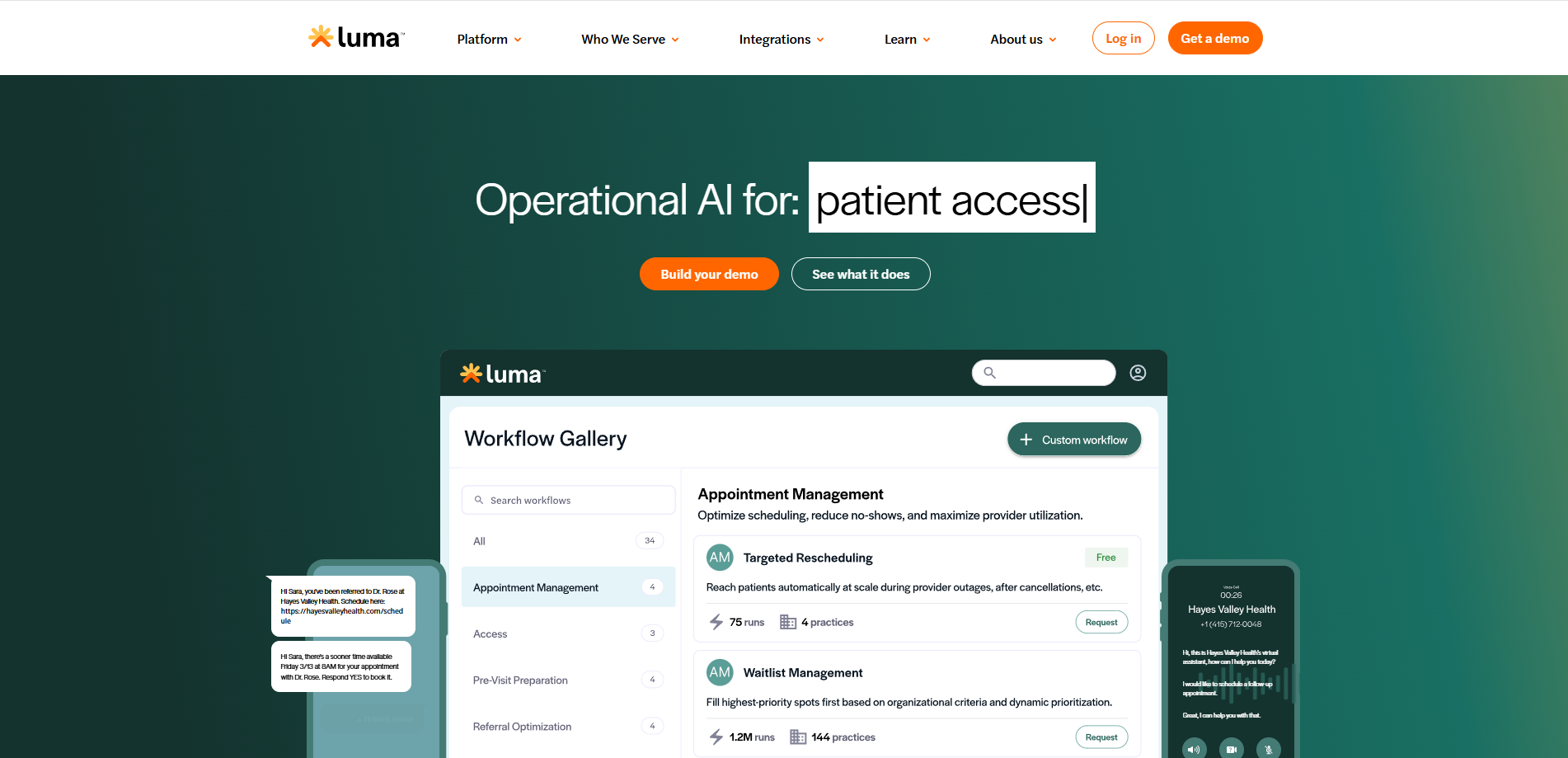
Luma Health is a patient-access and engagement platform offering rules-based self-scheduling, reminders, automated rebooking, waitlist management, and omnichannel communication on top of your existing EHR. It is widely used by health systems and specialty groups to publish real-time availability and keep schedules full. Among Notable alternatives, it is the strongest for patient-facing access and communication rather than back-office RCM.
Product Overview
Luma Health connects to the EHR to enable patient self-scheduling, proactive reminders and recalls, intake, and two-way messaging, coordinating the patient journey from booking through follow-up.
Pros & Cons
• Pro: Polished patient experience with strong, well-reviewed EHR integration, including Epic.
• Pro: Broad patient-access automation: scheduling, reminders, rebooking, and waitlist backfill.
• Con: It layers on top of your scheduler and is more access-and-engagement focused than a full operational or RCM agent.
Pricing
Luma Health uses custom pricing, generally reported to start around $250 per provider per month and scaling with practice size and modules. It does not publish a fixed price list.
Setup
Implementation typically runs a few weeks for standard configurations and longer for highly customized workflows, with strong vendor support cited by reviewers.
Tradeoffs
Luma Health is the right pick when patient access and engagement are the priority and you want a refined, well-integrated experience. Its limitation is scope: it is not a revenue-cycle automation engine or a build-your-own platform, so teams needing broader automation often pair it with another tool.
4. Artera
Best for AI patient communication
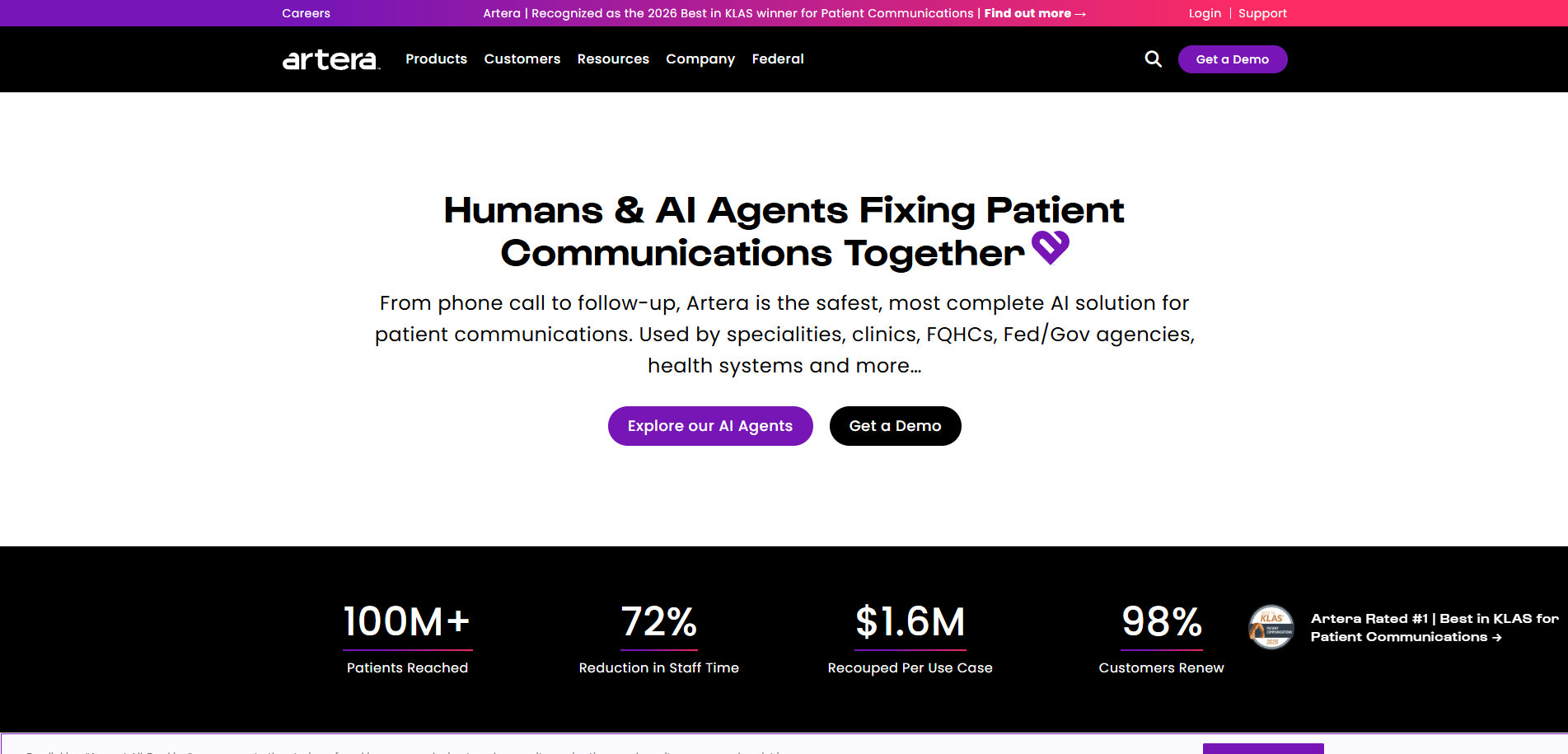
Artera is a trusted patient-communication platform that connects patients to organizations via text, phone, email, and chat, now with AI virtual agents that handle scheduling, intake, forms, and billing conversations. It is used by 900+ provider organizations and engages around 100 million patients a year across many languages. For Notable alternatives focused on the communication layer, Artera is among the highest-rated options.
Product Overview
Artera unifies patient messaging across channels and adds AI virtual agents (voice and text) that can augment front-desk staff or run autonomously, supporting billions of communications in over 100 languages.
Pros & Cons
• Pro: Top-rated, mature communication platform with strong multilingual support.
• Pro: Flexible AI virtual agents that scale from augmenting staff to fully autonomous handling.
• Con: Focused on patient communication; it is not a full operational or RCM automation suite, and pricing is custom.
Pricing
Artera uses custom enterprise pricing based on organization size, channels, and agent options. Pricing is quoted on request rather than published.
Setup
Implementation runs from a few weeks to a couple of months depending on channels, integrations, and how many AI agents are deployed.
Tradeoffs
Artera is the right pick when patient communication at scale, across channels and languages, is the core need. The tradeoff is that it concentrates on the communication layer rather than the broader administrative and revenue workflows Notable spans, so evaluate it alongside a workflow or RCM tool if you need both.
5. Thoughtful AI
Best for revenue cycle automation
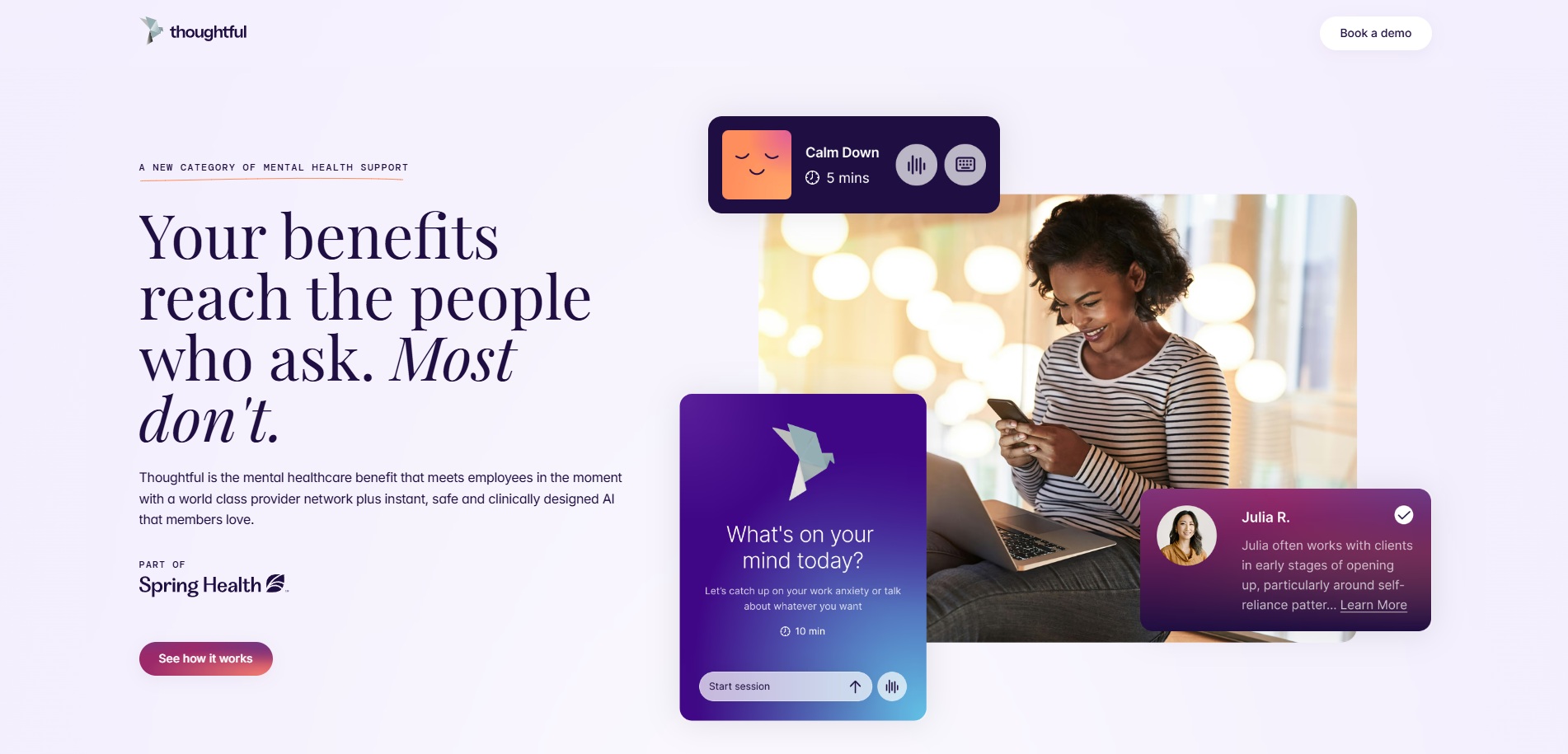
Thoughtful AI builds autonomous AI agents for revenue-cycle tasks: eligibility verification, prior authorization, claims submission, payment posting, and denial management. Where Notable spans the full patient journey, Thoughtful AI goes deep on the billing and claims side and backs deployments with ROI guarantees. It is the strongest Notable alternative when revenue-cycle automation is your priority.
Product Overview
Thoughtful AI deploys agents that each own a complete RCM workflow end to end, running against EHR, practice-management, and payer systems to reduce manual billing work and accelerate cash flow.
Pros & Cons
• Pro: Deep, specialized automation across the full revenue cycle.
• Pro: ROI guarantees create vendor accountability tied to financial results.
• Con: Focused on RCM rather than clinical or patient-facing workflows, and a newer vendor with limited public reviews.
Pricing
Thoughtful AI uses custom pricing, often structured around ROI or outcomes rather than a flat subscription. Contact Thoughtful AI for a scoped quote.
Setup
Deployment typically runs a few weeks, with the vendor configuring and tuning agents to your specific payers and billing workflows as part of a managed model.
Tradeoffs
Thoughtful AI is the right pick when reducing AR days, denials, and manual billing work is the goal. The tradeoff is scope: it does not handle patient access, scheduling, or communication, so organizations needing those will combine it with a patient-access tool or a flexible platform like Keragon.
6. Phreesia
Best for patient intake & registration
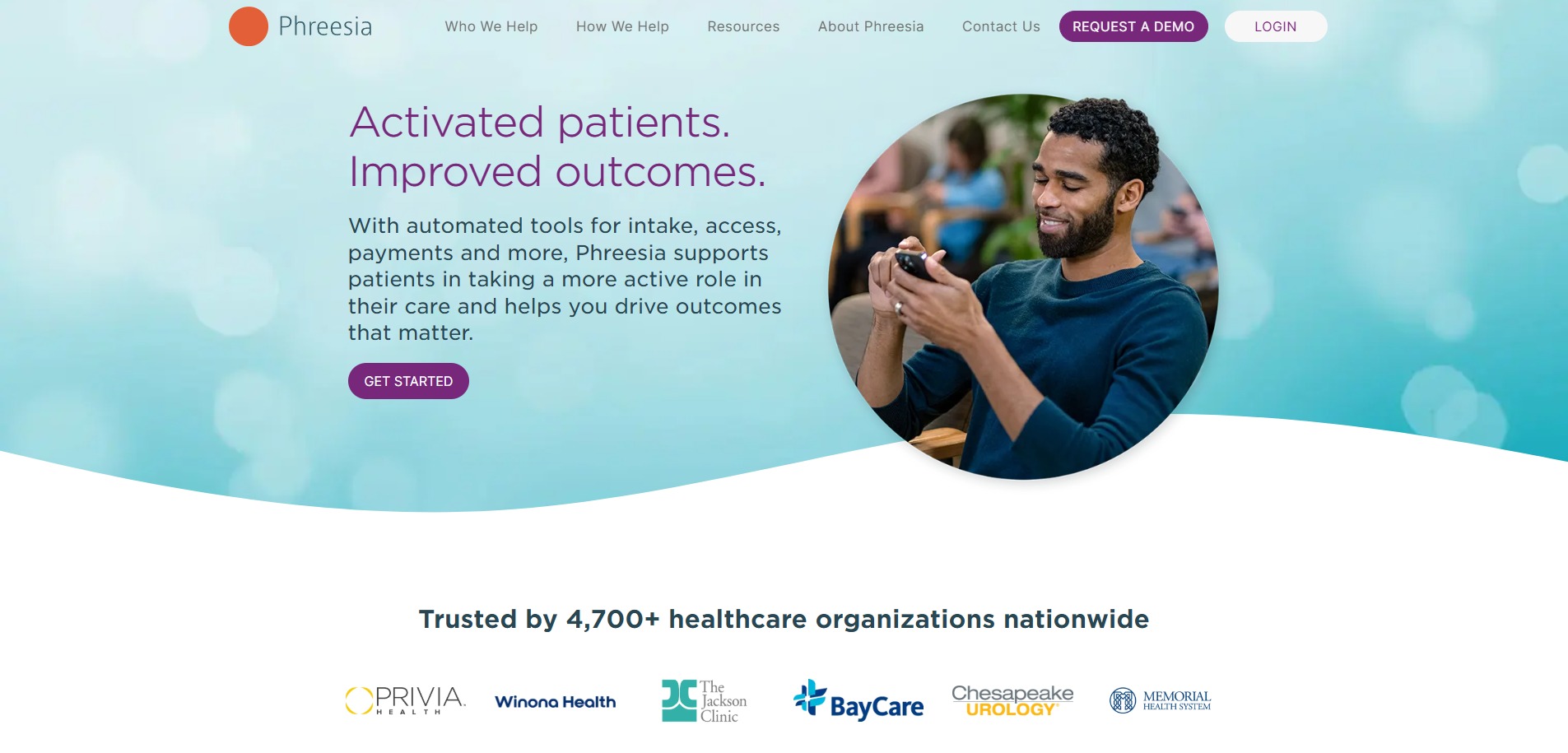
Phreesia is an intake-first platform that automates patient check-in, registration, insurance verification, and payment collection, with scheduling and outreach modules around it. It is purpose-built for structured, repeatable intake at scale, and reports involvement in roughly one in seven US patient visits. Among Notable alternatives, it is the strongest for the intake and registration slice of patient access.
Product Overview
Phreesia lets patients complete registration, consents, insurance, and payment on their own device or in-office tablets, using rules-based form logic and OCR, then feeds clean data into the practice workflow.
Pros & Cons
• Pro: Proven, large-scale intake with strong financial workflows like insurance verification and upfront payments.
• Pro: Improves data accuracy and reduces front-desk paperwork across multi-site groups.
• Con: Some teams report implementation can be demanding, and its focus is intake rather than end-to-end automation.
Pricing
Phreesia uses custom pricing commonly reported to start around $250 per month and rise to $500 to $1,000+ as practices add locations, users, and modules. It does not publish a fixed list.
Setup
Setup ranges from light to demanding depending on configuration; some reviewers describe a smooth, vendor-managed onboarding, while others note multi-site setup takes effort.
Tradeoffs
Phreesia is the right pick when structured intake, registration, and front-end financial capture are the priority, especially for high-volume multi-site groups. The tradeoff is breadth: it is an intake platform, not a full automation suite, so it pairs well with tools that handle communication, RCM, or operational automation.
7. Infinitus
Best for prior authorization & benefit checks
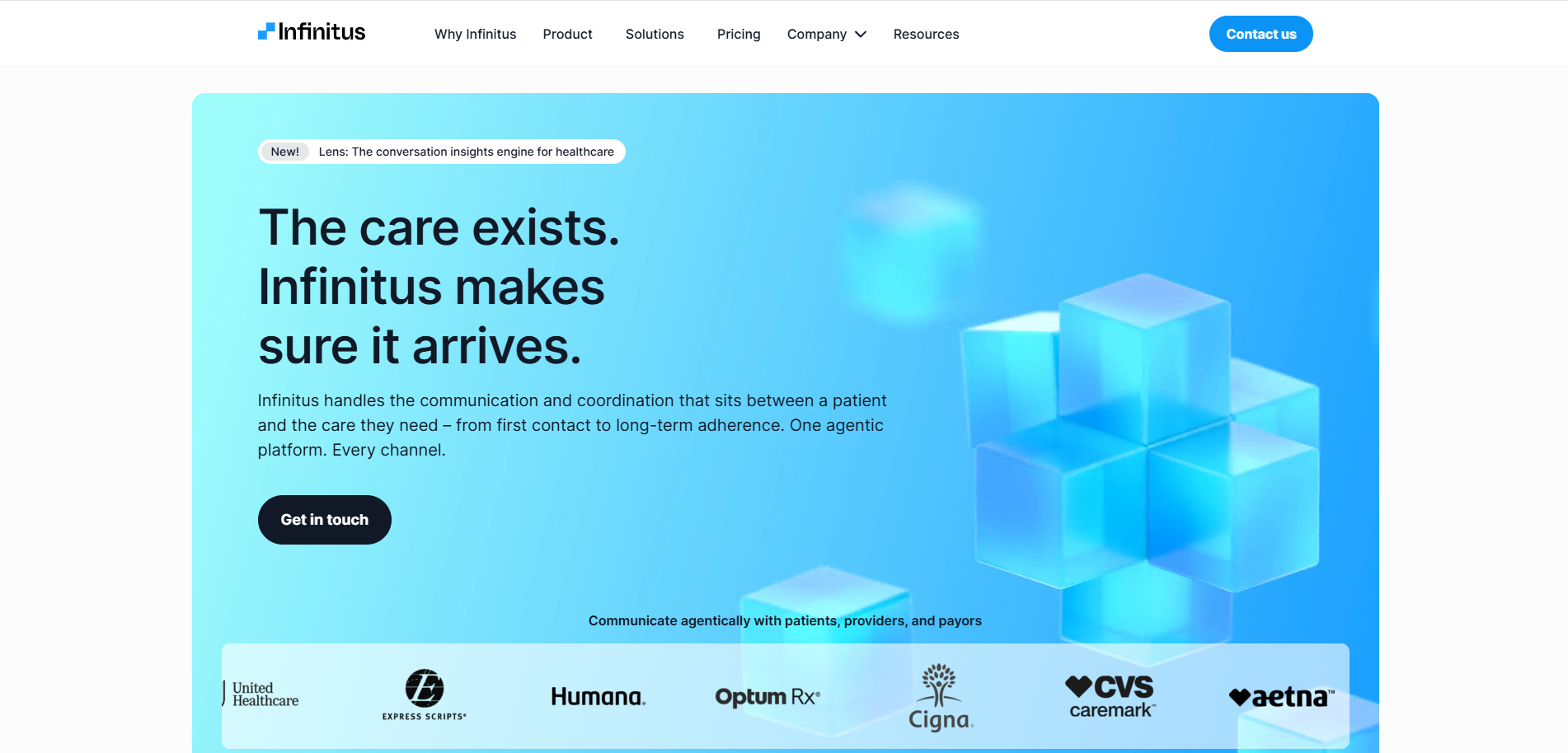
Infinitus uses AI voice agents to make the high-volume phone calls healthcare teams dread: benefit verification, prior authorization, and claim-status calls to payers. It automates a narrow but painful slice of administrative work that consumes enormous staff time. For Notable alternatives focused on payer-facing phone automation, Infinitus is the specialist.
Product Overview
Infinitus deploys autonomous AI agents that call payers, navigate phone trees, gather benefit and authorization details, and return structured data, removing the manual hold-time burden from staff.
Pros & Cons
• Pro: Automates payer phone calls end to end, recovering large amounts of staff time.
• Pro: Returns structured, usable data for benefits, prior auth, and claim status.
• Con: Narrowly focused on payer-facing calls and sold as an enterprise solution.
Pricing
Infinitus uses custom enterprise pricing scoped to call volume and use cases. Pricing is quoted on request and not published.
Setup
Implementation runs several weeks to a couple of months, including configuring the payer call types and integrating the returned data into your systems.
Tradeoffs
Infinitus is the right pick when payer phone calls for benefits and prior authorization are a major drain. The tradeoff is its narrow focus: it solves one expensive problem deeply but is not a broad patient-access or workflow platform, so it complements rather than replaces a tool like Notable or Keragon.
Why Choose the Alternatives to Notable Software
Teams evaluating alternatives to Notable software tend to share a similar set of reasons. Below are the most common drivers behind the search for Notable health competitors.
Cost and enterprise-only access
Notable is priced and built for large health systems, which puts it out of reach for many independent practices and specialty groups. Alternatives with transparent or lower entry pricing, like Keragon’s published plans, open automation to smaller teams without an enterprise contract.
Flexibility versus packaged agents
Notable delivers managed agents for defined workflows. Teams that want to build, edit, and own their own automations across whatever systems they use often prefer a flexible, no-code platform they control rather than a fixed set of vendor-run agents.
Depth in a specific area
Some organizations need depth, not breadth: conversational AI, patient communication, revenue cycle, or payer calls. Specialists like Hyro, Artera, Thoughtful AI, and Infinitus solve one problem more deeply than a broad platform.
Faster time-to-value
Enterprise agent deployments take time. A tool you can configure in days, or one focused tightly on a single workflow, often delivers measurable results faster than a system-wide rollout.
How to Choose the Right Notable Alternative for Your Organization
Choosing the right Notable alternative comes down to your highest-volume workflows, your systems, and how much you want to build versus buy. Use the steps below to narrow the field.
Map your highest-volume administrative workflows
Identify where staff time actually goes: scheduling, intake, prior authorization, billing, or phone calls. The best alternative differs by workflow, so naming your top one or two bottlenecks rules most tools in or out quickly.
Check EHR integration
Confirm native integration with your EHR (Epic, Oracle Health, athenahealth, or eClinicalWorks) and that data flows both ways. Keragon connects to 400+ healthcare systems, while others vary, so verify your specific EHR is supported.
Assess automation depth vs human-in-the-loop
Decide whether you want fully autonomous agents, assisted automation, or a builder you configure. Thoughtful AI and Infinitus run autonomously in their niches; Keragon gives you control to define how much runs automatically versus with review.
Evaluate HIPAA compliance, cost, and time-to-value
Verify HIPAA compliance and a signed BAA, then weigh total cost and setup time against expected value. For many teams, a flexible, affordable platform that ships in days beats an enterprise suite that takes months to deploy.
Key Features to Look for When Exploring Notable Health Competitors
When you shortlist Notable health competitors, the feature checklist matters more than the brand. The features below separate a tool that genuinely reduces administrative burden from one that adds another system to manage.
HIPAA compliance and a signed BAA
Any tool touching patient data must be HIPAA compliant, sign a BAA, and hold SOC 2 Type II certification. Confirm the BAA covers every place protected health information flows, and read the actual terms.
Native EHR and system integration
Count how many of the EHR, PMS, billing, and communication systems you use are supported natively. Native, bidirectional integration deploys far faster than custom interfaces and keeps data consistent.
Automation depth and AI agents
Look for AI that acts across systems, updating the record, triggering the next step, and notifying the team, rather than only generating outputs. Configurable agents beat fixed templates for adapting to your workflows.
Flexibility and ownership
A no-code builder lets your team ship and edit automations without filing a vendor ticket for every change, which determines whether you launch one workflow a quarter or many a month.
Transparent pricing and support
Prefer published or clearly scoped pricing and responsive support. Predictable cost makes ROI easy to model, and strong support shortens time-to-value, especially for smaller teams without dedicated IT.
Cost Comparison: Notable vs Competitors
Notable does not publish pricing; like most enterprise healthcare-automation platforms, it quotes custom contracts scoped to a health system, with implementation and change-management costs on top. Hyro, Artera, Thoughtful AI, and Infinitus follow the same enterprise model, with pricing tied to volume, channels, and use cases. These investments can pay off at scale, but they are significant commitments in both budget and time.
The clearest cost contrast is Keragon, which publishes tiered plans starting around $99 per month with a free trial, making compliant automation accessible to practices and growing groups, not just large systems. Patient-access tools like Luma Health and Phreesia sit in between, commonly starting around $250 per month and scaling with size and modules.
The practical decision: if you are a large health system that wants vendor-managed agents across the patient journey, budget for an enterprise platform like Notable or a specialist such as Hyro or Thoughtful AI. If you are a smaller practice or group that wants flexible, affordable automation you can own and extend, start with Keragon and add a specialist where you need depth.
Which Notable Alternative Is Right for Your Business?
Match the tool to your dominant need. For flexible, affordable, build-your-own automation, choose Keragon. For call and conversation automation, choose Hyro; for patient access and engagement, Luma Health; and for AI patient communication across channels, Artera.
For revenue-cycle automation, choose Thoughtful AI; for patient intake and registration, Phreesia; and for automating payer phone calls and prior authorization, Infinitus. Most organizations do best by naming their highest-volume workflow, choosing the tool that solves it deeply, and using a flexible automation layer to connect everything else.
Notable Health Alternatives: Key takeaways
Notable is a capable enterprise healthcare-automation platform, but its cost, enterprise-only access, and front-office focus push many teams to evaluate alternatives.
The best Notable alternative depends on your top workflow: conversation (Hyro), patient access (Luma Health), communication (Artera), revenue cycle (Thoughtful AI), intake (Phreesia), or payer calls (Infinitus).
Keragon is the best overall pick for teams that want flexible, HIPAA-compliant automation they can own and deploy in days, starting around $99 per month, rather than an enterprise rollout.
Whatever you choose, confirm native EHR integration, a signed BAA, and a realistic time-to-value before committing.
Get started with Keragon. Automate patient access and healthcare operations on a HIPAA-compliant platform, no code required.
FAQs
What are the main limitations of Notable that lead teams to evaluate alternatives?
Teams cite Notable’s enterprise cost, its focus on large health systems, and its weighting toward front-office workflows as the main reasons to look elsewhere. Smaller practices and specialty groups often cannot justify it, and some want more flexibility to build their own automations or deeper capability in one specific area.
Which Notable alternatives integrate with Epic, Oracle Health (Cerner), athenahealth, or eClinicalWorks?
Most do. Keragon connects to Epic, Oracle Health, athenahealth, eClinicalWorks, and 400+ healthcare systems through a no-code layer, and Hyro, Luma Health, Artera, and Phreesia integrate with major EHRs. Always confirm native, bidirectional integration for your specific EHR before purchase.
Are there cheaper alternatives to Notable for small practices or independent clinics?
Yes. Keragon is the most accessible, with published plans starting around $99 per month and a free trial, making automation viable for small practices and independent clinics. Patient-access tools like Luma Health and Phreesia start higher, around $250 per month, while most enterprise agent platforms require custom contracts.
Can these tools handle workflows beyond patient intake (scheduling, prior authorization, and revenue cycle)?
Yes. Keragon automates across intake, scheduling, and revenue workflows by connecting your systems; Thoughtful AI and Infinitus handle revenue cycle and prior authorization; Luma Health covers scheduling and engagement; and Hyro automates conversations. Match the tool to the workflows that consume the most staff time.
Which Notable alternative is best for specialty practices, multi-site groups, or large health systems?
Specialty practices and growing groups often fit Keragon for flexible automation or Luma Health for access; multi-site groups benefit from Phreesia’s intake and Artera’s communication; and large health systems may choose Hyro, Thoughtful AI, or Infinitus for deep, enterprise-grade automation in a specific area.
How do healthcare automation platforms stay HIPAA compliant?
They sign a Business Associate Agreement, hold SOC 2 Type II certification, encrypt data in transit and at rest, restrict access, and commit not to misuse or train models on your data. Compliance depends on the specific vendor and configuration, so always read the actual BAA before processing protected health information.
Related Articles

_%20Use%20Cases%20%26%20Benefits.png)

Related Articles