
AI in Healthcare
13 mins
8 Best Vim Alternatives in 2026: Top Picks for Healthcare Connectivity & AI Agents
Summary
Your Competitors Are Embracing AI – Are You Falling Behind?
Vim, the healthcare platform at getvim.com (not the text editor), connects payers, providers, and EHRs through an in-workflow layer that surfaces data, actions, and AI-driven apps at the point of care.
Provider networks use Vim Connect to close care gaps, review suspected diagnoses, and guide high-value referrals inside the EHR, without separate portals or extra clicks. It's a strong infrastructure for value-based care.
But teams evaluating Vim alternatives often want something different: broad operational automation they can run themselves, AI agents that handle day-to-day work like intake and reminders, and integrations that reach well beyond payer-driven care-gap closure.
This guide compares the eight best Vim alternatives for healthcare in 2026. We grouped them by the job you're actually trying to replace: point-of-care clinical insight, EHR connectivity, or operational automation, so you can match the tool to your team rather than its label.
Vim Alternatives Comparison & Ratings Chart
Here's a quick comparison before the detailed breakdowns.
Every platform below is built for healthcare and HIPAA compliant, so the real differences come down to which job it does best and how it's priced and deployed.
| Platform | Best For | Key Capabilities | Deployment & Compliance | Starting Price |
|---|---|---|---|---|
| Keragon | Automating healthcare operations with AI agents, no code | 400+ no-code integrations; AI agents for intake, reminders, no-show recovery, verification | Cloud; HIPAA + SOC 2 Type II | Free trial; published paid tiers |
| Navina | AI insight at the point of care for value-based care | Synthesizes records, surfaces suspected diagnoses, and care gaps inside the EHR | Cloud; HIPAA, SOC 2 | Custom (contact sales) |
| Innovaccer | Enterprise health data and population health | Data activation, care-gap management, VBC analytics | Cloud; HIPAA, SOC 2, HITRUST | Custom (contact sales) |
| Redox | Connecting apps to many EHRs | Single integration layer to hundreds of EHRs; interoperability infrastructure | Cloud; HIPAA, HITRUST | Custom (contact sales) |
| Health Gorilla | National health data exchange and records access | Patient records API, national network connectivity | Cloud; HIPAA, SOC 2, HITRUST | Custom (contact sales) |
| Reveleer | Risk adjustment and quality for VBC | AI for HCC coding, HEDIS quality, chart retrieval, and review | Cloud; HIPAA, SOC 2 | Custom (contact sales) |
| Notable Health | Clinical and administrative workflow automation | AI agents for scheduling, intake, registration, and prior authorization | Cloud; HIPAA | Custom (contact sales) |
| Particle Health | Developer access to medical records | API for querying and retrieving patient clinical data | Cloud; HIPAA, SOC 2 | Custom (contact sales) |
8 Best Vim Alternatives in 2026
These are the strongest Vim alternatives for healthcare teams this year, ranked by how broadly each one connects your systems and how much real work it takes off your team.
1. Keragon
Best Overall
Product Overview
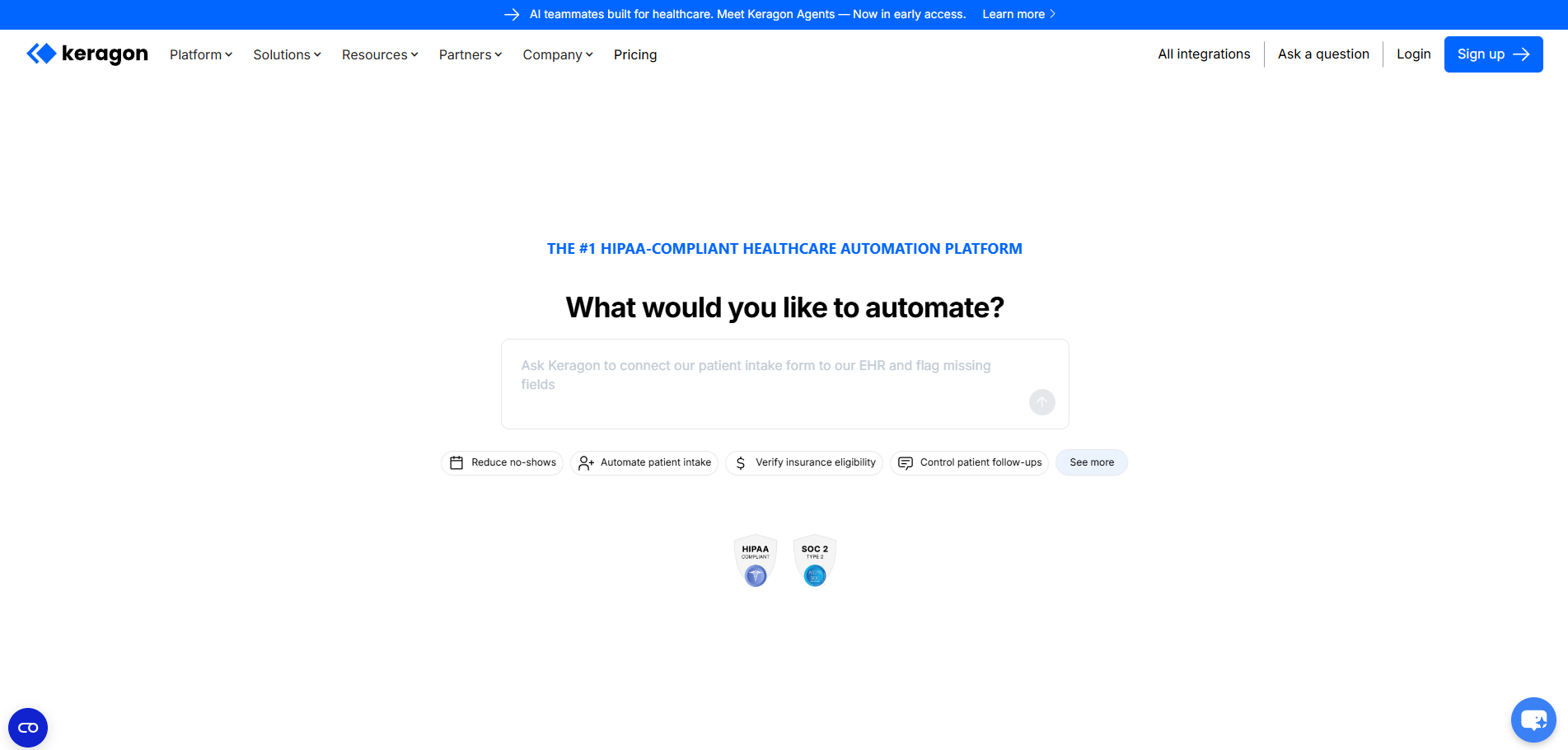
Keragon is a HIPAA-compliant healthcare automation platform that connects 400+ healthcare tools, including EHRs like Athenahealth, Healthie, DrChrono, Elation, and ModMed, plus schedulers and communication apps, with no engineering team required.
Where Vim embeds payer-driven insight at the point of care, Keragon Agents take over the operational work that runs a practice, and the data lands in your EHR.
Here are the three problems those agents are built to solve.
Pain 1: Manual intake and insurance verification bury the front desk
Staff lose hours rekeying patient forms and chasing coverage details.
Keragon's Patient Intake Specialist greets new patients, collects forms, and lands the data in your EHR before the first visit, while the Insurance Verification Specialist confirms coverage, benefits, and copays for every scheduled patient ahead of arrival.
The front desk stops doing data entry and starts doing patient care.
Pain 2: No-shows and missed appointments quietly drain revenue
Every empty slot is lost revenue and a care gap.
The Appointment Reminder Agent sends reminders by text, email, or voice that patients actually respond to, then confirms attendance back to your scheduler.
When a visit is missed anyway, the No-Show Recovery Specialist reaches out, finds a new time on your calendar, and rebooks the patient automatically.
Pain 3: Inbound leads and pre-visit prep slip through the cracks
Website inquiries go cold, and clinicians walk into appointments unprepared.
The New Patient Acquisition Agent picks up inbound leads, qualifies them, and books them straight onto a provider's calendar, while the Pre-Visit Prep Specialist reads intake responses, prior notes, medications, and recent labs to deliver a structured patient brief before every visit.
Pros & Cons
Pros:
- Healthcare-native automation platform with SOC 2 Type II and HIPAA compliance.
- 400+ no-code integrations across EHRs, schedulers, forms, and communication tools.
- AI agents handle the full operational workflow, not just point-of-care insight.
- Plain-English setup lets practice and ops staff build automations without developers.
- Free plan and published paid pricing make evaluation fast and self-serve.
- Human-in-the-loop controls and HIPAA audit logs keep your team in control.
Cons:
- Not built for payer-driven value-based care, HCC coding, or care-gap closure inside the EHR.
- Teams that only need a single point-of-care insight layer may not need a full platform.
- Some of the newest agent capabilities are expanding quickly, so the roadmap is still maturing.
Pricing
Keragon offers a trial plan to get started, plus published paid tiers that scale with usage. That transparency is a clear contrast with Vim and most platforms in this category, which are sold through custom enterprise contracts.
Setup
Most teams are live within an afternoon. Pick a trigger, describe the task in plain English, connect your EHR and comms tools, run a test, and switch it on. No IT project and no payer program required.
Tradeoffs
Keragon is the best overall choice when your goal is to automate operations and run AI agents across your tools without engineering.
It's the strongest fit for practices and digital health teams.
If your core need is value-based care enablement embedded in the EHR, a point-of-care platform like Navina or Vim itself is the better tool.
Pre-built templates. HIPAA compliant. No developers needed. Start your free trial today.
2. Navina
Best for: AI at the Point of Care
Product Overview
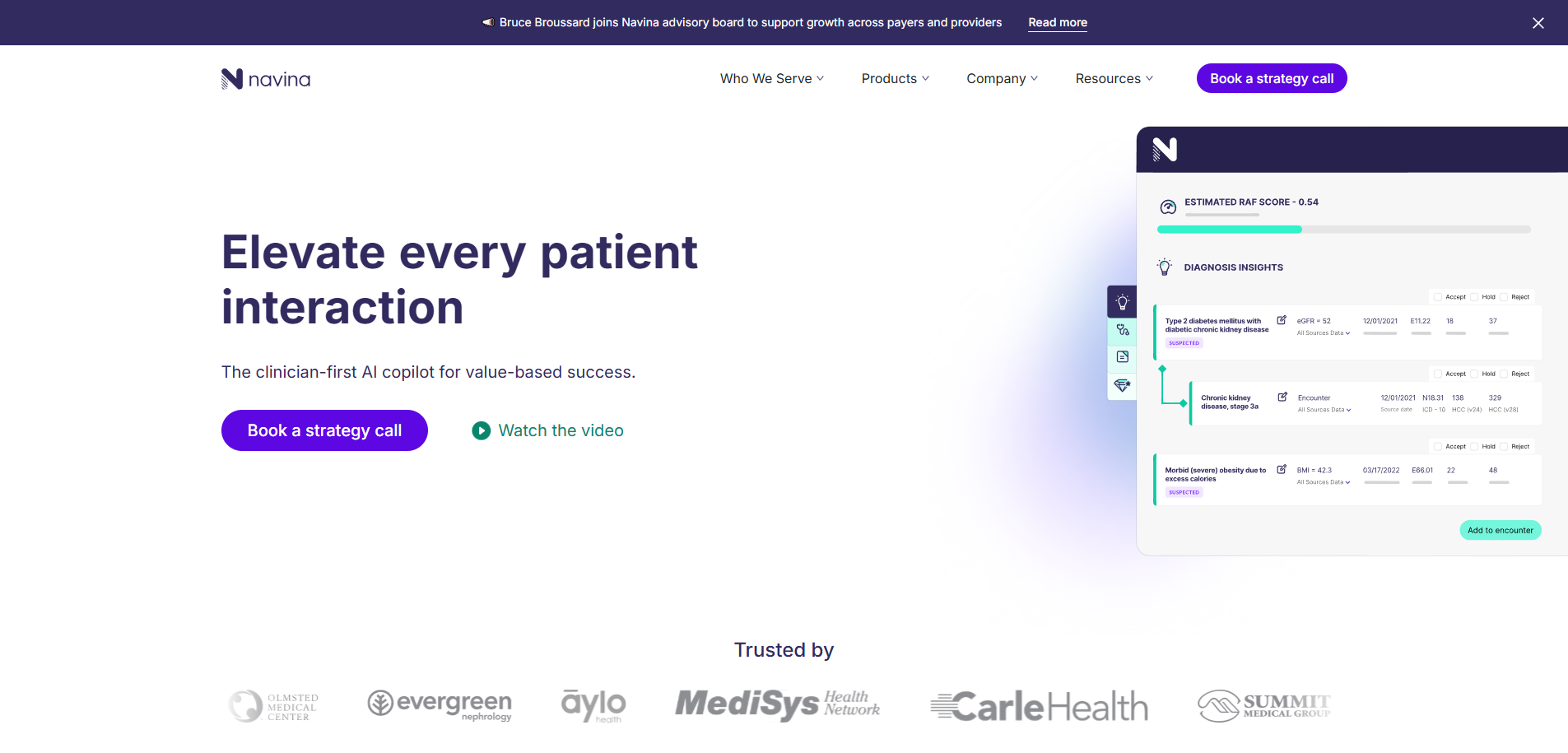
Navina is an AI clinical copilot for value-based care. It reads across a patient's records and surfaces a clear summary, suspected diagnoses, and open care gaps inside the provider's workflow, so clinicians act on the right information during the visit.
This is the capability most directly comparable to Vim's point-of-care enablement, delivered as an AI assistant rather than an app-and-connectivity layer.
Pros & Cons
Pros:
- Strong AI synthesis of messy, scattered patient data.
- Purpose-built for value-based care and risk adjustment.
- Clinician-friendly experience at the point of care.
Cons:
- Focused on clinical insight, not broad operational automation.
- Custom, enterprise-oriented pricing.
- Most valuable for risk-bearing groups and VBC programs.
Pricing
Custom pricing. Contact Navina for a quote.
Setup
Implementation with EHR integration and a guided rollout.
Tradeoffs
Navina is the closest like-for-like alternative to Vim's point-of-care intelligence.
If your need is operational automation rather than clinical insight, a platform like Keragon is the better fit.
3. Innovaccer

Best for: Enterprise Health Data and Population Health
Product Overview
Innovaccer is a healthcare intelligence cloud that unifies data from across systems and powers population health, care management, and value-based care analytics.
Large organizations use it as the data backbone for closing gaps, coordinating care, and measuring performance across populations.
Pros & Cons
Pros:
- Deep data unification and analytics.
- Mature population health and VBC tooling.
- Enterprise scale and breadth.
Cons:
- Heavy, enterprise-grade implementation.
- Custom pricing.
- More platform than smaller practices need.
Pricing
Custom pricing. Contact Innovaccer for a quote.
Setup
Enterprise data project measured in months, with integration and configuration support.
Tradeoffs
Innovaccer wins when you need an enterprise data and population health platform.
It’s overkill if you simply want to automate workflows or embed insight at the point of care.
4. Redox

Best for: EHR Integration Infrastructure
Product Overview
Redox is an interoperability platform that gives software vendors a single connection to hundreds of EHRs.
It competes with the connectivity side of Vim, the job of getting a solution into clinical workflows, but as integration infrastructure rather than an in-EHR app layer.
It’s built for engineering teams that need reliable, scalable EHR data exchange.
Pros & Cons
Pros:
- One integration to many EHRs.
- Established interoperability infrastructure.
- Strong fit for health-tech vendors scaling integrations.
Cons:
- Developer and integration-focused, not an end-user tool.
- Custom pricing.
- Requires engineering resources to use.
Pricing
Custom pricing. Contact Redox for a quote.
Setup
Engineering-led integration project.
Tradeoffs
Redox is the right layer for a vendor that needs to connect to many EHRs.
If you want no-code automation and AI agents for your own operations, Keragon is the better fit.
5. Health Gorilla

Best for: Health Data Exchange
Product Overview
Health Gorilla provides access to national health data through a records API and connections to nationwide exchange networks. The job it does is pulling a complete patient record, not embedding actions inside the EHR.
It’s widely used by teams that need a fuller clinical picture than a single EHR holds.
Pros & Cons
Pros:
- Broad access to national patient records.
- Strong interoperability credentials.
- API-first and developer-ready.
Cons:
- Data access rather than workflow automation.
- Custom pricing.
- Engineering needed to integrate.
Pricing
Custom pricing. Contact Health Gorilla for a quote.
Setup
API integration, developer-led.
Tradeoffs
Health Gorilla is ideal when complete patient data access is the goal.
It doesn’t automate operations or run agents, which is where Keragon comes in.
6. Reveleer
Best for: Risk Adjustment and Quality
Product Overview
Reveleer is an AI-powered platform for risk adjustment, quality measurement (such as HEDIS), and member management across value-based care.
It overlaps with Vim's care-gap and coding capabilities, focused on the payer and risk-bearing side of healthcare.
Pros & Cons
Pros:
- Purpose-built for risk adjustment and quality.
- AI chart review and retrieval.
- Clear value-based care focus.
Cons:
- Narrow to risk and quality workflows.
- Custom pricing.
- Enterprise orientation.
Pricing
Custom pricing. Contact Reveleer for a quote.
Setup
Implementation tied to your value-based care programs.
Tradeoffs
Reveleer is strong for organizations whose priority is risk adjustment and quality performance.
For day-to-day operational automation, it’s the wrong tool.
7. Notable Health
Best for: Clinical and Administrative Automation
Product Overview
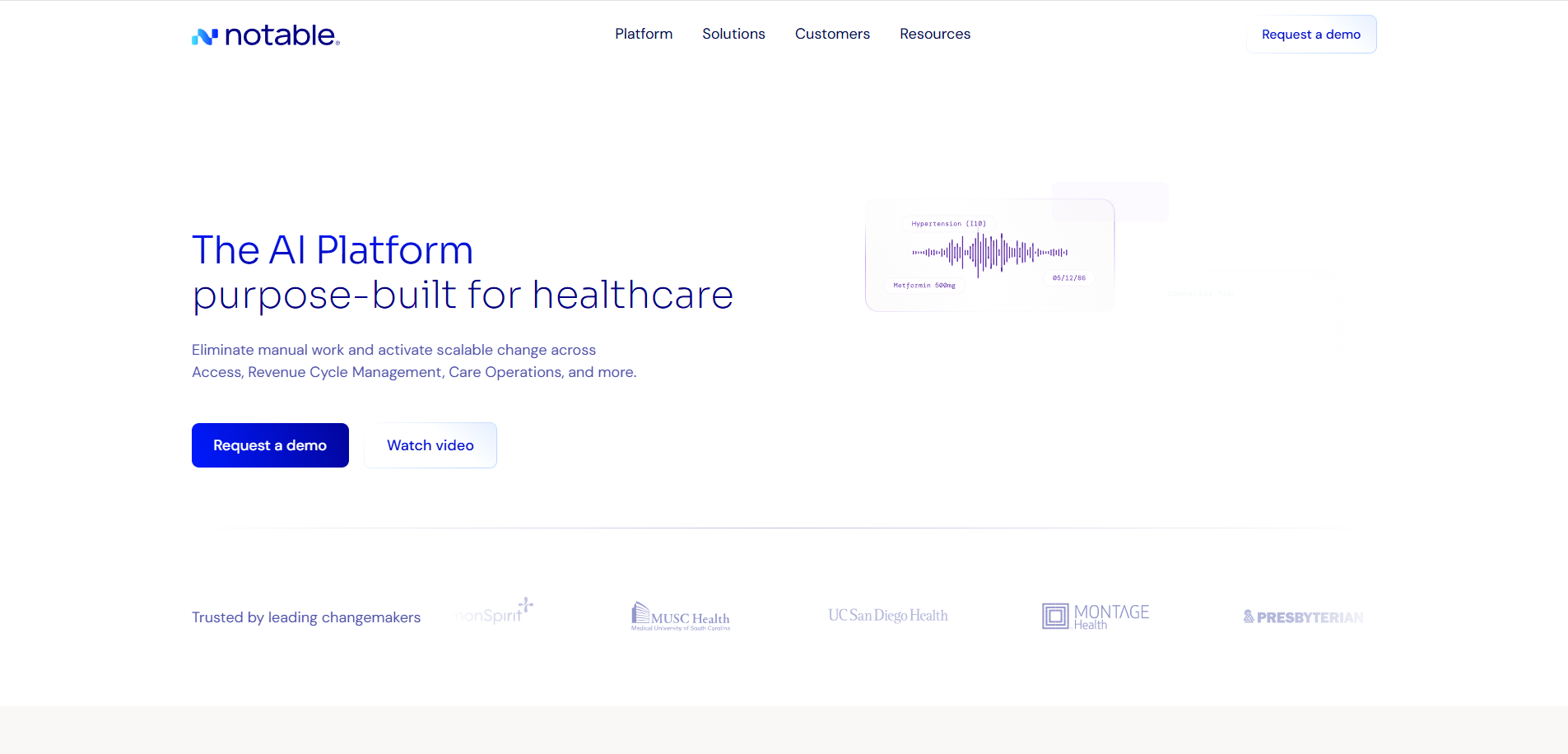
Notable builds AI agents for both administrative and clinical workflows, including scheduling, intake, registration, and prior authorization, with automation that reaches into the EHR.
It overlaps with Keragon on automation, with a heavier enterprise footprint.
Pros & Cons
Pros:
- Combines patient-facing and back-office automation.
- EHR-connected agents for scheduling, registration, and prior auth.
- Enterprise-ready.
Cons:
- Custom pricing.
- Heavier implementation than a no-code tool.
- Better fit for larger groups.
Pricing
Custom pricing. Contact Notable for a quote.
Setup
Guided project with EHR integration and workflow configuration.
Tradeoffs
Notable is a credible alternative when you want broad clinical and administrative automation at enterprise scale.
Teams that want fast, self-serve, no-code automation usually prefer Keragon.
8. Particle Health
Best for: Developer Access to Records
Product Overview
Particle Health offers a developer-friendly API for querying and retrieving patient medical records from national networks. Like Health Gorilla, it serves the data-access job rather than in-workflow enablement.
It’s a fit for product teams that need clinical data inside their own application.
Pros & Cons
Pros:
- Clean, developer-first API.
- Fast access to clinical data.
- Good documentation and developer experience.
Cons:
- Data access only, not automation.
- Custom pricing.
- Requires engineering to use.
Pricing
Custom pricing. Contact Particle Health for a quote.
Setup
API integration handled by your developers.
Tradeoffs
Particle is a fit for product teams that need medical records via API.
It’s not an operations or value-based care tool, so pair it with one or choose a platform like Keragon for workflow automation.
Why Choose the Alternatives to Vim Software
When you line up Vim competitors and alternatives side by side, the differences cluster in four areas. These are the reasons teams look beyond Vim.
No-code automation you can run yourself
Vim deployments are often tied to payer or network programs and to in-EHR engineering.
Platforms like Keragon let your own team build and change automations in plain English, with no developers and no program dependency.
AI agents for daily operations
Vim shines at point-of-care insight.
If the work you need to remove is operational, intake, reminders, verification, or no-show recovery, you want AI agents built for those tasks, not a clinical insight layer.
Integrations beyond the EHR
Closing the loop usually means touching schedulers, forms, and communication tools as well as the EHR.
The best alternatives connect across your whole stack, not only the chart.
Transparent pricing and fast time to value
Most platforms in this category are sold through custom enterprise contracts.
Tools with free plans and published pricing let you prove value before you commit, which matters most for practices and smaller groups.
How to Choose the Right Vim Alternatives
Use these steps to shortlist the right platform for your organization.
Step 1: Decide which Vim job you’re replacing
Vim does three things at once: point-of-care clinical insight, EHR connectivity, and value-based care enablement. Name the one you actually need, because the best alternative is different for each.
Step 2: Check integration breadth and whether it is no-code
Confirm how many of your tools the platform connects to and whether your team can build automations without engineering.
No-code breadth is what separates an automation platform from an integration project.
Step 3: Confirm HIPAA and security posture
Require a signed BAA and HIPAA compliance, and look for SOC 2 and HITRUST, where the platform handles large volumes of protected health information.
Step 4: Match the tool to your buyer and mandate
Payer and risk-bearing organizations weigh VBC and care-gap tools differently than practices focused on operations.
Choose based on who owns the outcome and whether you carry risk.
Step 5: Test setup time and self-serve control
Find out whether you can launch and adjust on your own or whether every change needs the vendor. Self-serve, plain-English setup keeps you fast and independent.
Key Features to Look for in Vim Competitors
These are the capabilities that separate a real healthcare platform from a narrow point tool.
HIPAA compliance and a signed BAA
Non-negotiable for any tool touching patient data, ideally backed by SOC 2 Type II or HITRUST and a clear data-handling policy.
Broad, no-code integrations
Look for native connections across EHRs, schedulers, forms, and communication apps that your team can configure without code.
AI agents and workflow automation
Prebuilt agents and plain-English builders let you automate intake, reminders, verification, and recovery end to end.
In-workflow or point-of-care delivery
If clinical insight is your priority, confirm the platform delivers inside the EHR at the moment of care, not in a separate portal.
Audit logs and human-in-the-loop controls
You should be able to review what an agent did, set guardrails, and require human approval on sensitive steps.
Transparent, predictable pricing
Published plans and forecastable usage beat quote-only contracts that hide the real cost until late in the cycle.
Cost Comparison: Vim vs Competitors
Vim is sold through custom enterprise contracts, typically to payers and provider networks rather than individual practices, so there is no public price to compare against.
Most of the alternatives here, including Navina, Innovaccer, Redox, Health Gorilla, Reveleer, Notable, and Particle Health, are also custom-quoted and weighted toward enterprise budgets.
Keragon is the clear outlier on cost transparency. It offers a free trial plus published paid tiers, so a practice can start automating, see real value, and only then decide where to scale. That removes the procurement friction that defines the rest of this category.
The practical takeaway: if you’re an enterprise or risk-bearing organization, custom quotes are normal, and the deciding factor becomes which job the platform does best and how deeply it integrates.
If you’re a practice or smaller group that wants to start fast, prioritize a platform with public pricing and self-serve setup.
Which Vim Alternative Is Right for Your Business?
Match the tool to the job you’re replacing:
- Point-of-care clinical insight for value-based care: Navina, or Vim itself.
- Enterprise data and population health: Innovaccer.
- Connecting your app to many EHRs: Redox. Pulling complete records via API: Health Gorilla or Particle Health.
- Risk adjustment and quality performance: Reveleer.
- Automating operations with AI agents and no engineering: Keragon.
- Broad clinical and administrative automation at enterprise scale: Notable Health.
Final Thought on Vim Alternatives
Vim does a specific job well: embedding payer-driven insight and actions directly into the EHR at the point of care. The reason teams shop around is rarely because Vim is broken. It is because the job they actually need done sits outside that lane.
Point-of-care clinical insight, enterprise data and population health, EHR connectivity, risk adjustment, and operational automation are five different problems, and no single platform leads in all of them. Navina is the closest like-for-like for clinical insight, Innovaccer owns the enterprise data layer, Redox and Health Gorilla solve connectivity and records access, Reveleer handles risk and quality, and Notable plays at the broader clinical-plus-administrative automation tier.
If your mandate is value-based care and care-gap closure, stay close to Vim or move to Navina. If you carry no VBC risk and the work you actually want removed is intake, reminders, verification, scheduling, and no-show recovery, a no-code automation platform like Keragon is a more direct fit, and the published pricing lets you prove value before you commit.
Name the job first, match the tool to that job second, and the rest of the shortlist falls into place quickly.
FAQs
What does Vim do?
Vim is a point-of-care connection platform that embeds data, actions, and AI apps into provider EHR workflows.
Provider networks and payers use it to close care gaps, review suspected diagnoses, and guide referrals for value-based care, without separate portals or extra clicks.
What are the main limitations of Vim that lead teams to evaluate alternatives?
Vim is built around payer-driven, value-based care embedded in the EHR, so it is less suited to broad operational automation.
Buyers also cite enterprise custom pricing, a focus on care-gap and coding workflows, and deployments that depend on network or payer programs.
What is the closest alternative to Vim?
Navina is the closest like-for-like alternative for point-of-care intelligence, surfacing patient summaries, suspected diagnoses, and care gaps inside the EHR.
For the connectivity side, Redox is the closest integration-layer alternative, and Keragon is the closest fit for operational automation.
Why would a healthcare organization switch from Vim?
Organizations switch when they need automation that they can run themselves, AI agents for daily work like intake and reminders, or integrations beyond payer-driven care-gap closure.
Practices without a value-based care mandate often find a workflow automation platform like Keragon a more direct fit.
Which Vim alternative is best for value-based care and care-gap closure?
For value-based care and care-gap closure, Navina, Innovaccer, and Reveleer are the strongest alternatives.
Navina excels at point-of-care insight, Innovaccer at enterprise data and population health, and Reveleer at risk adjustment and quality performance across VBC programs.
Is Keragon a good alternative to Vim?
Keragon is a strong alternative when your goal is operational automation rather than payer-driven care-gap closure.
It connects 400+ healthcare tools with no code and runs AI agents for intake, reminders, no-show recovery, and verification, with HIPAA and SOC 2 Type II compliance.
Are Vim alternatives HIPAA compliant?
Yes. The platforms in this guide are built for healthcare and maintain HIPAA compliance, and several add SOC 2 and HITRUST.
Always confirm a signed business associate agreement and current security certifications before sharing protected health information.


Related Articles