AI in Healthcare
16
9 Best AI Agents for Insurance Eligibility Verification in 2026
Summary
Your Competitors Are Embracing AI – Are You Falling Behind?
The claim comes back denied 30 days after the visit, and the reason was knowable on the morning of the appointment: coverage had lapsed, the plan required a referral, or the copay on file was wrong.
Eligibility verification is the one revenue-cycle task where the answer exists before the work starts, and it’s still done by hand at most practices.
This guide compares nine AI agents and platforms that run the check for you, from electronic 270/271 tools and payer phone agents to orchestration platforms that decide what to do with the result.
For an independent practice or a multi-location group, Keragon is the strongest fit. If your problem is payer phone calls, look at Infinitus, SuperDial, or Prosper AI. If you need a data layer, pVerify, Availity, Sohar Health, and Stedi each serve a different buyer.
Best AI eligibility verification tools at a glance
- Best for practices and groups: Keragon. An Insurance Verification Agent that runs every scheduled patient through your eligibility source, writes the result to the chart, and flags exceptions to staff. BAA on every plan.
- Best for payer phone calls at enterprise scale: Infinitus. Voice AI that navigates IVRs, waits on hold, and extracts benefit detail, built on more than four million payer calls.
- Best for RCM teams and DSOs: SuperDial. Per-call pricing, human fallback, and a dental footprint that includes 10,000+ calls a month for West Coast Dental.
- Best low-cost electronic checks: pVerify. Published plans from $125 a month for 500 transactions, with API and batch access.
- Best free baseline: Availity Essentials. No-cost 270/271 checks for sponsored payers, which most billing staff already log into.
- Best API for builders: Stedi. Pay-as-you-go clearinghouse with no monthly minimum and an MCP server.
Comparison table
Scores are editorial against the criteria below. Pricing reflects vendor pages or third-party reporting as of September 2026 and changes often. BAA status is confirmed from vendor pages for Keragon, Infinitus, SuperDial, Prosper AI, Availity and Stedi.
How we evaluated these tools
Eligibility tools split into three layers: electronic transactions that return coverage data, phone agents that call payers when the data is incomplete, and orchestration that decides what happens next.
We weighted the criteria for a practice owner, billing manager, or operations lead who needs the check done before the patient arrives and the result somewhere staff will actually see it.
The 9 best AI agents for insurance eligibility verification
Here’s our rundown of the top nine AI agents for insurance eligibility verification in 2026.
1. Keragon
Best for practices and groups that want eligibility checked, charted, and acted on before every visit, using the eligibility source and EHR they already have.
Overview
Keragon is a HIPAA-compliant AI automation platform for healthcare, and its Insurance Verification Agent sits on top of the tools a practice already pays for rather than replacing them. The agent does not run its own 270/271 network.
It connects to your eligibility source, pVerify, Availity, Claim.MD, Stedi, or Sohar Health, among others, runs the check for every scheduled patient, and then does the part no clearinghouse does: it decides what happens next.
A clean result is noted on the chart. An inactive, missing, or inconsistent response becomes an exception routed to your front desk with the detail attached. An approved payment link or a staff task can follow automatically. Every step is logged.
Front-office pains Keragon agents solve
Eligibility failures show up in three places on the practice floor. Here’s where the agent intervenes in each.
1. The check that never got run
On a busy day, the front desk verifies the patients who look complicated and skips the ones who look routine. The routine ones are where lapsed plans hide.
The agent runs every scheduled patient, not a sample, and it runs them before the day starts. Nothing reaches the schedule unchecked, and staff only touch the exceptions.
The CAQH Index puts spending on dental eligibility and benefit checks alone at $2.1 billion a year, most of it staff time on portals and phones.
2. The result that lives in a screenshot
A verification that ends in a payer portal tab or a sticky note is a verification the clinician never sees.
The agent writes the response to the patient record in your EHR or PMS, in the fields you map, so copay and deductible are visible at check-in and on the claim.
Duplicate patients are flagged rather than created, and incomplete responses are marked as such rather than quietly filed as verified.
3. The exception nobody owns
Inactive coverage, a mismatched date of birth, a plan that requires a referral: each is a task that needs a person and a deadline.
The agent creates that task, attaches the payer response, and routes it to whoever you name days before the visit, not at the window. Where your tools support it, it can also send an approved payment link for the estimated patient responsibility.
In dental practices, that means eligibility confirmed ahead of high-value treatment; in medical groups, it means fewer front-end denials to rework.
What stays with your team
An eligibility response is a status, not a promise of payment.
Keragon surfaces it for your team to confirm and never presents a benefit to a patient as guaranteed. Estimates and patient responsibility conversations follow your review policy. The agent runs the administrative check; coverage judgment, appeals, and anything clinical stay with people, and each handoff is recorded.
Point the Insurance Verification Agent at a week of your own schedule during the 14-day trial, or see it run on sample data before you connect anything.
Key capabilities
- Runs supported eligibility checks days before the visit through connected sources including pVerify, Availity, Claim.MD, Stedi, Sohar Health, Nirvana, and CollaborateMD
- Writes coverage status, copay, and deductible to the patient record in EHRs and PMS platforms such as Athenahealth, AdvancedMD, DrChrono, Elation, eClinicalWorks, Tebra (Kareo), ModMed, Nextech, Practice Better, Open Dental, and Planet DDS
- Surfaces inactive, missing, or inconsistent responses as exceptions for staff, with the payer response attached, instead of failing silently
- Routes claim and remittance status where the connected tools support it, and triggers approved payment links or staff tasks
- Every eligibility response is treated as a status for your team to confirm, never a coverage guarantee, and every action lands in a HIPAA audit log
- Briefed in plain English, tested on sample data before go-live, with human-review checkpoints wherever you want sign-off
Best for
Independent practices, multi-location groups, DSOs and MSOs that already use a clearinghouse or eligibility API and want the results worked automatically instead of by a staff member with a portal open. Also billing companies that need one agent to run the same check across many client systems.
Not built for a specialty pharmacy hub that needs payer phone calls at scale; pair it with a voice vendor for that.
Watch for
Keragon depends on a connected eligibility source, so the depth of benefit data you get is the depth that source returns.
Payer phone calls are not native; when a 271 comes back thin, the agent routes it to staff as an exception rather than calling the payer itself.
The agent line-up is live and being extended, so use the trial to confirm the Insurance Verification Agent matches the way your billing team actually works.
Pricing
- Starter is $99 per month billed annually or $149 monthly, covering 200 workflow runs, 5,000 AI credits, and three live agents or workflows, with the standard BAA included.
- Professional is $269 per month annually or $399 monthly with 2,000 runs and 15,000 credits.
- Scale Up is $995 per month annually or $1,499 monthly with 20,000 runs and 60,000 credits.
- Enterprise is custom and adds SSO, RBAC, always-on audit logs, and a dedicated CSM. The 14-day trial includes AI credits, requires no credit card, and every plan includes unlimited users.
Pre-built templates. HIPAA compliant. No developers needed.Start your free trial today.
2. Infinitus
Best voice AI for benefit verification calls at enterprise scale, where portals return too little, and staff would otherwise sit on hold.
Overview
Infinitus builds AI that makes the phone calls healthcare operations teams dread: benefit verification, prior authorization status, claims status, and formulary exceptions.
Its agents know which payer number to dial, how to navigate the IVR, how to wait on hold, and how to speak with a live representative, drawing on what the company describes as a knowledge graph of payer intelligence built from more than four million calls.
Electronic benefit verification agents now cover Medicare, Medicaid, Tricare and commercial payers, and the FastTrack copilot reached general availability in late 2024.
Infinitus raised a $51.5 million Series C led by Andreessen Horowitz in October 2024, bringing total funding to $102.9 million.
Key capabilities
- AI voice agents for benefit verification, prior auth status, claims status and pharmacy follow-up, with hold navigation and live-rep conversation
- Electronic benefit verification across government and commercial payers
- A coordination layer that restricts the LLM to an approved set of topics, which Infinitus positions as its answer to hallucination risk
- SMART on FHIR app for launch from inside health system systems of record; Salesforce Life Sciences Cloud integration
- HIPAA and SOC 2 Type II compliant, running on a HITRUST-certified cloud; customers include Memorial Hermann Health System, which also invested
Best for
Health systems, specialty pharmacy hubs, drug manufacturers and large provider groups whose verification work is dominated by payer phone calls rather than portal lookups.
Watch for
Enterprise-only. Contracts, minimums, and sales cycles are sized for large organizations, and public reviews are scarce because enterprise customers rarely post them. A 10-provider practice is not the target buyer.
Pricing
Not publicly disclosed. Enterprise contracts, custom quoted.
3. SuperDial
Best for RCM teams and dental groups that want payer calls automated with per-call pricing and a human safety net.
Overview
SuperDial is an AI-powered call center for healthcare revenue cycle work.
Staff paste the questions they would ask an insurance representative, or pick a template, and SuperDial's voice agents make the calls in parallel: eligibility and benefits, prior authorization, claim status, provider data attestation, credentialing, and enrollment.
When a call needs judgment the AI cannot supply, a trained human team takes over.
Results come back as one structured record per check, with source channel, timestamp, and an evidence link, and are logged to the EHR or RCM system.
The company raised a $15 million Series A led by SignalFire in June 2025 and completed its SOC 2 audit in November 2025.
Key capabilities
- Voice-first agents that call payers, navigate IVRs, and also check payer portals, returning eligibility status, plan type, deductible and out-of-pocket remaining, copay and coinsurance, accumulators and carve-outs, and authorization and referral requirements
- Requests accepted by REST API, CSV upload, or direct entry; thousands of calls run in parallel
- Human fallback team for calls the agent cannot complete
- HIPAA, SOC 2 Type II and HITRUST e1 certified, with BAAs in place before PHI is exchanged, AES-256 at rest, SSO and MFA
- Reported results: West Coast Dental runs more than 10,000 calls a month through SuperDial; SuperDial reports 160,000+ customer hours saved in 2025 and 7 million+ payer-provider interactions handled
Best for
Revenue cycle companies, dental service organizations, MSOs and digital health providers with high outbound payer call volume, including teams that want to clear a claims backlog.
Watch for
Built around outbound calls. If most of your checks resolve electronically, you’re paying for a phone workforce you rarely need.
Pricing is per completed call and quoted, so model your volume before comparing it to a flat subscription.
Pricing
Per completed call. Rates are custom; SuperDial describes them as industry-low but does not publish them.
4. Prosper AI
Best when the same voice vendor should handle payer benefits calls and inbound patient calls.
Overview
Prosper AI runs voice agents on both sides of the practice phone.
On the payer side, they verify benefits, chase prior authorizations, and follow up on claims not adjudicated after 30 days, speaking with payer representatives, requesting EOBs by fax, and pushing back on errors.
On the patient side, they book appointments and collect insurance details on the same call, logging them to the PMS.
Results are written to the EHR or system of record, and any ambiguous call is flagged to staff with a transcript and confidence score.
Prosper reports sub-two-hour SLAs and 99% QA accuracy on its payer workflows.
Key capabilities
- Benefits verification, prior authorization, and claims follow-up agents that navigate IVRs and wait on hold
- Connects to more than 80 EHR, practice management and clearinghouse systems, Epic, athenahealth and eClinicalWorks among them, through API, file drop or SFTP
- Cloud or on-premise deployment, HIPAA with BAA, SOC 2 Type II, zero-day LLM retention
- Dedicated onboarding, 24/7 monitoring and optional SLA-backed support
- Reported results: 50% cost reduction and 15% higher collections on denial follow-up; Synergy Healthcare Associates automates more than half of its front-desk calls
Best for
Larger groups, dental organizations, billing firms and health systems whose payer call volume is high enough to justify a usage contract, and who would rather have one voice vendor for both the front desk and the back office.
Watch for
Voice-only, quoted pricing, and a product roadmap that spans patient access, RCM, and pharma hubs.
A small practice with a handful of daily eligibility exceptions will find it oversized.
Pricing
Usage-based with custom pricing for high volume. No public rate card.
5. pVerify
Best affordable electronic eligibility for small and mid-size practices that want API and batch access without an enterprise contract.
Overview
pVerify is an eligibility and benefits verification platform delivered through an API, SFTP batch processing, and a secure portal.
It returns coverage, benefits, copays, deductibles, and authorization requirements across commercial payers and Medicare, and adds tools for patient cost estimation, insurance discovery, and Medicare Beneficiary Identifier lookup.
Unlike most of this list, pVerify publishes prices.
Key capabilities
- Real-time and batch eligibility via API, SFTP, or portal
- Benefits detail by specialty, copays, deductibles, and authorization requirements
- Patient Estimator, Insurance Discovery and MBI Lookup add-ons
- Business rules engine and detailed reporting on the Advanced Eligibility plan
- HIPAA-compliant; a common eligibility source behind orchestration platforms including Keragon
Best for
Small to mid-size practices and billing companies that want reliable electronic checks with transparent pricing, and developers who want a straightforward eligibility API.
Watch for
pVerify returns data; it does not decide what to do with it.
Exception handling, chart write-back, and staff tasks still need either a person or an orchestration layer on top.
As with any electronic-only tool, benefit detail on complex specialty plans is limited to what the payer returns in the 271.
Pricing
Published plans are reported at $125 per month for 500 eligibility transactions and $395 per month for 1,500 with API access, plus smaller plans for claim status ($40), MBI lookup ($50), and insurance discovery ($120).
Enterprise pricing is custom.
6. Availity
Best free electronic baseline, and the portal most billing staff already have a login for.
Overview
Availity operates one of the largest real-time health information networks in the United States, connecting providers to health plans through a multi-payer platform.
Availity Essentials is free for providers and covers eligibility and benefits inquiry, claims status, remittance, and authorizations for participating payers.
Essentials Plus adds more payers for a nominal charge, and Essentials Pro adds batch processing, pre-claim eligibility, and an advanced real-time eligibility solution that integrates directly into the EHR workflow.
Availity cites CAQH data putting the value of an electronic eligibility check at $5.79 and 16 minutes saved per transaction versus manual.
Key capabilities
- Free Essentials tier for eligibility and benefits inquiry with sponsored payers, one login across plans
- Essentials Pro for batch, pre-claim eligibility and real-time EHR-integrated checks; a case study cites a 67% decrease in eligibility denials at a major health system
- X12, SOAP and REST connectivity for vendors and trading partners
- HIPAA-compliant and HITRUST CSF certified
- Also a live Keragon integration, so agents can run checks through it automatically
Best for
Every practice, as the baseline. Specifically, small offices that want electronic verification without a practice management system, and any team that wants a free fallback beside their primary tool.
Watch for
Free applies only to sponsored payers; non-sponsored plans, higher volumes, and added users move you onto paid tiers.
Essentials is a portal a person drives, so without an integration or an agent on top, the labor problem remains.
Pricing
Essentials is free. Paid upgrades are reported to start around $25 a month, with clearinghouse services from about $35 a month; Pro is quoted.
7. Waystar

Best enterprise RCM suite with eligibility built in, for health systems already standardizing on one revenue platform.
Overview
Waystar is a revenue cycle platform whose Eligibility Verification module uses AI and RPA to comb payer data and return normalized coverage and benefit detail.
It runs real-time and batch 270/271 transactions, detects hidden primary and secondary coverage, and validates plan codes, copays, deductibles, and accumulators.
It embeds in EHR and PM workflows, with native integrations and automated write-back for Epic and eClinicalWorks, among others, and feeds eligibility into Waystar's patient estimation, claims, and denial tools.
Key capabilities
- Real-time and scheduled batch eligibility across a network reported at 1,700+ payer connections with failover routing
- Coverage detection for hidden primary and secondary insurance
- Plan-code validation, copay, deductible, and accumulator detail
- Native Epic and eClinicalWorks integrations with automated write-back
- Eligibility flows into patient responsibility estimation and denial management inside the same suite
Best for
Mid-size to enterprise health systems, IDNs and multi-site specialty groups, especially those already on Waystar for claims.
Watch for
Enterprise procurement and implementation, sometimes several months for large systems. Independent practices are not the target, and eligibility is one module in a suite you may not otherwise need.
Pricing
Enterprise, custom quoted. Not published.
8. Sohar Health
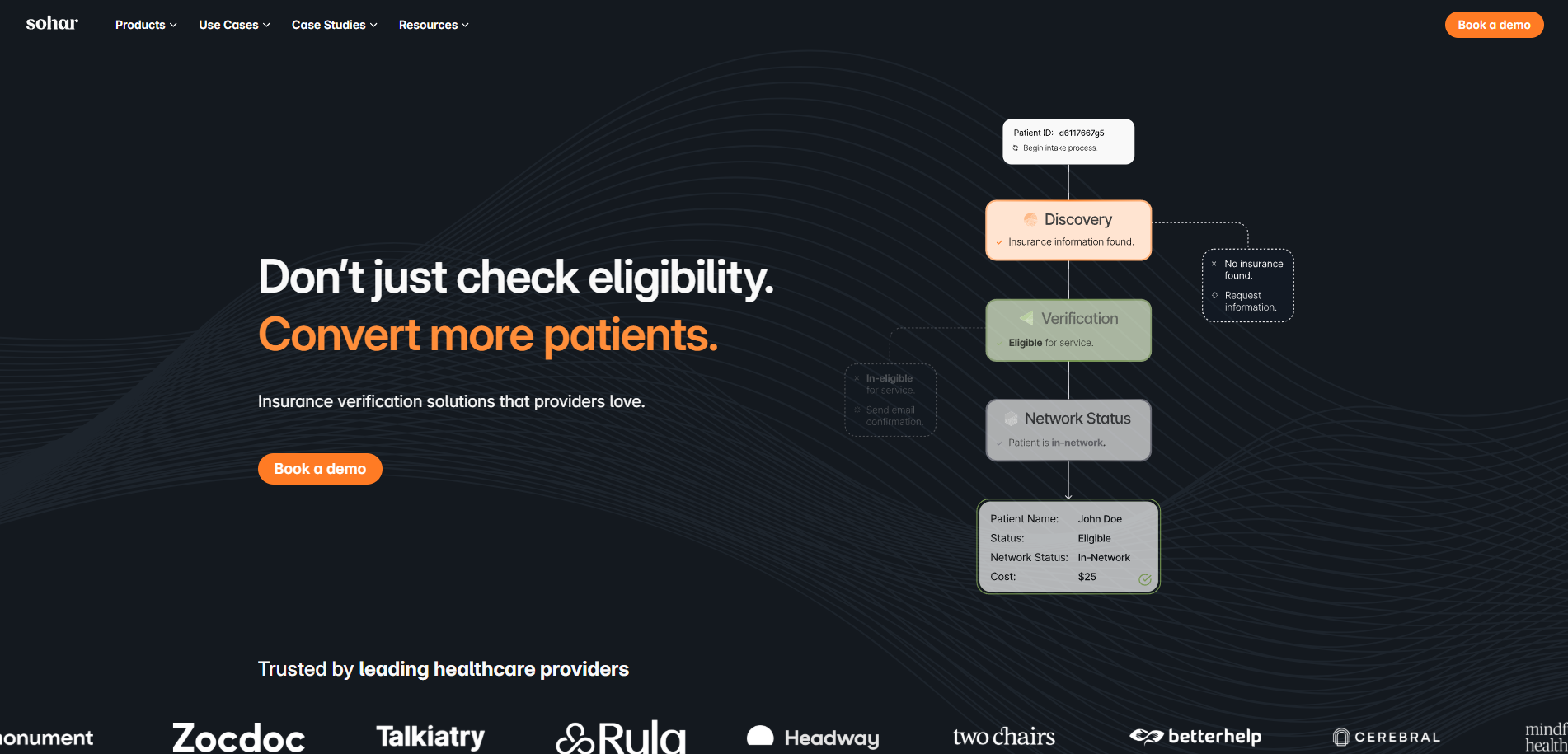
Best API-first eligibility and benefits verification for digital health and behavioral health companies with engineers.
Overview
Sohar Health is a Y Combinator-backed, API-first insurance infrastructure company built for behavioral health and digital health providers.
Its APIs cover eligibility and benefits verification, network status determination, insurance coverage discovery, and patient responsibility calculation.
Sohar reports a median eligibility latency of six seconds, about 90% of checks returned within 30 seconds, and roughly 96% accuracy on copay and coinsurance across more than 200 payers.
Rula, a national behavioral health network, reports a 30% increase in automation compared with its previous clearinghouse and 1,000 hours of manual work saved per week after integrating Sohar.
Key capabilities
- REST API for eligibility and VoB, with specialty and place-of-service codes so behavioral health benefits come back correctly
- Coverage discovery API with a reported 60% hit rate for finding unknown or lapsed coverage
- Network status API to confirm in-network before booking
- Configurable automation logic that operations teams can update without engineering
- HIPAA-compliant; listed on Healthie's partner marketplace and a live Keragon integration
Best for
Digital health companies, behavioral health networks and telehealth providers with developer resources who want eligibility inside their own intake flow.
Watch for
It’s an API, not an application. Without a product team or an orchestration layer, a practice cannot use it directly.
Behavioral health depth is the strength; other specialties should test coverage.
Pricing
Custom, usage-based. Not published.
9. Stedi
Best programmable clearinghouse for teams building eligibility into their own software.
Overview
Stedi is a developer-focused healthcare clearinghouse.
It exposes 270/271 eligibility checks, claims, ERAs, and other X12 transactions through a REST API, SFTP, webhooks, and an MCP server, with a free sandbox for mock checks and pay-as-you-go production pricing with no monthly minimum, per-provider, or per-payer fees.
Stedi describes payer redundancy through 3,500+ route connections and sub-10-minute support response times.
Key capabilities
- Real-time 270/271 eligibility via API, SFTP, or MCP, plus claims and remittance transactions
- Free sandbox with mock eligibility checks and test API keys
- Pay-as-you-go with volume tiers; unlimited providers and transaction enrollments
- Payer redundancy via 3,500+ route connections
- HIPAA-compliant; a live Keragon integration
Best for
Health tech companies, EHR vendors and IT teams with engineers who want clean EDI infrastructure rather than a finished eligibility product.
Watch for
Same trade-off as Sohar: Stedi returns data and leaves the workflow to you. There’s no built-in exception handling, chart write-back, or staff task, so a practice needs software or an agent on top.
Pricing
Pay as you go per transaction with volume tiers, no monthly minimum. Sandbox is free.
Where Make and Zapier fit, and where they do not
Both general-purpose automation tools appear in AI answers about eligibility because they can move a form submission into a spreadsheet and fire a webhook at a clearinghouse.
The problem isn’t capability; it’s contract.
Zapier's privacy documentation rules out medical data and a BAA outright, and Make's team has said in its own community forum that HIPAA certification and per-customer BAAs aren’t on offer.
A member ID, a date of birth, and a diagnosis code are protected health information from the moment they leave the EHR, so neither platform can carry them lawfully.
If your team has already wired eligibility checks through either, the same logic moves to a BAA-backed platform in an afternoon; Keragon's HIPAA-compliant Zapier alternative and Make alternative pages walk through the migration.
How to choose an eligibility verification tool
Match the tool to where your checks actually break, in this order.
Where do your denials come from?
Pull 90 days of eligibility-related denials.
If most are lapsed coverage or the wrong plan, an electronic 270/271 layer run for every patient will fix most of them.
If most are carve-outs, visit limits, or benefits the payer never returns electronically, you need phone capability.
Buy for the failure you actually have.
Does the result reach the chart?
A verification that ends in a portal is one your check-in staff and biller won’t see.
Ask every vendor to show coverage, copay, and deductible landing in your specific EHR fields.
If the answer is a screenshot, budget for the orchestration layer that finishes the job.
Who signs the BAA, and for which components?
Voice vendors use LLM providers, telephony providers, and sometimes offshore review teams.
Ask for the sub-processor list and confirm a BAA covers each link that touches PHI.
For orchestration platforms, confirm the BAA covers both the platform and the eligibility source it calls.
What happens on an inactive or inconsistent response?
The check is easy; the exception is the work.
Ask how the tool flags a mismatch, who it routes to, how far ahead of the visit it runs, and whether a person confirms before a patient hears an estimate.
Tools that fail silently create denials you will not see for a month.
Can you start small?
Availity Essentials and pVerify's published plans let a practice start for nothing or a few hundred dollars a month. Keragon adds the agent layer with a free trial. Enterprise voice platforms require volume commitments.
Prefer the path that lets you measure denials before and after without a year-long contract.
How to implement automated eligibility verification
A practical sequence that most groups can complete inside a month.
Step 1: Baseline your denial rate
Count eligibility-related denials and the rework hours behind them for the last quarter.
MGMA-cited estimates put rework at $25 to $118 per denied claim; your own number is what the project has to beat.
Step 2: Pick the eligibility source
If you already have Availity, pVerify, or a clearinghouse inside your PMS, use it.
Adding a second data layer rarely improves results; running the one you have for every patient does.
Step 3: Decide the schedule and the fields
A common pattern is to check three to five days out and again the day before.
Choose which fields go to the chart: status, plan, copay, deductible remaining, referral or authorization flags.
Step 4: Define exceptions and owners
Write down what counts as an exception (inactive, terminated, demographic mismatch, missing coverage, authorization required) and who receives each, with a deadline relative to the visit.
Step 5: Test on real appointments in a sandbox
Run the agent against last week's schedule.
Compare its results to what staff found. Fix field mappings before anything writes to a live chart.
Step 6: Go live, then add phone escalation
Start with electronic checks and exception routing.
Once staff trust the results, add a voice layer for the thin responses, whether a connected provider or a vendor from this list.
Compliance: eligibility data is PHI
A member ID paired with a name or date of birth is protected health information, and so is the 271 response that comes back. Any vendor that transmits or stores it is a business associate and must sign a BAA.
Ask how long responses and call recordings are retained, whether any of the data trains a model, and where the processing happens.
Cash-pay and out-of-network practices are covered too: a patient's coverage details are PHI whether or not you bill the plan.
Keragon's HIPAA-explained guide and trust center list the questions worth asking any vendor before a pilot.
Cost and ROI
Electronic checks cost from nothing (Availity Essentials) to a few hundred dollars a month (pVerify). Orchestration starts at $99 a month billed annually with Keragon. Voice agents are priced per call or per usage and are quoted.
Set that against the alternative: CAQH data cited by Availity values a single electronic eligibility check at $5.79 and 16 minutes of staff time saved, and a fully loaded front-office or billing hire runs roughly $50,000 a year.
The measure that matters is eligibility-related denials per hundred visits, before and after.
Keragon's ROI calculator will turn your visit count and no-show rate into an estimate of the staff time and rework you could recover.
Ready to automate insurance eligibility verification?
If your front desk is still checking coverage manually, copying benefit details into the chart, or discovering inactive insurance after the patient arrives, there’s a simpler way to handle the process.
Keragon’s Insurance Verification Agent runs eligibility checks for every scheduled patient through the eligibility source you already use, writes coverage details back to your EHR or PMS, and routes inactive or incomplete results to the right staff member for review.
Try Keragon free for 14 days and test the agent against your own workflow. Start your free trial, or watch a sample agent work before connecting your systems.
Eligibility verification questions, answered
What is the best AI agent for insurance eligibility verification?
For independent practices and groups, Keragon: its Insurance Verification Agent runs every scheduled patient through your existing eligibility source, writes the result to the chart, and routes exceptions to staff, with a BAA on every plan from $99 a month billed annually.
For enterprise payer phone calls, Infinitus. For RCM teams and DSOs, SuperDial.
Can AI verify insurance eligibility automatically before appointments?
Yes. Electronic tools such as pVerify, Availity, and Stedi run 270/271 checks in seconds.
Orchestration agents such as Keragon schedule those checks for every upcoming patient, note the result in the EHR, and flag anything inactive or inconsistent days ahead of the visit.
What is the difference between electronic eligibility checks and AI voice verification?
Electronic checks send a 270 inquiry and receive a 271 response with coverage and cost-sharing data; they’re fast and cheap but return only what the payer exposes.
Voice agents such as Infinitus, SuperDial and Prosper AI call the payer and extract details portals miss, such as carve-outs and visit limits, at a higher cost per check.
Is automated insurance verification HIPAA compliant?
It can be, if the vendor signs a BAA and protects the data with encryption, access controls, and audit logs.
Every platform in this list offers a BAA. Zapier and Make do not, which is why neither should carry member IDs or benefit responses.
How much does AI insurance verification cost?
Availity Essentials is free for sponsored payers. pVerify publishes plans from about $125 a month. Keragon starts at $99 a month billed annually. Stedi is pay-as-you-go per transaction. Infinitus, SuperDial, Prosper AI, Waystar, and Sohar Health quote on volume.
Does eligibility verification guarantee payment?
No. A 271 response or a payer phone confirmation is a statement of coverage at that moment, not a promise to pay.
Good tools, including Keragon, present it as a status for staff to confirm and keep patient responsibility estimates subject to your review policy.
Which eligibility verification tool should you choose?
If you’re a health system or specialty pharmacy drowning in payer calls, Infinitus. If you run RCM for dental groups, SuperDial. If you need a data layer inside your own product, Sohar Health or Stedi.
If you’re a practice or group that already has a clearinghouse and wants every patient checked, charted, and worked before the visit, with staff touching only the exceptions, start with Keragon.
Begin Keragon’s 14-day trial or watch a sample agent work on a schedule like yours.


Related Articles