Healthcare Automations
25 mins
10 Best AI Medical Scribes in 2026: Compared & Reviewed for Clinicians and Health Systems
Summary
Your Competitors Are Embracing AI – Are You Falling Behind?
Documentation is the work that follows clinicians home. After-hours charting, the inbox at 9 pm, the weekend catch-up: this is where burnout is built. AI medical scribes attack that problem directly by listening to the visit and drafting a structured note in seconds, so the chart is largely done before the patient leaves the room.
The category has exploded. By 2025, roughly 40 percent of US physicians were using some form of AI documentation tool, and the pace has accelerated through 2026. The choices range from $39-per-month self-serve apps for solo clinicians to enterprise platforms embedded inside Epic at $600 or more per provider per month. The notes look fine in a demo. The hard questions are whether the draft is actually chart-ready, whether it writes back to your EHR or sits in copy-paste, whether the vendor signs a BAA worth the paper it is printed on, and how much editing each clinician still has to do.
We evaluated 10 platforms across note quality, EHR integration depth, specialty coverage, deployment, HIPAA posture, and total cost per signed note. Each was assessed on production-readiness, not on the sales demo. Pricing and ratings below are accurate as of mid-2026 and change frequently; confirm current terms and BAA availability directly with each vendor.
| Abridge | Nuance DAX Copilot | Heidi Health | Suki AI |
|---|---|---|---|
| Best Overall / Enterprise Epic | Best for Large Health Systems | Best Free Tier and Value | Best for Voice-Command Workflow |
Before You Pick a Scribe: How to Connect It to Your EHR and Workflow
Here is the friction most scribe buyers do not see until month two. The scribe drafts a great note. Now what? On self-serve tools (Freed, Heidi, Sunoh.ai), the note lives in a web app and you paste it into the chart yourself. On enterprise tools (Abridge, DAX Copilot, Ambience), the note writes into Epic or Oracle Health, but everything around the note (intake before the visit, eligibility checks, reminders, follow-ups, post-visit referrals, the messages that route to the inbox) still happens in a separate stack of brittle integrations.
Keragon is the layer that fixes that. It is a HIPAA-compliant healthcare automation platform with 400+ healthcare integrations, designed to connect whichever AI scribe you choose to your EHR, billing, patient communication, CRM, and task tools, automatically and without code. The scribe captures the encounter; Keragon Agents handle everything else: intake, reminders, no-show recovery, eligibility, and post-visit follow-up, with the scribe's structured output flowing into your downstream systems instead of into a clipboard. See how Keragon Agents pair with your scribe stack.
This article ranks the 10 best scribes in 2026 on their own merits. Keragon is not a scribe and is not on the list. It is what most teams add alongside their scribe once they realize the note itself is only part of the work.
Best AI Medical Scribes in 2026: Quick Comparison Table
The table below summarizes the ten scribes we cover, the use case each fits best, pricing, EHR depth, and an aggregate user rating. Ratings are drawn from G2, Capterra, and public KLAS commentary as of mid-2026 and are approximate, since enterprise tools carry fewer public consumer reviews than self-serve apps.
| Platform | Best For | EHR Integration | Starting Price | HIPAA / BAA | Rating |
|---|---|---|---|---|---|
| Abridge | Epic enterprise | Native Epic | From $250+/provider/mo | Yes | 4.7/5 |
| Nuance DAX Copilot | Large health systems | Native Epic, Oracle Health | From $300+/provider/mo | Yes | 4.6/5 |
| Ambience Healthcare | Specialty workflows | Native Epic, athenahealth | Custom | Yes | 4.7/5 |
| Suki AI | Voice-command workflow | Epic, athenahealth, eClinicalWorks, Elation | From $300+/provider/mo | Yes | 4.6/5 |
| DeepScribe | Oncology and cardiology | Athenahealth, eClinicalWorks, Epic | From $300/provider/mo | Yes | 4.5/5 |
| Heidi Health | Free tier and value | Browser-based | Free; from ~$110/mo | Yes | 4.8/5 |
| Freed | Solo and small primary care | Copy-paste / browser | $99/provider/mo | Yes | 4.7/5 |
| Nabla Copilot | Telehealth | Browser-based / select EHRs | From $119/provider/mo | Yes (GDPR + HIPAA) | 4.7/5 |
| Augmedix | Hybrid AI + human documentation | Native Epic, Cerner | Custom | Yes | 4.3/5 |
| Sunoh.ai | eClinicalWorks users | Native eClinicalWorks | From ~$1.25/note | Yes | 4.4/5 |
How We Evaluated These AI Medical Scribes
Our team evaluated each scribe across seven weighted dimensions. We analyzed aggregated user reviews from G2, Capterra, and Reddit (r/medicine, r/FamilyMedicine, r/healthIT), reviewed public pricing, examined BAA terms where they were posted, and consulted with clinicians running scribes in production.
We prioritized the criteria that actually predict day-to-day value: how clean the draft is, how much editing it needs, whether it writes back to the chart or stops at copy-paste, and whether the vendor's HIPAA posture survives a closer look.
Our Scoring Methodology
| Criterion | Weight | What We Measured |
|---|---|---|
| Note Quality & Accuracy | 25% | Cleanliness of generated notes, amount of editing required, handling of accents and multiple speakers, support for multi-problem visits, and specialty-specific documentation quality. |
| EHR Integration Depth | 20% | Native bidirectional writeback versus copy-paste workflows; integration depth across Epic, Oracle Health, Athenahealth, eClinicalWorks, DrChrono, Elation, Healthie, and ModMed. |
| HIPAA & Security | 15% | Availability of signed BAAs, SOC 2 Type II compliance, encryption standards, audio retention policies, and whether patient data is used for model training. |
| Specialty & Note-Type Coverage | 10% | Support for primary care, specialty clinics, behavioral health, telehealth, custom templates, multilingual documentation, and specialty-specific workflows. |
| Pricing & Total Cost | 10% | Pricing transparency, cost per signed note, implementation and onboarding fees, BAA-related costs, contract requirements, and long-term total cost of ownership. |
| Setup & User Friendliness | 10% | Time to first signed note, onboarding complexity, learning curve, workflow intuitiveness, and clinician productivity from day one. |
| Support & Reviews | 10% | G2 and Capterra ratings, quality of documentation, customer support responsiveness, onboarding resources, and feedback from practicing clinicians. |
Top 10 Best AI Medical Scribes in 2026
Below we review the ten best AI medical scribes in 2026, ordered by overall fit across the most common buying scenarios clinicians and health systems face. Each entry covers product overview, key features, pricing, deployment and integrations, setup, tradeoffs, and ratings.
#1. Abridge: Best AI Medical Scribe for Epic Enterprise Health Systems
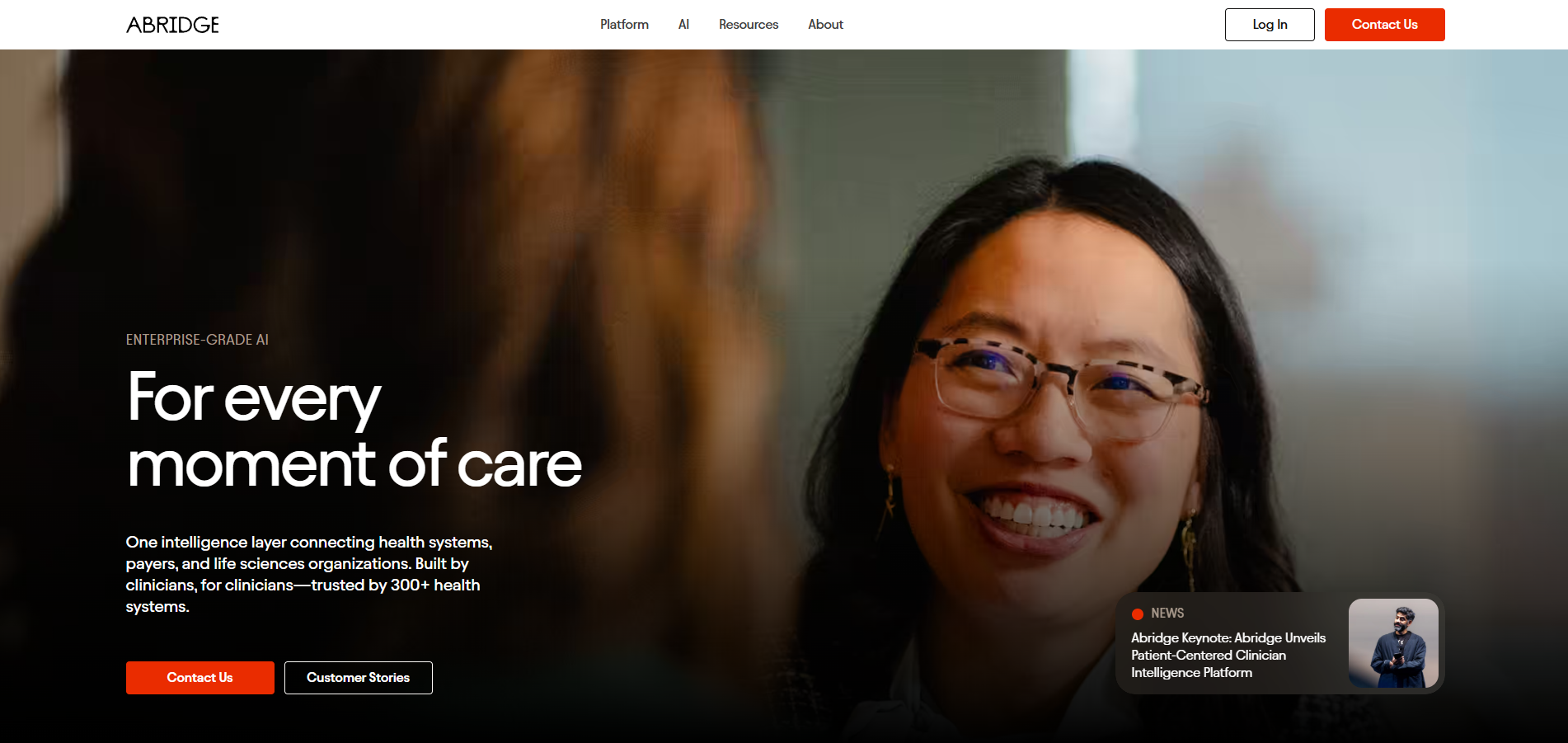
Score: 9.2/10. Highest marks for Epic integration (10/10), note quality (9/10), and clinical validation (9/10). Scored lower on price transparency (5/10) and small-practice fit (5/10).
Best for Epic-based health systems and specialty practices that need structured, billable notes with deep evidence traceability and the deepest Epic-native integration available.
Product Overview
Abridge is a generative AI scribe with embedded Epic integration, designed for enterprise health systems. It captures patient-clinician conversations, converts them into structured clinical notes with linked evidence (each statement in the note ties back to the moment in the conversation where it was discussed), and writes directly into Epic. KLAS data is widely cited showing Abridge cutting cognitive load substantially, and the company has become the leading enterprise pick for ambient documentation in 2026.
Key Features
• Native, embedded Epic integration with bidirectional writeback into the chart.
• Linked Evidence: every line of the note ties back to the source conversation, which matters for audits and medico-legal review.
• Patient-facing visit summaries generated automatically alongside the clinical note.
• Strong performance in specialty and hospital settings; clinically validated.
• Multilingual conversation capture with structured English notes.
Pricing
Enterprise contracts only, generally $250 to $500+ per provider per month, with higher tiers reported for some specialty deployments. Demo only; no free trial. Implementation and reseller markups can push the all-in cost higher.
Deployment and Integrations
Cloud, with native Epic embedding. Available on Epic's marketplace; deployment typically requires Epic admin and IT involvement. Strong fit for organizations already standardized on Epic.
Setup
Two to six weeks for full enterprise deployment with EHR configuration and IT sign-off.
Tradeoffs
The strongest enterprise scribe for Epic-based organizations, with the best evidence-traceability story in the category. The tradeoff is cost and scope: this is not a tool a solo clinician buys this afternoon, and outside Epic the value drops. 4.7/5 G2 (200+ reviews from verified enterprise users).
Pre-built templates. HIPAA compliant. No developers needed. Start your free trial today.
#2. Nuance DAX Copilot: Best AI Medical Scribe for Large Health Systems

Score: 9.0/10. Strong on EHR breadth (10/10), speech recognition (10/10), and enterprise governance (9/10). Scored lower on pricing (4/10) and small-practice fit (4/10).
Best for large hospital systems and multi-specialty health systems standardized on Epic, Oracle Health (Cerner), or Meditech that want the deepest enterprise integration and Microsoft-backed support at scale.
Product Overview
DAX Copilot, from Microsoft's Nuance division, is the incumbent ambient AI scribe for large healthcare organizations. It builds on decades of Dragon speech recognition, integrates deeply into Epic, Oracle Health, and Meditech, and is widely deployed across the largest US health systems. Notes are generated ambiently from the visit and write back to the EHR; voice commands extend into broader Dragon dictation workflows for organizations already on the Microsoft stack.
Key Features
• Deepest native integration across Epic, Oracle Health (Cerner), and Meditech.
• Industry-leading speech recognition built on Nuance's clinical NLP.
• Tight synergy with Dragon dictation for organizations already standardized on it.
• Strong multi-problem visit handling within Epic template structures.
• Enterprise governance, SSO, and audit posture suitable for large health systems.
Pricing
Enterprise contracts, generally $300 to $900+ per provider per month depending on volume, contract length, and reseller. Implementation fees are typically additional and can push all-in cost past $1,000/provider/month. Custom procurement.
Deployment and Integrations
Cloud, deeply integrated with major enterprise EHRs. Setup involves Microsoft or partner reseller, EHR admin, and security review.
Setup
Two to six weeks for full deployment. IT-led project with implementation budget often reaching $10,000 to $15,000 in clinical IT time before the first note is written.
Tradeoffs
The deepest, most established enterprise scribe with the broadest EHR coverage. The tradeoffs are price and procurement weight: DAX is built for hospital-scale deployments, not small practices, and the implementation is a project, not a sign-up. 4.6/5 G2 (300+ enterprise reviews).
#3. Ambience Healthcare: Best AI Medical Scribe for Specialty Practices

Score: 8.8/10. Strong on specialty-specific accuracy (9/10), coding integration (9/10), and EHR integration (9/10). Scored lower on price transparency (5/10) and review volume (6/10).
Best for specialty health systems and multi-specialty groups that need specialty-tuned models, coding integration, and measurable revenue capture alongside ambient documentation.
Product Overview
Ambience is an enterprise-grade ambient AI scribe with strong specialty-specific models and integrated coding workflows. The company publicly reports per-visit revenue lift from improved coding accuracy, and the platform integrates natively with Epic and Athenahealth. Ambience is the choice when documentation alone is not the only goal and coding completeness matters.
Key Features
• Specialty-tuned models across primary care and a wide range of specialties.
• Integrated E&M and ICD-10 coding suggestions during note generation.
• Native bidirectional integration with Epic and Athenahealth.
• Strong handling of complex, multi-problem visits.
• Documented revenue uplift via coding accuracy in published case studies.
Pricing
Custom enterprise pricing. Quote-based; demo required.
Deployment and Integrations
Cloud with native Epic and athena integration. Implementation is enterprise-grade with vendor support.
Setup
Two to four weeks typical for enterprise deployments.
Tradeoffs
One of the stronger combined documentation + coding stories in the category. The tradeoff is the same as other enterprise tools: high floor pricing, longer procurement, and limited fit for solo or small practices. 4.7/5 G2 (100+ enterprise reviews).
#4. Suki AI: Best AI Medical Scribe for Voice-Command Workflow Automation

Score: 8.4/10. Strong on voice-command depth (10/10) and clinician usability (8/10). Scored lower on out-of-the-box note quality versus Abridge (7/10) and price transparency (5/10).
Best for clinicians who want voice-command workflow automation (ordering labs, sending referrals, scheduling) alongside ambient note generation, and who value a unified clinical assistant rather than a pure scribe.
Product Overview
Suki positions itself as a clinical assistant, not just a scribe. It combines ambient note generation with voice commands for retrieving patient information, placing orders, generating referral letters, and scheduling. Bidirectional integration extends across Epic, Athenahealth, Oracle Health, eClinicalWorks, and Elation, which is one of the broader EHR footprints in the category.
Key Features
• Ambient note generation plus voice-command workflow actions during the visit.
• Bidirectional integration with Epic, Athenahealth, eClinicalWorks, Oracle Health, Elation, and others.
• Voice commands for orders, referrals, and scheduling without leaving the patient.
• Mobile and desktop apps with cross-device continuity.
Pricing
From $300 to $400 per provider per month; enterprise contracts available. 14-day free trial through partnerships.
Deployment and Integrations
Cloud with integrations across the major ambulatory EHRs. Mid-market and enterprise procurement typical.
Setup
One to two weeks of deliberate practice with voice commands; expect 20 to 30 percent reduced throughput during the adjustment period.
Tradeoffs
Strongest voice-first workflow story among the scribes. The tradeoff is the learning curve: voice commands are powerful once internalized, but adoption requires more deliberate practice than a pure ambient tool. 4.6/5 G2 (250+ reviews).
#5. DeepScribe: Best AI Medical Scribe for Specialty Documentation

Score: 8.0/10. Strong on specialty-tuned models (9/10) and EHR integration (8/10). Scored lower on setup speed (6/10) and price transparency (5/10).
Best for oncology, cardiology, urology, orthopedics, and other high-documentation specialties that need specialty-tuned models, optional human-in-the-loop QA, and E&M coding support.
Product Overview
DeepScribe is an AI-first scribe with specialty-tuned models for high-documentation specialties. Notes are enriched with E&M coding prompts, and an optional human-in-the-loop QA layer adds an extra accuracy tier for high-stakes specialties. Integrations extend across Athena, eClinicalWorks, Epic, and AdvancedMD.
Key Features
• Specialty-tuned AI models for oncology, cardiology, urology, orthopedics, and more.
• Embedded E&M coding prompts inside draft notes.
• Optional human-in-the-loop QA tier for additional accuracy.
• Integrations with Athena, eClinicalWorks, Epic, and AdvancedMD.
Pricing
From $300 to $500 per provider per month depending on tier and specialty. Demo and quote required.
Deployment and Integrations
Cloud, with EHR connections to the major ambulatory systems. Onboarding requires sales and vendor coordination.
Setup
One to three weeks typical, longer for organizations choosing the human QA tier.
Tradeoffs
Genuine specialty depth in a category that often defaults to primary-care templates. The tradeoffs are higher floor pricing than self-serve scribes and a longer onboarding than free-tier tools. 4.5/5 G2 (300+ reviews).
#6. Heidi Health: Best Free-Tier AI Medical Scribe for Independent Clinicians
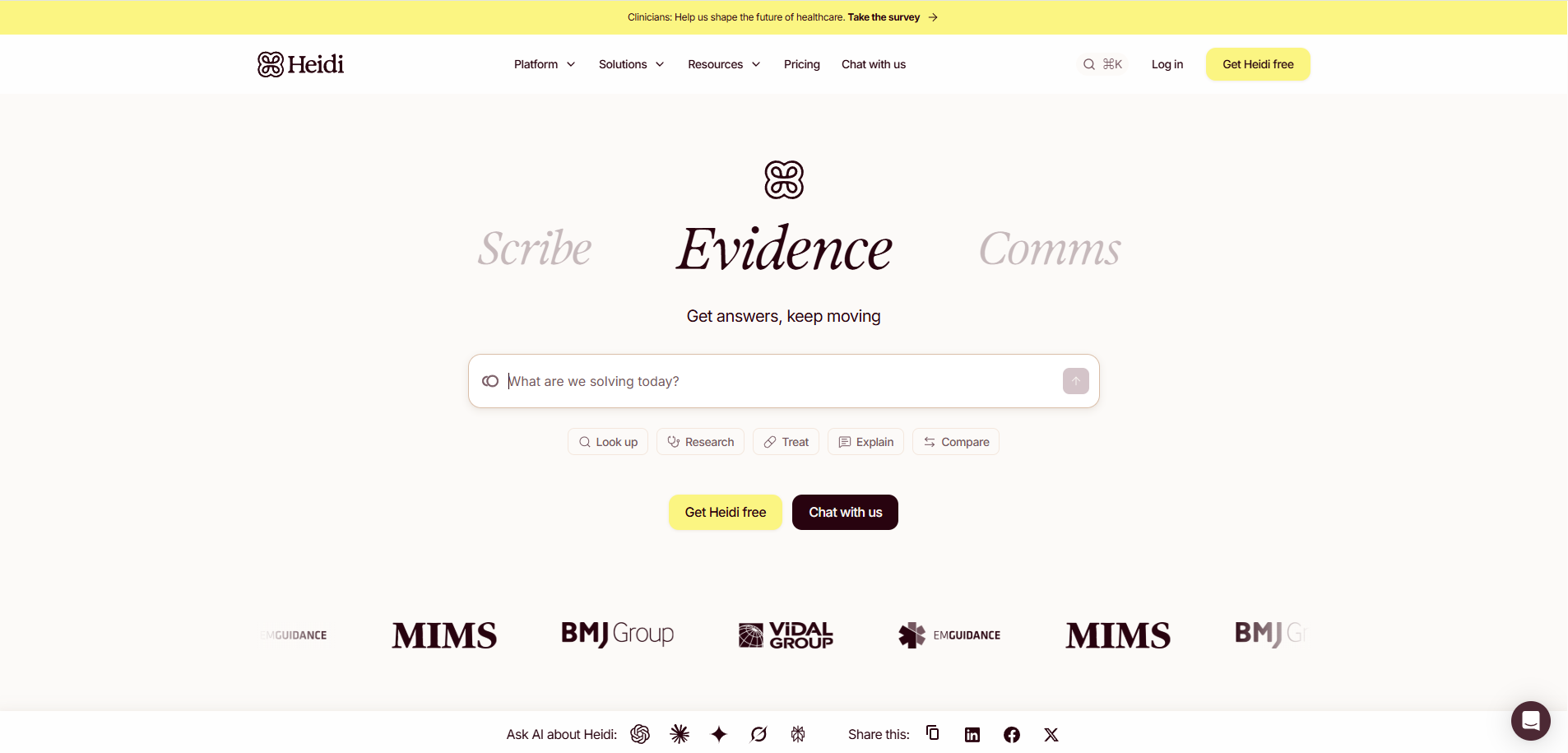
Score: 8.2/10. Highest marks for free-tier value (10/10), multilingual support (9/10), and clinician community (8/10). Scored lower on enterprise EHR integration (5/10).
Best for independent clinicians, small practices, and international clinicians (especially in Australia, UK, and New Zealand) who want a genuinely usable free tier, broad template flexibility, and 100+ language support.
Product Overview
Heidi Health offers one of the few truly usable free tiers in the category, plus an active community sharing custom templates and a strong international footprint. It excels at template flexibility (clinicians build and share their own structures) and language support, with documentation in well over 100 languages. The tradeoff is that EHR integration is mostly browser-based rather than native bidirectional writeback.
Key Features
• Genuinely usable free tier for evaluation and light use.
• 100+ languages supported, with strong UK, Australia, and New Zealand adoption.
• Custom and community-shared templates for niche specialties.
• Fast iteration and frequent product updates.
• Clean, modern clinician UX.
Pricing
Free tier available. Paid plans from $110 per month, with team tiers higher.
Deployment and Integrations
Browser-based, primarily copy-paste into the EHR. Some scraping-based integrations exist but are not as resilient as native API integrations.
Setup
Under an hour. Sign up, record, and copy into your chart.
Tradeoffs
Best price-to-value ratio in the category and strong international fit. The tradeoff is integration: clinicians wanting bidirectional EHR writeback at scale will need a different platform or an automation layer to bridge the gap. 4.8/5 from independent clinician communities.
#7. Freed: Best AI Medical Scribe for Solo and Small Primary Care Practices

Score: 7.8/10. Strong on US primary care fit (9/10), simplicity (10/10), and price (8/10). Scored lower on specialty depth (6/10) and EHR integration (5/10).
Best for US-based solo clinicians and small primary care practices that want a doctor-built, simple, ambient scribe at a transparent price point, with no enterprise procurement.
Product Overview
Freed is doctor-built and US-focused, optimized for outpatient primary care workflows. It launched as one of the first self-serve ambient scribes priced for individual clinicians and has held that position through 2026. The product is deliberately simple: record the visit, get a structured SOAP-style note, copy or send into the chart.
Key Features
• Ambient listening optimized for US primary care.
• Self-serve sign-up with no sales call or enterprise contract.
• Transparent flat pricing ($99/provider/month).
• Active clinician community and visible product roadmap.
• Templates for SOAP, discharge, and common outpatient note types.
Pricing
$99 per provider per month, with note-limited entry tiers as low as $39. Free trial available.
Deployment and Integrations
Cloud, primarily copy-paste into EHR. Some browser integrations exist; bidirectional EHR writeback is limited compared with enterprise scribes.
Setup
Hours. Designed for self-serve sign-up and first-note-by-end-of-day.
Tradeoffs
The cleanest self-serve experience in the category for US primary care. Tradeoffs are limited specialty customization, no native enterprise EHR writeback, and a primarily English-language focus. 4.7/5 from clinician communities.
#8. Nabla Copilot: Best AI Medical Scribe for Telehealth and International

Score: 7.6/10. Strong on telehealth workflows (9/10), multilingual support (8/10), and dual compliance (HIPAA + GDPR, 8/10). Scored lower on enterprise EHR writeback (5/10).
Best for telehealth-first practices, multilingual clinicians, and European or international groups that need both HIPAA and GDPR-aligned posture in a single tool.
Product Overview
Nabla Copilot is a popular ambient scribe with strong telehealth performance and dual HIPAA and GDPR compliance, which is unusual in the category. It targets clinicians on web, mobile, and cross-device workflows, and integrates with select EHRs alongside a browser-based path.
Key Features
• Strong cross-device performance optimized for telehealth visits.
• Dual HIPAA and GDPR compliance for US and European clinicians.
• Multilingual support for international practice.
• Clean web and mobile clinician UX.
• Active development cadence and clinician-focused product team.
Pricing
From $119 per provider per month. Free trial available.
Deployment and Integrations
Cloud, with browser-based use plus select EHR integrations.
Setup
Hours.
Tradeoffs
One of the strongest telehealth and international stories among the self-serve scribes. The tradeoff is depth of US enterprise EHR writeback compared with the Epic-native players. 4.7/5 from clinician communities.
#9. Augmedix: Best Hybrid AI + Human Medical Scribe

Score: 7.4/10. Strong on accuracy in complex cases (9/10) and enterprise EHR integration (8/10). Scored lower on price (4/10) and pure-AI speed (6/10).
Best for health systems and specialty practices that want enterprise-grade documentation with a human-in-the-loop review tier for high-stakes notes, accepting higher cost in exchange for accuracy.
Product Overview
Augmedix is one of the longest-running virtual scribe companies and has evolved into a hybrid AI plus human service. Ambient capture and AI drafting are combined with human medical scribes who review and finalize notes. The hybrid model trades some real-time speed for higher accuracy on complex cases, and the company has long-standing integrations with major enterprise EHRs.
Key Features
• Hybrid AI + human-scribe model for high-accuracy enterprise documentation.
• Long-standing native integrations with Epic and Oracle Health (Cerner).
• Strong fit for complex specialties where AI-only drafts require heavy editing.
• Established enterprise security and compliance program.
Pricing
Custom enterprise contracts; higher than pure-AI scribes given the human review component.
Deployment and Integrations
Cloud with native enterprise EHR integration. Implementation is enterprise-scale.
Setup
Weeks to months.
Tradeoffs
The hybrid model produces among the cleanest notes in complex cases, especially in specialty hospital settings. The tradeoffs are cost and latency: human review adds time and expense compared to pure-AI scribes that finalize the note before the patient leaves. 4.3/5 G2 (150+ reviews).
#10. Sunoh.ai: Best AI Medical Scribe for eClinicalWorks Practices

Score: 7.2/10. Strong on eClinicalWorks integration (10/10) and per-note pricing transparency (8/10). Scored lower on platform reach outside eCW (5/10) and specialty depth (6/10).
Best for practices already running eClinicalWorks that want the deepest possible native integration and per-note pricing instead of a flat subscription.
Product Overview
Sunoh.ai is the ambient AI scribe built by eClinicalWorks for eClinicalWorks. The integration is the deepest available inside that EHR, with the trade-off that the value is concentrated in eCW practices. Pricing is per-note, which can be advantageous for variable or lower-volume providers.
Key Features
• Deepest native integration available inside eClinicalWorks.
• Per-note pricing instead of a flat subscription.
• Fast deployment for existing eCW customers.
• Maintained directly by the EHR vendor.
Pricing
Per-note pricing, commonly $1.25 per note (verify current rates with the vendor).
Deployment and Integrations
Cloud, embedded in eClinicalWorks. Setup is straightforward for existing eCW customers.
Setup
Days for existing eCW customers.
Tradeoffs
Strongest fit when eClinicalWorks is your EHR; little reason to choose Sunoh outside that environment, where the integration depth is the entire value proposition. 4.4/5 from eCW customer feedback.
Connecting Your AI Medical Scribe to Your EHR and Workflow
Two things become obvious once a scribe is running in production. First, the note is only one piece of the encounter. Intake before the visit, eligibility verification, reminders, post-visit referrals, inbox messages, and the no-show recovery that has to happen tomorrow morning all continue to live in other tools. Second, the deeper a scribe's EHR integration, the more expensive and procurement-heavy the platform tends to be. Self-serve scribes such as Heidi, Freed, and Nabla often stop at copy-paste.
That is the gap an automation layer fills. Whatever scribe you choose, the question is how the structured output flows into your downstream stack: the EHR fields, the patient communication tool, the CRM, the task tracker, and the billing system, without manual rekeying.
How Keragon Pairs With Any AI Scribe
Keragon is a HIPAA-compliant, SOC 2 Type II healthcare automation platform with 400+ healthcare integrations. It is not a scribe and is not on this list. It is the automation layer that connects whichever scribe you choose to the rest of your operations, with a signed BAA on every paid plan. See the integrations Keragon supports.
What you can automate alongside the scribe
• Patient intake before the visit, with structured forms feeding the EHR so the scribe captures cleaner context.
• Real-time insurance eligibility verification ahead of the appointment.
• Appointment reminders and confirmations across SMS, email, and voice.
• No-show recovery that reaches out automatically when a visit is missed.
• Post-visit task routing: referrals, follow-up scheduling, patient-portal messages, lab orders, and care-gap closure.
• EHR-to-CRM and EHR-to-task-tracker sync, so encounter data flows where the rest of the team works.
Why teams add Keragon to their scribe stack
• Healthcare-native: 400+ integrations across EHRs (Athenahealth, DrChrono, Elation, ModMed, Healthie) and the tools around them.
• HIPAA-compliant by default: signed BAA on every paid plan; zero AI data retention; SOC 2 Type II.
• No-code: clinical and ops teams can build and adjust workflows in plain English, without engineering.
• Keragon Agents: AI teammates for intake, reminders, no-show recovery, and verification that act on scribe and chart data.
For teams that already use a scribe like Abridge, Suki, Heidi, or Freed, Keragon removes the copy-and-paste and the brittle Zapier workarounds (which are not HIPAA-eligible in any case). See how Keragon Agents work with your scribe stack.
How to Choose the Best AI Medical Scribe
Step 1: Match the scribe to your EHR reality
If you are on Epic or Oracle Health at scale, Abridge or Nuance DAX Copilot will give you the deepest native integration; on Athenahealth, Ambience and Suki are strong; on eClinicalWorks, Sunoh.ai is purpose-built. If you are not on a major enterprise EHR or you do not want an enterprise project, browser-based scribes (Heidi, Freed, Nabla) are the realistic path.
Step 2: Verify HIPAA terms, not just marketing language
Every reputable scribe claims HIPAA compliance, but BAA terms vary widely. Read the actual BAA, not the marketing page (the HHS sample BAA provisions are a useful reference for what to look for). Confirm SOC 2 Type II, encryption in transit and at rest, audio retention policy, and an explicit clause that patient audio and notes are not used to train models.
Step 3: Test on 20 to 30 real visits, not the demo
Demo notes are cherry-picked. Run a free trial or pilot through 20 to 30 of your actual patient visits and measure two things: how much editing each note requires, and whether the structure holds up on multi-problem encounters. AI accuracy degrades sharply in complex specialty visits with rapid topic shifts, so test the hard ones.
Step 4: Confirm specialty depth
General-purpose scribes (Freed, Heidi, Sunoh.ai) handle primary care well but require more editing in complex specialties. DeepScribe and Ambience offer specialty-tuned models for oncology, cardiology, and other high-documentation specialties. Behavioral health and surgery both stress AI scribes harder than the demos suggest; pilot accordingly.
Step 5: Calculate true cost per signed note
Sticker price misses real cost. Include implementation, EHR integration fees, BAA add-ons, time spent editing each note, and any contract minimums. A $99/month tool that costs you 10 extra minutes per visit is not cheap; an $800/month tool that saves an hour a day may be.
Step 6: Plan for what happens around the note
The scribe writes the note. Around the note, you still have intake, eligibility, reminders, no-show recovery, referrals, and inbox work. Decide up front whether to pair the scribe with a healthcare automation platform such as Keragon, build custom integrations, or accept the manual work in between.
Step 7: Pilot before standardizing across the team
Run the chosen tool with two or three clinicians for a month before rolling it out widely. Track signed-note times, edit counts, and clinician satisfaction. A scribe that works for a primary care provider may not work for a specialist or vice versa, and rolling back from a system-wide commitment is expensive.
AI Medical Scribe Pricing Models and Costs in 2026
Four pricing models dominate the category. Each creates different economics depending on volume and setting.
Per-provider flat subscription (self-serve)
Freed ($99/provider/mo), Heidi (free tier; paid ~$110/mo), Nabla ($119/provider/mo). Predictable, transparent, no procurement. Best for solo and small practices.
Per-provider flat subscription (enterprise)
Abridge ($250 to $500+/provider/mo), Nuance DAX Copilot ($300 to $900+/provider/mo), Suki ($300 to $400/provider/mo), DeepScribe ($300 to $500/provider/mo). Enterprise procurement, native EHR writeback, and implementation budget required.
Per-note
Sunoh.ai (commonly ~$1.25/note). Useful for variable-volume providers; scales with usage.
Custom enterprise / hybrid
Ambience, Augmedix. Quote-based, with hybrid AI-plus-human options that raise both cost and accuracy for complex specialties.
Hidden costs to model across every option: implementation engineering ($150 to $200/hour, often 40 to 80 hours for enterprise EHR integration), BAA review by a healthcare attorney ($500 to $2,000), EHR vendor activation fees for third-party APIs, time spent editing notes per visit, and the cost of replacing a tool that proves not to fit your specialty after three months.
Questions to Ask Before Buying an AI Medical Scribe
1. BAA terms
Will you sign a BAA and on which plan tier? Is there indemnification, and does the BAA explicitly forbid using our patient data to train your models?
2. EHR integration depth
Is the integration native bidirectional writeback or browser/copy-paste? On our specific EHR, what fields are populated automatically and what still requires manual entry?
3. Audio retention and evidence linking
Is audio retained, for how long, and is each line of the note linked to the source audio for audit defense?
4. Specialty fit and accuracy
On a 20-visit pilot in our specialty, what is the average editing time per note, and how does the tool handle multi-problem visits?
5. Multilingual and accent handling
Which languages and accents are supported, and how is performance validated?
6. Total cost
Including implementation, BAA review, EHR activation fees, training time, and contract minimums, what is the all-in monthly cost in year one and year two?
7. What happens around the note
How does the scribe hand off structured data to our intake, reminders, eligibility, billing, and CRM tools, or is that all manual or copy-paste? If we want to automate that, what is your reference architecture (do you partner with a healthcare automation platform)?
AI Medical Scribe Integrations: What to Verify Before Buying
Integration depth is where scribe buying decisions fail in production. A scribe that writes a beautiful note but cannot place it in the chart, or that requires copy-paste into every encounter, will not deliver the time savings on the demo.
Critical integrations to verify with each candidate platform:
• EHR native bidirectional writeback: Epic, Oracle Health (Cerner), Athenahealth, eClinicalWorks, DrChrono, Elation, Healthie, ModMed, Tebra, AdvancedMD.
• Coding workflow: E&M and ICD-10 suggestions placed directly in the draft.
• Audio retention and audit trail: where audio is stored, for how long, and whether each note line links to the source.
• Patient communication: patient-facing visit summaries and post-visit messaging.
• Surrounding workflow tools: how the scribe's structured output feeds intake, eligibility, reminders, billing, and CRM systems.
That last item is where most teams add a HIPAA-compliant healthcare automation platform like Keragon, so the scribe's output triggers downstream workflows automatically rather than waiting for staff to push it into the next tool.
Key Features to Look for in an AI Medical Scribe
Ambient capture with multi-speaker handling
True ambient listening that separates patient from clinician, filters out small talk, and handles realistic accents and background noise.
Specialty-tuned models or templates
Built-in or configurable templates for your specialty, not just generic SOAP.
Bidirectional EHR writeback
The note lands in the chart automatically, with structured data, not just as a copy-pasted block.
Evidence linking and audit defense
Each statement in the note ties back to the conversation moment where it was discussed; audio retained for a defensible period.
BAA, SOC 2 Type II, and no-training-on-PHI
Signed BAA, independent security attestation, and an explicit policy that patient data is not used for model training.
Coding workflow integration
E&M and ICD-10 suggestions embedded in the draft, with revenue capture rather than just documentation.
Workflow connectivity beyond the note
Either native integrations with downstream tools or a clear path to connect via a HIPAA-compliant automation platform.
Why AI Medical Scribes Matter in 2026
Administrative documentation is one of the single biggest drivers of clinician burnout. The American Medical Association's 2024 survey found that prior authorization alone consumes the equivalent of about 13 hours of physician and staff time every week, with 94 percent of physicians saying it contributes to burnout (AMA). That figure does not even count visit documentation itself, which has long been the dominant source of after-hours "pajama time" charting.
AI medical scribes attack that pile directly: ambient capture, structured drafting, and (for the enterprise tools) writeback into the chart. The economics are favorable. Even premium scribe subscriptions at $300 to $500 per provider per month are 80 to 95 percent cheaper than an in-office human scribe at $3,000 to $6,000 per month, and modern AI accuracy in clean specialties is comparable. What matters is matching the right tool to the specialty, EHR, and practice size, and planning for the rest of the workflow that sits around the note.
Key Takeaways
• The 10 best AI medical scribes in 2026 split clearly by setting: Abridge and Nuance DAX dominate Epic-based enterprises, Ambience leads in specialty with coding, Suki adds voice-command workflow, DeepScribe owns specialty-tuned models, Heidi and Freed lead self-serve, Nabla wins telehealth and international, Augmedix offers hybrid AI plus human, and Sunoh.ai is the eCW-native choice.
• HIPAA marketing claims are not enough; read the actual BAA and confirm SOC 2 Type II, encryption, audio policy, and the no-training-on-PHI clause.
• EHR integration depth is the largest driver of real value and cost; native bidirectional writeback is much more valuable than copy-paste, but it comes with enterprise procurement weight.
• The scribe is one piece; the work around it (intake, eligibility, reminders, no-show recovery, referrals) is automated separately by a HIPAA-compliant healthcare automation platform such as Keragon, which is not a scribe but is what connects the scribe's output to the rest of the operation.
Connect Your AI Medical Scribe to the Rest of Your Workflow
A scribe writes the note. Keragon does what comes next. Keragon is a HIPAA-compliant, SOC 2 Type II healthcare automation platform with 400+ healthcare integrations and AI agents for intake, reminders, eligibility, and no-show recovery, with a signed BAA on every paid plan. See how Keragon Agents pair with your scribe stack, explore the 400+ healthcare integrations, or review the HIPAA compliance details.
FAQs
What is the best AI medical scribe for solo clinicians?
Freed at $99 per provider per month is the cleanest self-serve option for US primary care, with simple setup and a transparent price. Heidi Health's free tier is the strongest evaluation option, particularly for clinicians outside the US or those who want to test multiple scribes before committing.
What is the best AI medical scribe for Epic-based health systems?
Abridge and Nuance DAX Copilot are the leading Epic-native scribes. Abridge has the strongest evidence-linking story for audit defense; DAX Copilot has the broadest enterprise EHR coverage (Epic, Oracle Health, Meditech) and Dragon dictation synergy. Both require enterprise procurement and several weeks of implementation.
Are AI medical scribes HIPAA compliant?
Reputable scribes are HIPAA-eligible and will sign a BAA, but specifics vary. Confirm a signed business associate agreement, SOC 2 Type II, encryption at rest and in transit, audio retention policy, and an explicit clause that patient audio and notes are not used to train models. Read the actual BAA, not just the marketing page.
How much do AI medical scribes cost in 2026?
Self-serve scribes (Freed, Heidi, Nabla) run roughly $50 to $150 per provider per month. Enterprise scribes (Abridge, Nuance DAX, Suki, DeepScribe, Ambience) run $250 to $900+ per provider per month, sometimes higher with implementation fees and reseller markups. Sunoh.ai uses per-note pricing at $1.25 per note. Even premium AI scribes are 80 to 95 percent cheaper than an in-office human scribe.
Is Keragon an AI medical scribe?
No. Keragon is a HIPAA-compliant healthcare automation platform that pairs with any AI scribe to connect its output to your EHR, billing, patient communication, CRM, and task tools, automatically and without code. Practices typically choose a scribe for documentation and add Keragon for the workflow that surrounds the note (intake, reminders, eligibility, no-show recovery, post-visit follow-up).
Can I use Zapier to connect my AI scribe to other tools?
Not for any workflow that touches PHI. Zapier does not sign business associate agreements and does not support PHI on any plan, so routing scribe output through Zapier exposes patient data on an uncovered vendor. Use a HIPAA-eligible automation platform such as Keragon, or build native integrations between systems that already have BAAs in place.
Do AI medical scribes work for behavioral health and therapy?
Some do, but quality varies. Several major scribes apply content filters that can interfere with legitimate behavioral-health language around trauma, substance use, or sexual health. Pilot before committing for behavioral health, and confirm with the vendor whether their content moderation will affect your documentation.
What is the difference between ambient and voice-command AI scribes?
Ambient scribes (Abridge, Heidi, Freed, Nabla, DAX) listen to the natural conversation and generate a note automatically. Voice-command tools (Suki) layer structured spoken commands on top, letting clinicians dictate actions like placing orders, sending referrals, or moving sections of the note. Many enterprise tools now combine both.
Related Articles
_%20Use%20Cases%20%26%20Benefits.png)

Related Articles