Healthcare Automations
29 mins
10 Best AI Workflow Tools for Healthcare Automation in 2026
Summary
Your Competitors Are Embracing AI – Are You Falling Behind?
Most workflow automation tools were built for marketing ops and sales. They route leads. They sync rows between SaaS apps. They handle the workflows that do not care about HIPAA.
That model breaks the moment patient data enters the pipeline. The popular general tools either refuse to sign a Business Associate Agreement at all, or sign one only on six-figure enterprise contracts, which is why so many practices end up with non-compliant Zaps quietly moving PHI between systems. The best AI workflow tools for healthcare automation in 2026 do the opposite: HIPAA compliance is the default, not an enterprise add-on, and the AI is wired into healthcare-specific integrations from day one.
We evaluated 10 platforms across HIPAA compliance and BAA availability, healthcare integration depth, AI workflow capability, deployment flexibility, and total cost. Each was assessed on its ability to handle real healthcare automation jobs (patient intake, appointment reminders, eligibility checks, referral routing, EHR-to-CRM sync, revenue cycle) rather than the generic SaaS automations the same tools advertise to other industries.
| Keragon | Workato | Make | Redox |
|---|---|---|---|
| Best Overall / HIPAA-compliant healthcare automation | Best for Enterprise iPaaS | Best for Visual Builders (non-PHI) | Best for EHR Connectivity Infrastructure |
Best AI Workflow Tools for Healthcare Automation in 2026: Quick Comparison Table
The table below summarizes the ten tools we cover, the use case each fits best, BAA availability, deployment, current pricing, AI depth, and an aggregate user rating. Ratings are drawn from G2 and Capterra as of mid-2026 and are approximate, since enterprise and healthcare-specific platforms carry fewer public consumer reviews than general automation apps. Confirm current terms and BAA availability directly with each vendor.
| Platform | Best For | BAA | Deployment | Starting Price | AI Depth | Rating | Score |
|---|---|---|---|---|---|---|---|
| Keragon | Healthcare automation | Yes (paid plans) | Cloud | From $149/mo | Native AI + Agents | 4.8/5 | 9.4/10 |
| Workato | Enterprise iPaaS | Yes (enterprise) | Cloud / Private | Custom (5–6 figures/yr) | AI add-ons | 4.7/5 | 8.2/10 |
| Tray.ai | Mid-market low-code | Yes (contracted) | Cloud | Custom | Merlin AI | 4.5/5 | 7.6/10 |
| Boomi | Enterprise integration | Yes | Cloud / Hybrid | Custom | Boomi AI | 4.4/5 | 7.4/10 |
| MuleSoft | Large enterprise / IT | Yes (enterprise) | Cloud / Hybrid | Six-figure+/yr | Einstein | 4.5/5 | 7.2/10 |
| Microsoft Power Automate | M365 ecosystem | Yes (via M365 BAA) | Cloud | From $15/user/mo | Copilot | 4.5/5 | 7.0/10 |
| Make | Visual builders (non-PHI) | No | Cloud (EU/US) | Free; from $9/mo | AI modules | 4.7/5 | 5.4/10 |
| Zapier | SaaS glue (non-PHI) | No | Cloud | Free; from $19.99/mo | AI actions | 4.5/5 | 5.2/10 |
| n8n | Self-hosted, technical | Self-managed | Self-hosted / Cloud | Free; from $20/mo | AI nodes | 4.6/5 | 6.6/10 |
| Redox | EHR connectivity | Yes | Cloud | Custom | Limited | 4.6/5 | 7.8/10 |
How We Evaluated These AI Healthcare Workflow Tools
Our team evaluated each platform across seven weighted dimensions. We analyzed aggregated user reviews from G2 and Capterra, reviewed public pricing and BAA terms, tested deployment workflows where access permitted, and consulted with healthcare operations teams running automation in production.
We prioritized platforms healthcare buyers (clinics, multi-specialty groups, hospitals, and digital health companies) would encounter during a real evaluation, and we weighted HIPAA compliance heavily, because in healthcare it is a hard gate, not a feature.
Our Scoring Methodology
| Criterion | Weight | What We Measured |
|---|---|---|
| HIPAA Compliance & BAA | 25% | Whether a signed BAA is available, at which plan tier, and at what added cost; SOC 2 Type II certification; PHI handling controls and security safeguards. |
| Healthcare Integration Depth | 20% | Native connectors to EHRs (Athenahealth, Epic, DrChrono, Healthie, Elation, ModMed), practice management systems, billing platforms, and patient communication tools. |
| AI Workflow Capability | 15% | Whether AI is built directly into the workflow engine or added separately; support for multi-step reasoning, agentic workflows, and natural-language workflow creation. |
| User Friendliness | 10% | Setup time, learning curve, visual workflow experience, and whether non-technical healthcare teams can build and maintain automations. |
| Pricing & TCO Predictability | 10% | Pricing transparency, scalability of costs, hidden fees, BAA-related charges, and overall total cost of ownership. |
| Deployment & Data Sovereignty | 10% | Cloud, private cloud, or self-hosted deployment options; data residency controls; and architecture for keeping PHI within compliant boundaries. |
| Support & Reviews | 10% | G2 and Capterra ratings, quality of documentation, onboarding experience, customer support responsiveness, and healthcare-specific implementation assistance. |
Pricing and ratings below are accurate as of mid-2026 and change frequently. Confirm current terms and BAA availability directly with each vendor.
Top 10 Best AI Workflow Tools for Healthcare Automation in 2026
Below we review the ten best AI workflow tools for healthcare automation in 2026, ordered by fit for the most common healthcare scenarios. Each entry covers product overview, top features, pricing, deployment and integrations, setup, tradeoffs, support, and ratings.
1. Keragon: Best AI Workflow Tool for HIPAA-Compliant Healthcare Automation
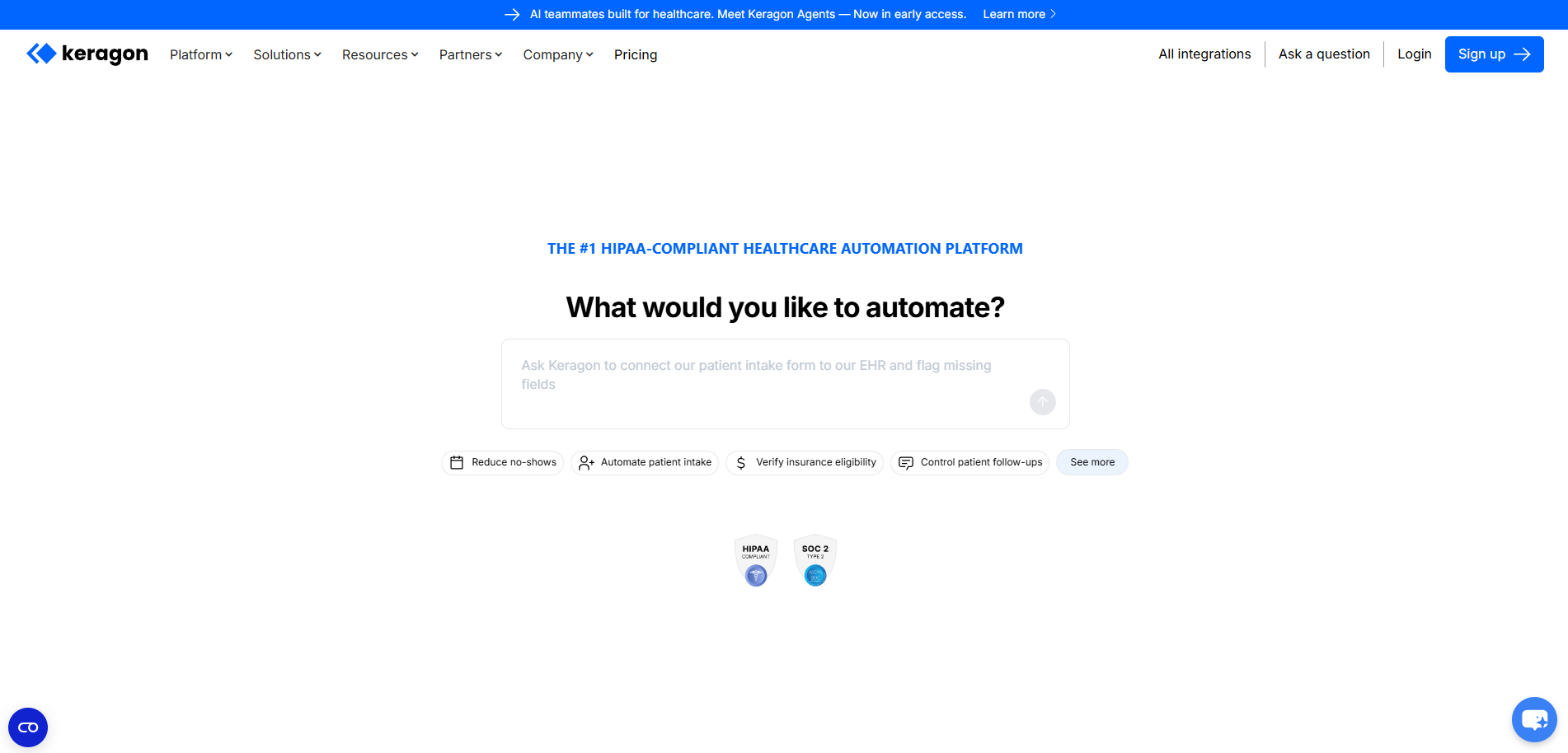
Score: 9.4/10. Highest marks for HIPAA compliance (10/10), healthcare integration depth (10/10), and AI workflow capability (9/10). Scored lower on community review volume (7/10), which is typical for a healthcare-specific platform.
Keragon is a HIPAA-compliant healthcare automation platform built specifically for workflows that touch patient data. Its no-code visual builder lets clinical, operations, and revenue-cycle teams connect their EHR, PMS, billing, CRM, and communication tools, then automate multi-step workflows such as patient intake, appointment reminders, eligibility checks, referral routing, and EHR-to-CRM sync. Where general tools like Zapier were never built for PHI, Keragon signs a BAA on every paid plan and runs every workflow on healthcare-grade infrastructure, which is why teams adopt it as the compliant alternative to stitched-together automation.
Best for clinics, multi-specialty groups, digital health companies, and revenue-cycle teams that need real HIPAA-compliant automation across EHR, scheduling, billing, and patient communication, without writing code or carrying the BAA gaps of general SaaS tools.
Product Overview
Pain 1: General automation tools route PHI through vendors that will not sign a BAA
Zapier states in its own data privacy documentation that the platform does not support PHI and cannot sign business associate agreements. Make takes a similar position. Every patient record that passes through those tools is uncovered PHI, regardless of how well the rest of the stack is protected. Keragon was built the other way around: a signed BAA on every paid plan, SOC 2 Type II certification, and PHI boundary architecture that keeps sensitive data inside healthcare-grade infrastructure. Compliance is the default, not an enterprise add-on.
Pain 2: General connectors do not speak healthcare
A generic iPaaS can connect Salesforce to Slack, but it cannot natively trigger from a new appointment in Athenahealth, write structured intake into Healthie, or update a chart in DrChrono. Keragon offers 400+ healthcare-native integrations across EHR and practice management systems (Athenahealth, DrChrono, Elation Health, ModMed, Healthie, and more), plus scheduling, billing, CRM, AI scribes, and patient communication tools, with connectors built and maintained for clinical workflows. That removes the brittle webhook scripting that practices end up paying engineers to maintain.
Pain 3: Automation only pays off when non-engineers can ship workflows
Healthcare ops teams rarely have a developer on staff. Keragon's no-code visual builder includes AI that turns a plain-English prompt into a complete workflow, including triggers, logic, field mappings, and integrations. Keragon Agents act as AI teammates for healthcare operations, handling intake, reminders, no-show recovery, insurance verification, and pre-visit prep. Most teams ship their first workflow within an afternoon, and adjustments happen in plain English rather than in code.
Top Features
• No-code visual workflow builder with AI that drafts complete multi-step workflows from a plain-English prompt.
• Keragon Agents: AI teammates for healthcare operations such as patient intake, appointment reminders, no-show recovery, insurance verification, and pre-visit prep.
• Secure MCP layer that connects AI agents to 400+ healthcare integrations under HIPAA-compliant controls.
• Pre-built templates for the most common healthcare jobs: new-patient intake, eligibility verification, referral routing, post-visit follow-up, and EHR-to-CRM sync.
• Conditional, multi-branch logic with human-in-the-loop approval steps for sensitive workflows.
• Audit logs, role-based access, and zero AI data retention across the platform.
Pricing
Keragon uses tiered pricing with a free trial. Plans scale by monthly workflow runs and active (published) workflows:
• Starter: $149/month (or $99/month billed annually), 200 workflow runs/month, 3 published workflows. Suitable for solo and small private practices.
• Professional: $399/month, 2,000 workflow runs/month, 15 published workflows. Built for small-to-medium practices and growing digital health startups.
• Scale Up: $1,499/month, 20,000 workflow runs/month, 100 published workflows. Designed for large healthcare companies and multi-specialty groups.
• Enterprise: custom pricing. Custom workflow run volume, custom published workflows, custom BAA, priority support with a dedicated account manager. For enterprise healthcare organizations and hospitals.
Deployment and Integrations
Cloud-hosted on healthcare-grade infrastructure with SOC 2 Type II certification and HIPAA controls. Keragon offers more than 400 healthcare integrations spanning EHR and practice management (Athenahealth, DrChrono, Elation Health, ModMed, Healthie), scheduling, billing, CRM, AI scribes, and patient communication. A secure MCP layer lets AI agents act across those integrations under HIPAA-compliant controls, with native HL7 and FHIR support for deeper EHR connectivity.
Setup
Hours, not weeks. Sign the BAA, connect your EHR and tools through pre-built connectors, describe the workflow in plain English, run a test, and ship. Many customers ship their first workflow within an afternoon, and the same team can build the next one without engineering involvement.
Tradeoffs
Keragon is healthcare-only by design, which is the point if you handle PHI and a poor fit if you do not. It has fewer raw app connectors than mass-market platforms like Zapier (400+ healthcare-focused versus Zapier's 7,000+ general), but the connector depth on the healthcare apps that matter is significantly greater. Reviewers note a learning curve on the most complex multi-branch automations, which is typical of any flexible platform.
Support
Keragon offers 24/7 live chat and help desk support, backed by a documentation hub, an active user community, and a directory of certified automation experts for teams that want hands-on implementation help, plus healthcare-specific onboarding for enterprise plans.
Ratings and Reviews
Reviewers consistently praise Keragon for HIPAA-compliant automation, responsive support, and the time saved connecting siloed healthcare systems without custom development. The most common critique is the learning curve on advanced builds. Keragon holds a 4.8 out of 5 rating on G2 from verified healthcare users, with most awarding five stars.
Pre-built templates. HIPAA compliant. No developers needed. Start your free trial today.
#2. Workato: Best Enterprise iPaaS for Healthcare Automation
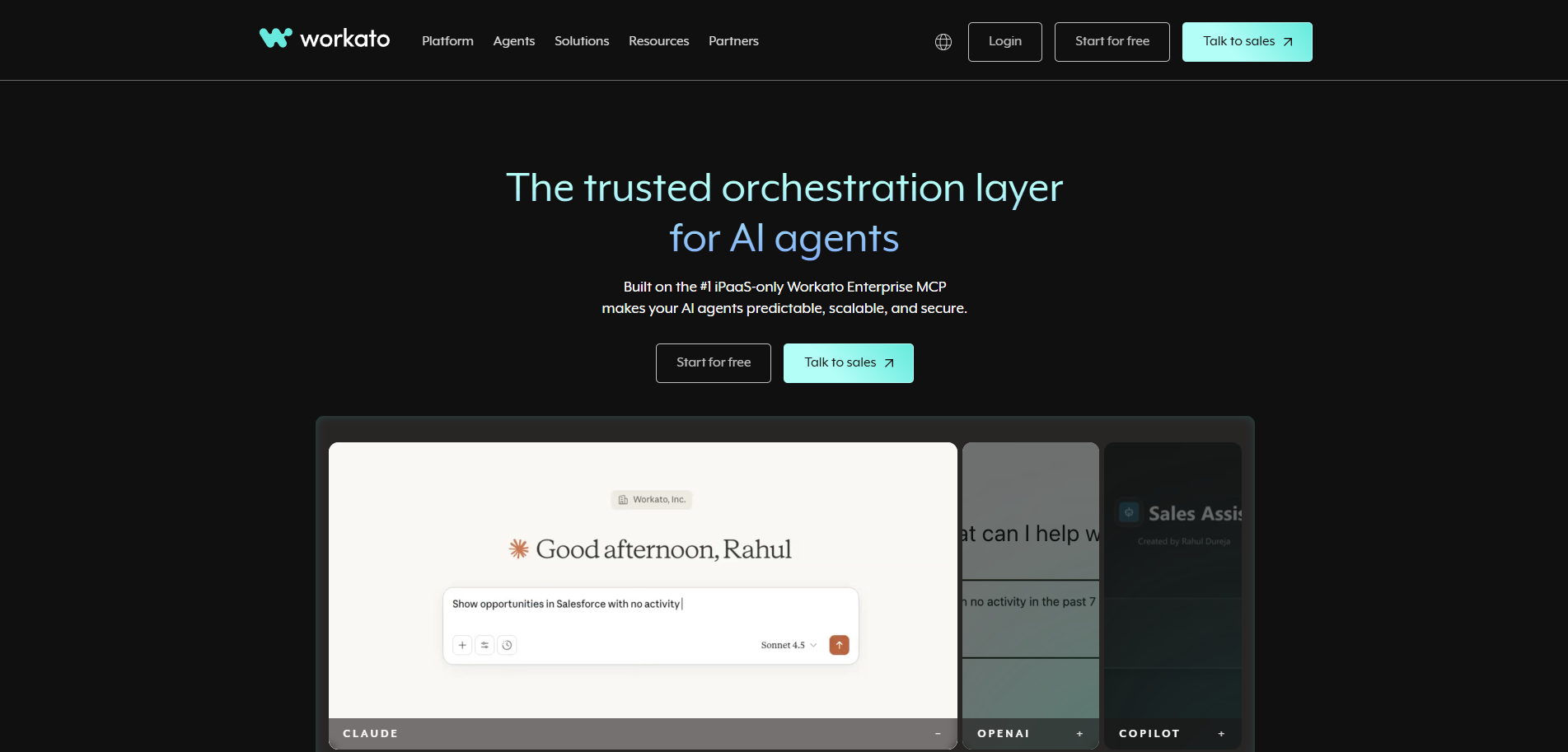
Score: 8.2/10. Strong on enterprise governance (9/10), HIPAA compliance (8/10), and integration breadth(9/10). Scored lower on user friendliness (6/10) and pricing transparency(4/10).
Product Overview
Workato is an enterprise integration platform (iPaaS) used across regulated industries including healthcare, financial services, and HR. It signs BAAs on enterprise contracts, supports HL7 and FHIR connectors, and offers strong governance with role-based access, audit logs, and private-cloud deployment options. Best for large health systems and digital health companies that need cross-functional automation(clinical, finance, HR, IT) on a single platform.
Pricing
Custom enterprise pricing, with starting subscriptions typically in the low five figures annually and scaling by recipe and task volume. No published list pricing; BAAs are negotiated as part of enterprise contracts.
Deployment and Integrations
Cloud and private-cloud options.1,000+ enterprise connectors across SaaS, on-prem, and APIs, with HL7 and FHIR support for EHR connectivity.
Setup
Weeks to months for full deployment. Designed for enterprise IT teams with implementation support.
Tradeoffs
One of the strongest governance stories in the category, with verifiable HIPAA, SOC 2, ISO 27001, and PCI-DSS posture. The tradeoff is cost and complexity: Workato is overpowered and expensive for solo or small practices, and you will not get the healthcare-native template library that a purpose-built platform provides. 4.7/5 G2 (1,000+ reviews).
#3. Tray.ai: Best Low-Code Automation for Mid-Market Healthcare

Score: 7.6/10. Strong on flexibility (8/10) and AI capability (8/10). Scored lower on out-of-the-box healthcare templates (5/10) and pricing transparency (4/10).
Product Overview
Tray.ai (formerly Tray.io) is a low-code integration platform with a drag-and-drop builder, 600+ connectors, and Merlin AI for natural-language workflow building. It signs BAAs on contracted plans and passed an independent HIPAA audit. Best for mid-market healthcare and digital health teams that need flexibility and AI capability without writing code, with engineering available for the harder edges.
Pricing
Custom pricing. Plans contracted annually; BAA available on enterprise tiers.
Deployment and Integrations
Cloud-only. 600+ general SaaS connectors plus a Universal REST/GraphQL step for anything custom. Engineers can drop JavaScript snippets mid-flow for FHIR-to-JSON transforms or custom logic.
Setup
Days to weeks for typical deployments. More flexible than out-of-the-box healthcare platforms, but requires more configuration to reach the same workflow.
Tradeoffs
Strong all-purpose iPaaS with HIPAA support. The tradeoff is that healthcare is not the default focus, so you will build more from scratch than on a healthcare-native platform, and pricing is not public. 4.5/5 G2 (500+ reviews).
#4. Boomi: Best for Enterprise Integration with Healthcare Modules

Score: 7.4/10. Strong on enterprise integration (8/10) and HIPAA compliance (8/10). Scored lower on AI workflow capability (6/10) and user friendliness (5/10).
Product Overview
Boomi is a cloud-native iPaaS owned by Dell, with a visual workflow builder (AtomSphere) and pre-built connectors for business and healthcare applications. It signs BAAs and has healthcare-specific deployment patterns. Best for hospitals and large health systems standardizing on a single integration platform across clinical and corporate systems.
Pricing
Custom enterprise pricing; quote-based.
Deployment and Integrations
Cloud and hybrid. Strong library of connectors with healthcare-specific patterns, including HL7 and FHIR support.
Setup
Weeks to months. Designed for IT-led implementations.
Tradeoffs
Mature enterprise platform with HIPAA support. The tradeoff is the same as Workato: heavy for smaller practices, slow to ship simple workflows, and the AI layer is lighter than what AI-first platforms offer. 4.4/5 Capterra (300+ reviews).
#5. MuleSoft: Best for Large-Enterprise IT Integration

Score: 7.2/10. Strong on enterprise capability (9/10) and CRM integration via Salesforce (10/10). Scored lower on pricing (3/10) and user friendliness for non-engineers (4/10).
Product Overview
MuleSoft Anypoint Platform is the integration platform owned by Salesforce. It is heavily used in healthcare for enterprise integration, especially among organizations already on Salesforce, and offers HIPAA eligibility under Salesforce's enterprise framework. Best for large health systems and payers that need API-led, governed integration at scale, with the engineering team to support it.
Pricing
Six-figure annual contracts are typical. License model based on cores and API calls. BAA available under enterprise contracts.
Deployment and Integrations
Cloud and hybrid deployment. Deep CRM integration via Salesforce; broad enterprise connector library; HL7and FHIR support.
Setup
Months. Requires Salesforce and integration engineering expertise.
Tradeoffs
Among the most capable enterprise integration platforms in healthcare, with Salesforce-level governance. The tradeoff is cost and complexity: this is not a tool a clinic operations manager will use to ship a workflow this week. 4.5/5 G2 (700+reviews).
#6. Microsoft Power Automate: Best for M365 Healthcare Environments

Score: 7.0/10. Strong on Microsoft ecosystem integration (10/10) and BAA availability via M365 (8/10). Scored lower on healthcare-specific connectors (5/10) and AI agent depth(6/10).
Product Overview
Power Automate is the workflow automation engine inside Microsoft 365. For healthcare organizations already onM365, the BAA is covered by Microsoft's Online Services Terms, which means PHI workflows can run under existing licensing. Copilot adds AI assistance for workflow building. Best for healthcare IT teams already standardized on Microsoft, automating internal processes and document workflows alongside lighter clinical use cases.
Pricing
From $15 per user per month for Power Automate Premium. AI features included in Copilot licensing where applicable.
Deployment and Integrations
Cloud, within the Microsoft 365ecosystem. Strong Microsoft-native integration; limited native healthcare connectors out of the box.
Setup
Hours to days for Microsoft-centric workflows; longer for healthcare-specific integrations that require custom connectors.
Tradeoffs
Genuine value for M365healthcare organizations because BAA coverage rides on the existing Microsoft agreement. The tradeoff is that healthcare-specific connectors are limited, so you will build more of the EHR integration yourself than on a healthcare-native platform. 4.5/5 G2 (5,000+ reviews).
#7. Make: Best for Visual Builders (Non-PHI Workflows Only)

Score: 5.4/10. Strong on visual workflow design (9/10) and value (8/10). Scored very low on HIPAA compliance (1/10),which is decisive for healthcare buyers.
Product Overview
Make (formerly Integromat) is a visual workflow automation platform popular for its powerful builder and lower price than Zapier. The decisive issue for healthcare is HIPAA: as of mid-2026,Make does not publish a HIPAA program and does not sign BAAs (Paubox). Best for non-PHI healthcare workflows only: internal operations, marketing automation, and back-office tasks that never touch patient data.
Pricing
Free tier available. Paid plans from $9 per month, scaling with operations consumed.
Deployment and Integrations
Cloud-only with EU or US region selected at organization creation (no UK region, no easy region migration). 1,500+general connectors.
Setup
Hours. Visual builder is one of the most approachable in the category.
Tradeoffs
Excellent general-purpose automation tool, blocked from PHI workflows by the BAA gap. If your healthcare operation has clean separation between marketing/internal automation and clinical data, Make can cover the former. For anything touching PHI, choose a HIPAA-eligible platform. 4.7/5 Capterra (300+ reviews).
#8. Zapier: Best for Non-PHI SaaS Automation

Score: 5.2/10. Highest marks for connector breadth (10/10) and user friendliness (9/10). Scored very low on HIPAA compliance (0/10), because no BAA is available on any plan.
Product Overview
Zapier is the most widely used workflow automation tool in the world, with 7,000+ app connectors and an extremely accessible builder. The hard limit for healthcare is explicit: Zapier states on its own data privacy page that the use of PHI under HIPAA is not supported on the platform and that Zapier cannot sign BAAs (Zapier). Best for non-PHI healthcare workflows: marketing automation, internal task routing, and integrations that never touch patient data.
Pricing
Free tier available. Paid plans from $19.99 per month, scaling with task volume and AI usage.
Deployment and Integrations
Cloud-only on AWS in the United States. 7,000+ general SaaS connectors, more than any other platform on this list.
Setup
Minutes to hours. The fastest setup of any platform here.
Tradeoffs
Hugely capable for non-healthcare automation. The compliance gap is structural, not configurable: encryption and SOC 2 do not substitute for a BAA, and every PHI record passing through Zapier is an unprotected transmission. Many practices end up with legacy Zaps quietly moving patient data; auditing and replacing those with a HIPAA-eligible tool is one of the highest-ROI compliance cleanups available.4.5/5 G2 (1,500+ reviews).
#9. n8n: Best for Self-Hosted, Technical Healthcare Teams
Score: 6.6/10. Strong on flexibility (9/10) and self-hosted deployment (10/10). Scored lower on out-of-the-box healthcare support (4/10) and BAA availability (5/10, as it depends on self-hosting).
Product Overview
n8n is an open-source, source-available workflow automation tool. Healthcare teams self-host it on HIPAA-eligible infrastructure (AWS or Azure under their own BAA) to keep PHI within their own environment. AI nodes provide LLM and agent capability. Best for technical healthcare teams (digital health startups, internal IT) that want full control over data residency and infrastructure, and have the engineering to operate it.
Pricing
Self-hosted Community Edition is free. n8n Cloud paid plans from $20 per month, though for HIPAA work the self-hosted path is the relevant option.
Deployment and Integrations
Self-hosted or cloud. 400+integrations including LLMs and vector databases; custom nodes for anything else.
Setup
Days. Requires engineering to deploy, harden, and operate the self-hosted instance.
Tradeoffs
Genuine self-hosted option means PHI stays in your environment under your own BAA, which solves the cloud-vendor BAA problem. The tradeoff is operational overhead: you own the infrastructure, the upgrades, the security hardening, and the compliance posture. 4.6/5 G2(200+ reviews).
#10. Redox: Best EHR Connectivity Infrastructure

Score: 7.8/10. Strong on EHR connectivity (10/10) and HIPAA compliance (9/10). Scored lower on AI workflow capability (5/10) and user friendliness for non-engineers (4/10).
Product Overview
Redox is a healthcare interoperability platform that gives software vendors and digital health companies a single connection to hundreds of EHRs. It is more EHR-connectivity infrastructure than a no-code workflow tool, but it is on this list because many healthcare automation projects start with one core problem (getting reliably into the EHR) and Redox is one of the strongest answers. Best for digital health companies and vendors scaling EHR integrations across many provider customers.
Pricing
Custom pricing, contracted annually. BAA included.
Deployment and Integrations
Cloud-only. Single API to hundreds of EHRs, abstracting HL7 and FHIR complexity.
Setup
Engineering project. Weeks to months.
Tradeoffs
If your problem is EHR connectivity at scale, Redox is the category leader. If your problem is end-user automation (intake, reminders, eligibility) inside a practice, Redoxis the wrong layer; you want a workflow platform like Keragon that can sit on top of Redox or connect to EHRs directly. 4.6/5 G2 (50+ reviews).
How to Choose the Best AI Workflow Tool for Healthcare Automation
Step 1: Confirm BAA Availability Before Evaluating Features
If patient data will flow through the platform, a signed business associate agreement is the gate, not a checkbox (see the HHS sample BAA provisions). Eliminate vendors that do not sign one on a plan you can actually afford. SOC 2 and encryption are not substitutes.
Step 2: Map the Healthcare-Specific Workflows You Need to Automate
List the workflows costing the most staff time: intake, reminders, eligibility, prior auth, referrals, claims status, EHR-to-CRM sync. Choose a platform with native connectors and templates for those jobs, not one where you build them all from scratch.
Step 3: Test Integration Depth With Your Actual EHR and Stack
"Healthcare-ready" means very different things across vendors. Ask for a live demo against your specific EHR (Athenahealth, Epic, DrChrono, Elation, Healthie, ModMed). Confirm two-way writeback, not just read access, and ask what happens when an integration fails mid-workflow.
Step 4: Evaluate AI Capability for Real Multi-Step Healthcare Work
AI in a workflow tool means more than a chat sidebar. Look for natural-language workflow building, multi-step agents that can take action across integrations, and human-in-the-loop approval for sensitive steps. Pressure-test on a real healthcare scenario, not the demo's happy path.
Step 5: Assess Who Will Build and Own the Workflows
If your team has no developers, a no-code, healthcare-native platform pays back faster than an enterprise iPaaS that needs engineers. If you have an integration team and broader cross-functional needs, an enterprise platform may justify the cost. Match the tool to the team that will run it.
Step 6: Model Total Cost at Real Volume
Per-task and per-recipe pricing compounds at healthcare scale, where a single patient journey can fire dozens of automation steps. Add implementation, BAA premiums (if any), and the engineering time to maintain custom connectors. Compare against published, tiered healthcare-native pricing.
Step 7: Run a Production Pilot on a Single High-Value Workflow
Pick one workflow that genuinely hurts (intake, eligibility, no-show recovery), run it end to end on a small slice of volume, and measure completion rate, exception handling, and PHI controls before expanding. A platform that cannot handle the messy edge cases of one workflow will not scale to ten.
AI Healthcare Workflow Tools: Pricing Models and Costs in 2026
Four pricing models dominate the category. Each creates very different economics at healthcare scale, and each has hidden costs worth modeling before signing.
Tiered, run-based (healthcare-native)
Keragon: published tiers start at $149/month (Starter), $399/month (Professional), and $1,499/month (Scale Up), with custom Enterprise pricing. Plans scale by monthly workflow runs and active workflows, with a BAA included on every paid plan. Predictable cost; no per-recipe markup.
Enterprise iPaaS (custom)
Workato, MuleSoft, Boomi, Tray.ai: custom annual contracts, typically five to six figures, with BAA negotiated as part of enterprise terms. Strong governance but high floor.
Per-user / per-seat (ecosystem)
Microsoft Power Automate: from $15/user/month, with BAA covered by M365 commercial terms. Predictable per-seat cost, but healthcare-specific connectors are limited.
Per-task or per-operation (general SaaS)
Zapier, Make: low entry pricing, but no BAA on any plan. Suitable only for non-PHI workflows in healthcare.
Hidden costs across all models: implementation, custom connectors for the specific EHR you run, BAA add-on fees on some enterprise tiers, engineering time to maintain custom logic, and the cost of replacing a non-compliant tool after a HIPAA finding.
Questions to Ask Before Buying an AI Healthcare Workflow Tool
1. BAA availability and plan tier
Will you sign a BAA, on which plan, and is there a separate fee for it? Confirm in writing before any patient data flows through the platform.
2. Healthcare connector depth
How deep is the integration with our specific EHR and PMS? Is it two-way writeback, and how is it maintained when the EHR updates its API?
3. PHI boundary architecture
Where does PHI sit at each step of a workflow? Is it encrypted at rest and in transit? Are execution logs scrubbed of PHI?
4. AI governance and human-in-the-loop
Can we require human approval before an AI agent takes a sensitive action? Are AI prompts and decisions auditable?
5. Data residency and sub-processors
Which sub-processors handle PHI? Where is data stored? Is residency configurable?
6. Audit logs and retention
What is logged on every workflow run, who can access logs, and how long are they retained?
7. Total cost at our volume
Model real monthly cost at expected workflow volume in year one and year two, including BAA premiums and any engineering support.
AI Healthcare Workflow Tools: Integrations to Verify Before Buying
Integration depth is where healthcare automation projects fail in production. A platform that can fetch a record but cannot reliably write back to the chart, or one that breaks on every payer eligibility check, will not survive contact with daily clinic operations.
Critical handoffs to verify with any candidate platform:
• EHR two-way writeback: Athenahealth, Epic, eClinicalWorks, NextGen, DrChrono, Elation Health, ModMed, Healthie, Tebra. Native connectors over HL7 or FHIR, not generic webhooks.
• Practice management and scheduling: appointment creation, rescheduling, status updates.
• Insurance and eligibility: real-time benefits checks via your clearinghouse or payer connections.
• Patient communication: HIPAA-compliant SMS and email, plus voice channels where relevant.
• Forms and intake: Jotform, Typeform, and dedicated intake tools, with PHI handling preserved end to end.
• Billing and revenue cycle: claim status, payment posting, and reconciliation.
• Failure handling: what happens when an integration times out mid-workflow? Does the platform retry, escalate, or freeze?
Key Features to Look for in AI Workflow Tools for Healthcare
Signed BAA and SOC 2 Type II
Non-negotiable for any tool touching PHI. SOC 2 Type II adds independent attestation of security controls; ideally on every paid plan, not gated behind enterprise.
Healthcare-native integrations and HL7/FHIR support
Pre-built, maintained connectors for the EHRs, schedulers, and billing systems healthcare teams actually run, with FHIR for modern API workflows.
AI-driven workflow building and agents
Plain-English workflow generation, AI agents that act across integrations, and human-in-the-loop approval for sensitive steps.
Conditional, multi-branch logic
Real healthcare workflows have exceptions. Look for if/then/else logic, loops, and error handling beyond simple linear flows.
PHI boundary architecture and audit logs
Sensitive data confined to the platform's protected perimeter, with full audit trails of every run, change, and access event.
Pre-built healthcare templates
Out-of-the-box templates for the high-frequency jobs (intake, eligibility, reminders, referrals, no-show recovery) so non-engineers can ship quickly.
Why AI Workflow Automation Matters in Healthcare
The administrative burden in healthcare is measurable and growing. The American Medical Association's 2024 survey found that prior authorization alone consumes the equivalent of about 13 hours of physician and staff time every week, with 40 percent of practices employing staff dedicated exclusively to it (AMA). The CAQH Index estimates the industry could save more than $20 billion a year simply by moving remaining manual transactions to electronic and automated workflows (CAQH).
At the same time, missed appointments cost the U.S. healthcare system an estimated $150 billion a year (MGMA), much of it preventable with reliable reminders, eligibility checks, and no-show recovery, the same workflows an AI healthcare automation platform is designed to run. The best tool is the one that can do that work, safely, on the EHR and tools you already have.
Key Takeaways
• HIPAA compliance and BAA availability are the deciding factors; eliminate vendors that will not sign a BAA on a plan you can afford, regardless of how strong the rest of the feature set looks.
• Healthcare-native platforms like Keragon outperform general iPaaS for clinic-level automation because the connectors, templates, and PHI architecture are built for healthcare from day one.
• Enterprise iPaaS (Workato, MuleSoft, Boomi, Tray.ai)makes sense for large health systems with cross-functional integration needs and engineering teams to run it; expect high floor pricing.
• Zapier and Make are widely used but do not sign BAAs, so they are off-limits for any workflow that touches PHI; they remain useful for non-PHI marketing and internal automation.
• Match the tool to the team that will run it: no-code for clinic ops, low-code for hybrid teams, enterprise iPaaS for IT-led organizations.
Get Started with the Best AI Workflow Tool for Healthcare Automation
Keragon is a HIPAA-compliant, SOC 2 Type II healthcare automation platform. Its no-code visual builder and AI agents automate patient intake, appointment reminders, eligibility checks, referral routing, and EHR-to-CRM sync across 400+ healthcare integrations, with a signed BAA on every paid plan. See how Keragon Agents work, explore the 400+ healthcare integrations, or review the HIPAA compliance details.
FAQs
What makes an AI workflow tool HIPAA compliant?
A HIPAA-compliant workflow tool signs a business associate agreement, encrypts PHI in transit and at rest, restricts access by role, maintains audit logs, and keeps sensitive data within a controlled boundary. SOC 2 Type II strengthens the security posture but is not a substitute for the BAA, which is the legal foundation (see the HHS sample BAA provisions).
Why is Zapier not HIPAA compliant?
Zapier's own data privacy documentation states the use of PHI under HIPAA is not supported on the platform and that Zapier cannot sign BAAs on any plan (Zapier). Encryption and SOC 2do not substitute for a BAA, so PHI flowing through Zapier is an unprotected transmission.
Is Make.com HIPAA compliant?
No. As of mid-2026, Make does not publish a HIPAA program and does not sign BAAs (Paubox). It remains useful for non-PHI workflows but should not handle patient data.
Can I use AI agents in a HIPAA-compliant healthcare workflow?
Yes, if the underlying platform is HIPAA compliant and the AI provider is covered by the same BAA, with zero data retention for training. Keragon runs AI agents under HIPAA-compliant controls with zero AI data retention.
What is the best AI workflow tool for small healthcare practices?
For small practices and clinics, healthcare-native, no-code platforms with published pricing and a BAA on every paid plan are the best fit. Keragon is built for that profile, with published tiers starting at $149/month (or $99/month billed annually) and 400+ healthcare integrations. See pricing.
What is the best AI workflow tool for large health systems?
Large health systems with cross-functional integration needs (clinical, financial, HR, IT) often choose enterprise iPaaS platforms like Workato, MuleSoft, or Boomi, all of which sign BAAs on enterprise contracts. Health systems that want healthcare-native automation alongside that infrastructure run Keragon at the operations layer.
Can AI workflow tools integrate with my specific EHR?
It depends on the platform. Healthcare-native tools like Keragon include native connectors for Athenahealth, DrChrono, Elation Health, ModMed, Healthie,and others, with HL7 and FHIR support. General iPaaS platforms typically require you to build the EHR integration yourself. Confirm two-way writeback for your specific EHR before committing.
Related Articles
_%20Use%20Cases%20%26%20Benefits.png)


Related Articles