AI in Healthcare
14 mins
9 Best AI Agents for Appointment Reminders in Healthcare in 2026
Summary
Your Competitors Are Embracing AI – Are You Falling Behind?
Most practices already send reminders. The gap is what happens after the text goes out: the patient replies, "Can we do Thursday instead?" and the message sits in a shared inbox until someone has a minute. An AI reminder agent closes that loop.
The agent sends the reminder, reads the reply, confirms or reschedules inside your real schedule, and writes the outcome back to the EHR so the front desk sees who’s coming.
This guide ranks nine tools that do some or all of that, from agents that run on your existing systems to full engagement platforms.
Practices and groups will get the most from Keragon. Health systems should start with Artera or Luma. Dental and optometry offices that want phones in the same box should look at Weave and NexHealth.
Best AI appointment reminder tools at a glance
- Best reminder agent for independent practices and groups: Keragon. An Appointment Reminder Agent that reads tomorrow's schedule, sends personal reminders by text, email, or voice, and writes confirmations back to your scheduler. BAA on every plan, from $99 a month billed annually.
- Best for health systems: Artera. Best in KLAS for patient communications in 2026, 2B+ messages a year, voice and text agents on top of Epic, Oracle Health, and MEDITECH.
- Best all-in-one for dental and optometry: Weave. Phones, texting, reminders, and payments in one platform with caller ID from the PMS.
- Best value texting platform: Emitrr. Reminders and two-way texting from your existing number, Capterra 4.8 with 99% positive sentiment, entry plans reported from $42 a month.
- Best for patient access at scale: Luma Health. Reminders, waitlists, and Spark AI on bi-directional EHR integration.
Comparison table
Scores reflect the weighted criteria below and are our own. Prices were checked in September 2026 against vendor pages or review-site listings and move frequently. BAA availability was verified on the vendor's own site for Keragon, Luma Health and NexHealth.
How we evaluated these tools
Sending a text is easy. The criteria below reward what happens after the send: whether the reply is handled without a person, whether the confirmation lands where the front desk works, and whether a practice with three providers can buy and run it.
The 9 best AI agents for appointment reminders
Here we list the top nine AI agents for appointment reminders on the market today.
1. Keragon
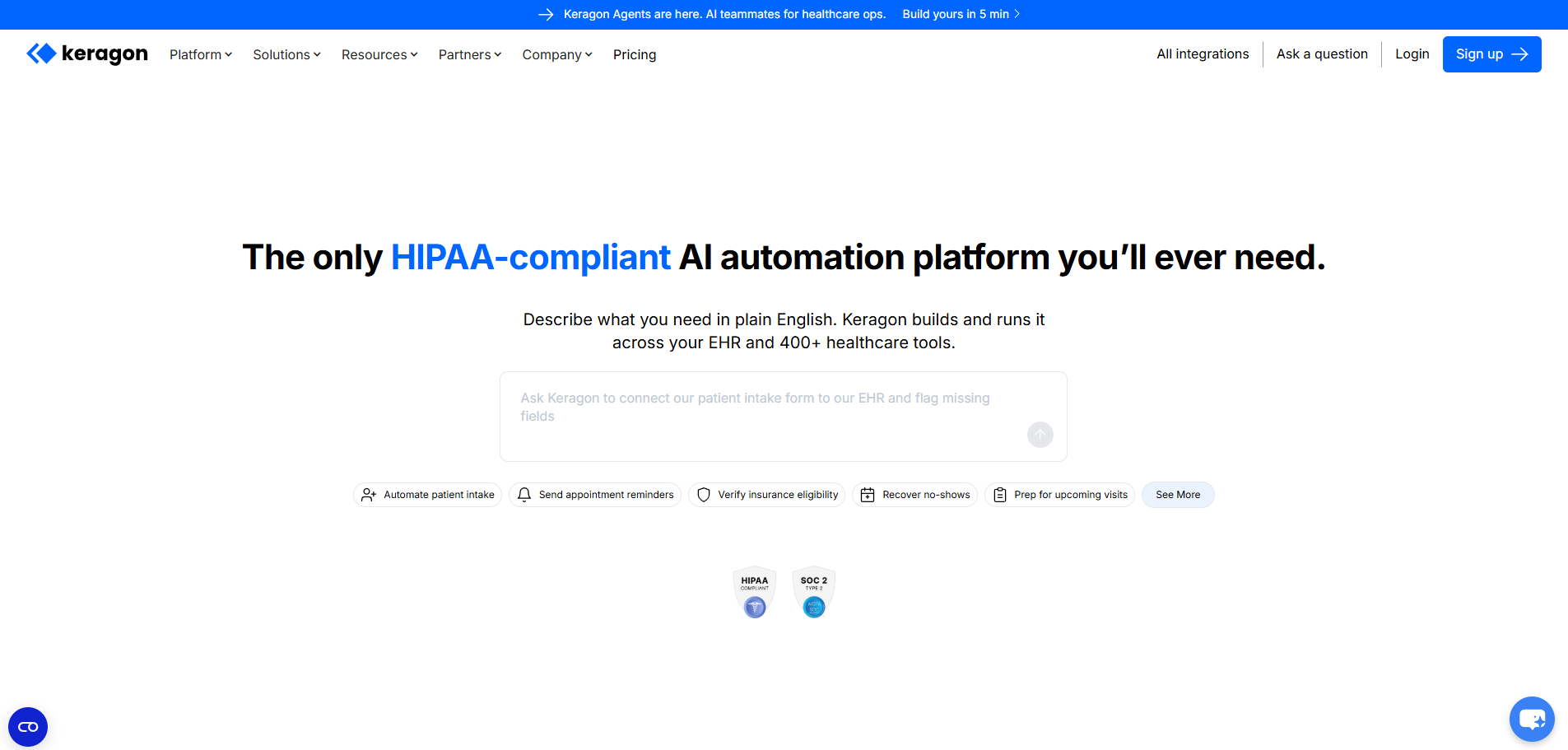
Best reminder agent for practices that want replies handled and confirmations posted to the scheduler they already run.
Overview
Keragon gives healthcare teams two things on one HIPAA-compliant platform: Workflows, for processes where every step is fixed, and Agents, for work where the right next step depends on what came back.
Reminders sit in the second category more than most people assume. The schedule changes daily, patients reply in their own words, and a same-day cancellation should trigger a waitlist offer, not a form letter.
Keragon's Appointment Reminder Agent is briefed in plain English, connected to your scheduler and messaging tools, and handles that variability inside guardrails you set.
It’s not a scheduler or a phone system. It works on top of the ones you have.
Front-office pains Keragon agents solve
Reminders fail in predictable ways. The agent is built around three of them.
1. The reply nobody answers
The reminder went out on time. The patient wrote back asking to move to Friday. By the time staff saw it, Friday was gone and so was the patient.
The agent reads the reply the moment it arrives, offers real alternatives, books the new time, and confirms it, without anyone opening an inbox.
Keragon's own med spa page cites a Zenoti benchmark that 37% of first rebookings get canceled; the return visit is the one practices lose most often, and it’s the one a reminder agent should be fighting for.
2. The cadence set once and never touched
Most reminder tools send the same two messages to everyone at the same intervals.
The agent follows the cadence you set per appointment type, adds pre-care or consent reminders where the visit needs them, respects quiet hours and opt-outs, and stops when the patient has confirmed.
For a dental office that extends to hygiene recall, it means working one patient at a time on your interval; for a med spa, it means locking in the first return visit after a treatment and keeping a package on cadence.
3. The confirmation that never reaches the desk
A reply captured in a separate dashboard is a reply the front desk doesn't see when they build tomorrow's day sheet.
The agent writes confirmation status, reschedules, and cancellations back to the scheduler or EHR you name, so the schedule the team looks at is the truth. Every write is logged.
What stays with your team
The agent sends, reads, and books. It doesn’t decide what’s urgent, answer clinical questions, or send anything outside your approved answers and quiet hours.
Emergency language you define triggers an immediate handoff with context. Reminder and recall outreach runs only on the lists and consent rules you approve, and promotional messages are never mixed into clinical ones.
That holds for cosmetic and cash-pay practices too; a reminder that names a patient and a visit is PHI regardless of who pays.
Put the Appointment Reminder Agent on tomorrow's schedule during a 14-day free trial, or see a sample agent run before you connect anything.
Key capabilities
- Pulls tomorrow's appointments from the scheduler or EHR you run, whether that is Athenahealth, DrChrono, Healthie, IntakeQ/PracticeQ, Tebra (Kareo), eClinicalWorks, AdvancedMD, Elation, ModMed, Nextech, Open Dental, Planet DDS, Calendly or Acuity Scheduling, and posts every reply back to it
- Sends personal reminders by text and email through Twilio, SimpleTexting, SlickText, Paubox Text, Spruce Health, Weave or Emitrr, and by voice through a connected voice AI such as Retell AI, Thoughtly or Bland
- Processes confirm, reschedule, and cancel replies against live availability; a cancellation can start a same-day rebooking conversation and offer the slot to the waitlist
- Sends intake, consent, and pre-care reminders before the visit, and works recall and reactivation lists at the cadence you set, with opt-outs honored and quiet hours enforced
- Approval checkpoints where you want them, tools scoped to exactly what the agent may touch, dry runs on real appointments, and an audit trail covering each message and each reply
- 500+ integrations, a universal HTTP connector, and Keragon MCP so your own AI client can act on the same tools under your BAA
Best for
Any practice or group, from a solo provider to a DSO or MSO, that already owns a scheduler and a texting tool and wants replies handled and confirmations posted without buying a new platform.
Digital health companies embedding reminders in their own product fit too.
A health system looking for one vendor to own all patient communications should look at Artera or Luma instead.
Watch for
Voice reminders run through a connected voice AI, so a BAA with that provider is needed alongside Keragon's.
The agent adapts wording from run to run, which is the point, but it means you approve templates and review the audit log rather than signing off every message.
The agent roster is live and growing; confirm the Appointment Reminder Agent matches your cadence rules during the trial.
Pricing
Four tiers:
- Starter: $99 a month on an annual plan or $149 month-to-month, 200 workflow runs, 5,000 AI credits, three live agents or workflows, standard BAA.
- Professional: $269 annual or $399 monthly, 2,000 runs, 15,000 credits, 15 live agents or workflows.
- Scale Up: $995 annual or $1,499 monthly, 20,000 runs, 60,000 credits, 100 live agents or workflows.
- Enterprise: quoted, adding SSO, role-based access, and always-on audit logs. Unlimited users throughout, and the 14-day trial ships with AI credits and no card required.
Pre-built templates. HIPAA compliant. No developers needed.Start your free trial today.
2. Artera
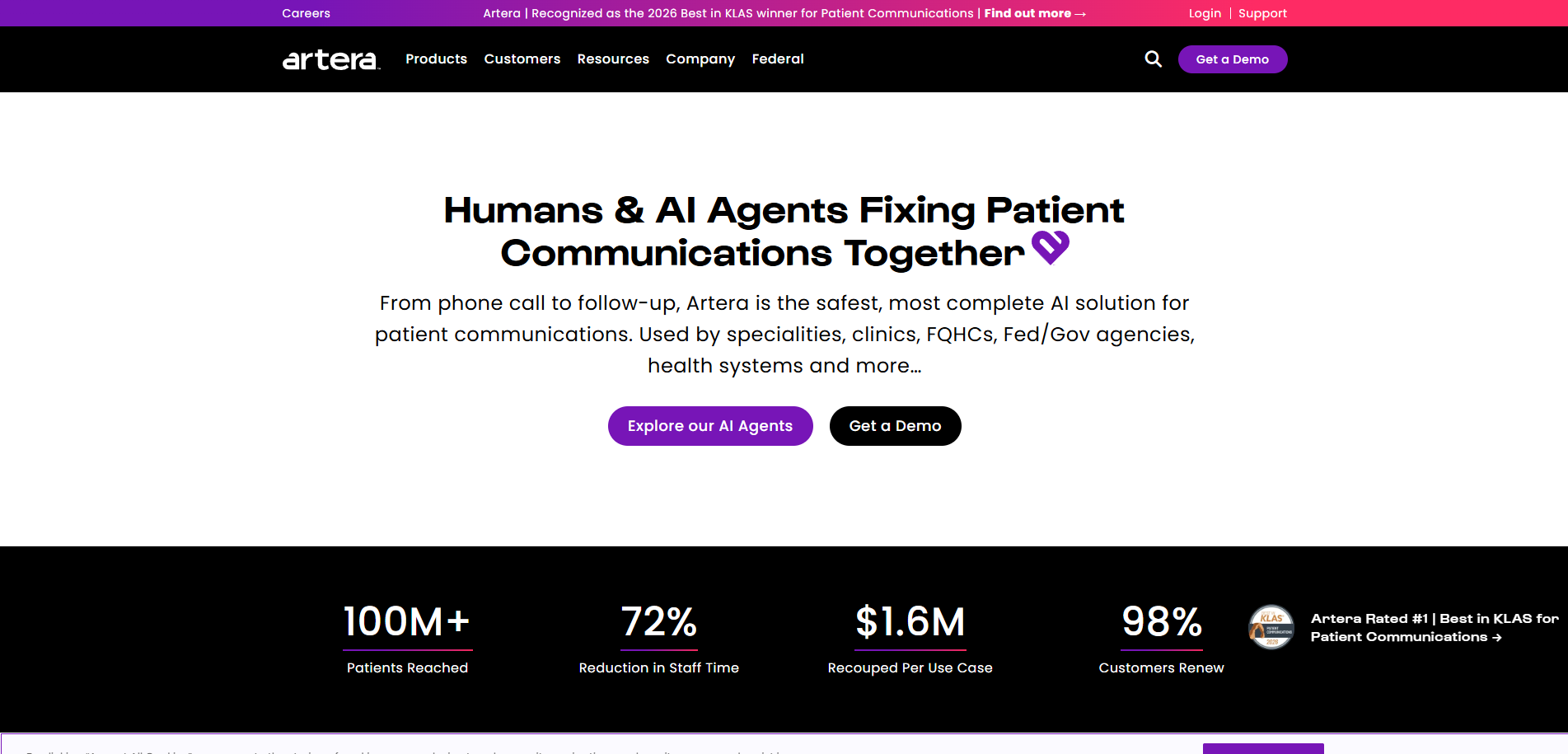
Best patient communications platform for health systems that want reminders, outreach, and AI agents from one vendor.
Overview
Artera is a patient communications platform used by more than 1,000 provider organizations, including specialty groups, FQHCs, large integrated delivery networks and federal agencies.
It was named Best in KLAS for patient communications in 2026 and reports more than two billion communications a year.
Its virtual agents, voice and text, handle self-scheduling, intake, forms, and billing on top of the reminder and outreach engine, and the company describes a staged approach where a health system can start with one agent and expand.
Artera raised a $65 million Series D in December 2025, taking total funding to about $111 million.
Key capabilities
- Automated reminders, confirmations and recalls across text, voice, email and web, with two-way messaging in a shared staff inbox
- Voice and text AI agents for scheduling, intake, forms and billing that can augment staff or run autonomously
- Native integrations with Epic, Oracle Health, MEDITECH Expanse, NextGen, athenaOne, eClinicalWorks, AdvancedMD, ModMed and Veradigm
- SOC 2 Type II, HITRUST, HIPAA and FedRAMP Class D certification
- Artera reports a 72% reduction in staff time and a 98% customer renewal rate; Capterra shows 4.9 across 25 reviews
Best for
Health systems, FQHCs, multi-specialty groups and federal health agencies that want one vendor for reminders, outreach and patient-facing AI, and have the implementation capacity to match.
Watch for
Enterprise sizing. Review sites list a starting price around $15,000 a year, and at least one reviewer reports glitches in automated messages that confused patients.
Independent practices are outside the target.
Pricing
Reported from $15,000 per year on Capterra and GetApp.
3. Luma Health
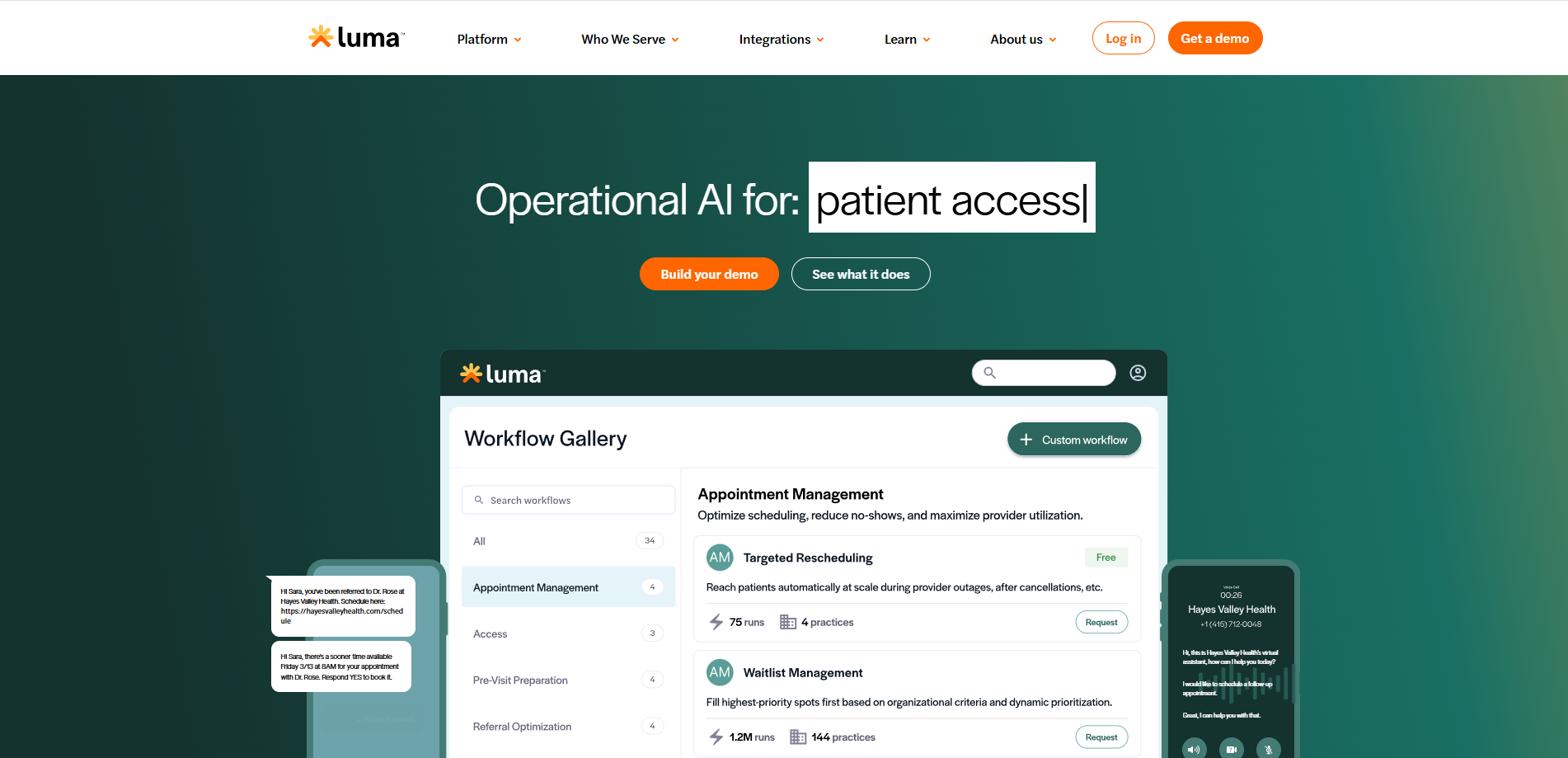
Best for large groups and health systems that want reminders as one piece of a patient access platform with AI on top.
Overview
Luma Health began as a patient engagement platform and has spent a decade on bi-directional EHR integration.
Reminders, confirmations, waitlists, and recall are core to it, and patients can confirm, reschedule, or join a waitlist by text.
Its Spark AI core adds a voice concierge, Navigator, and fax automation, all built on the same EHR context.
Reviewers consistently credit the reminders and messaging with lower no-shows and reduced call volume.
Key capabilities
- Text, email, and voice reminders with reply handling for confirm, reschedule, and waitlist
- Two-way connections into Epic, Oracle Health, MEDITECH, eClinicalWorks, athenahealth, NextGen, and Greenway, with reviewers counting more than 80 EHR and PM systems in total
- Spark-powered Navigator, a voice concierge for inbound calls, running on zero-retention generative AI
- Referral management that prompts referred patients to self-schedule
- G2 4.8 across 83 reviews; Capterra 4.6 across 82; BAA text published on Luma's site
Best for
Large medical groups, FQHCs and health systems that would rather buy reminders inside a full access platform than bolt on a point tool.
Watch for
Quote-based pricing with integration fees, and reviewers flag reminder cadences that can feel aggressive to patients, plus occasional sync lag.
It’s a platform purchase, not a reminder add-on.
Pricing
Custom subscription sized to providers, volume, locations, and integration scope. Not published.
4. Weave
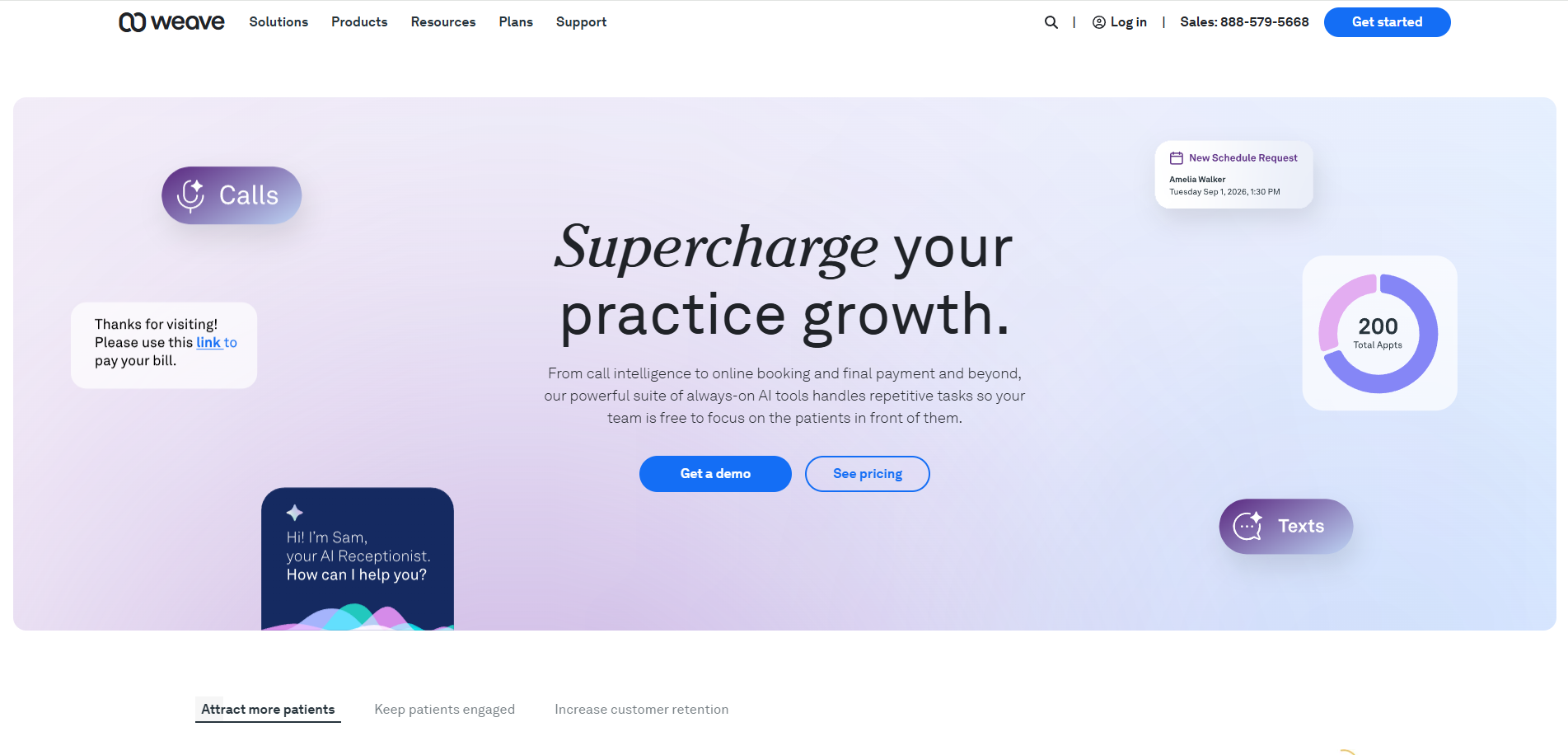
Best all-in-one phone and reminder platform for dental, optometry, veterinary and small medical practices.
Overview
Weave replaces the practice phone system with VoIP that talks to the practice management system, so when a patient calls, the front desk sees who they are, their next appointment, and any balance before picking up.
Around that, it adds two-way texting, automated reminders and confirmations, online scheduling, review requests, digital forms, and text-to-pay.
Newer features include Call Intelligence and, for dental, insurance verification and practice analytics.
Capterra rates it 4.3 across 669 reviews with 85% positive sentiment and places it on 2026 shortlists for appointment scheduling and dental.
Key capabilities
- Automated reminders and confirmations customized by appointment type, plus recall outreach
- Two-way texting, missed-call texting, and a unified inbox for calls, texts, emails, and voicemails
- Caller ID that pulls the patient profile from the practice management system, with syncs for dental, optometry, and veterinary systems
- Online scheduling, digital forms, text-to-pay, and review management in the same platform
- HIPAA-compliant, and one of the messaging channels a Keragon agent can send through
Best for
Single and multi-location dental, optometry, veterinary, and med spa practices that want phones and patient communication from one vendor.
Watch for
Recurring complaints in reviews about phone reliability and slow support after onboarding, and contract friction when practices try to leave.
Reminders are template-driven; there’s no agent reading free-text replies and rebooking.
Pricing
Pricing is by quote; Software Advice lists plans starting at $199 per month.
5. NexHealth
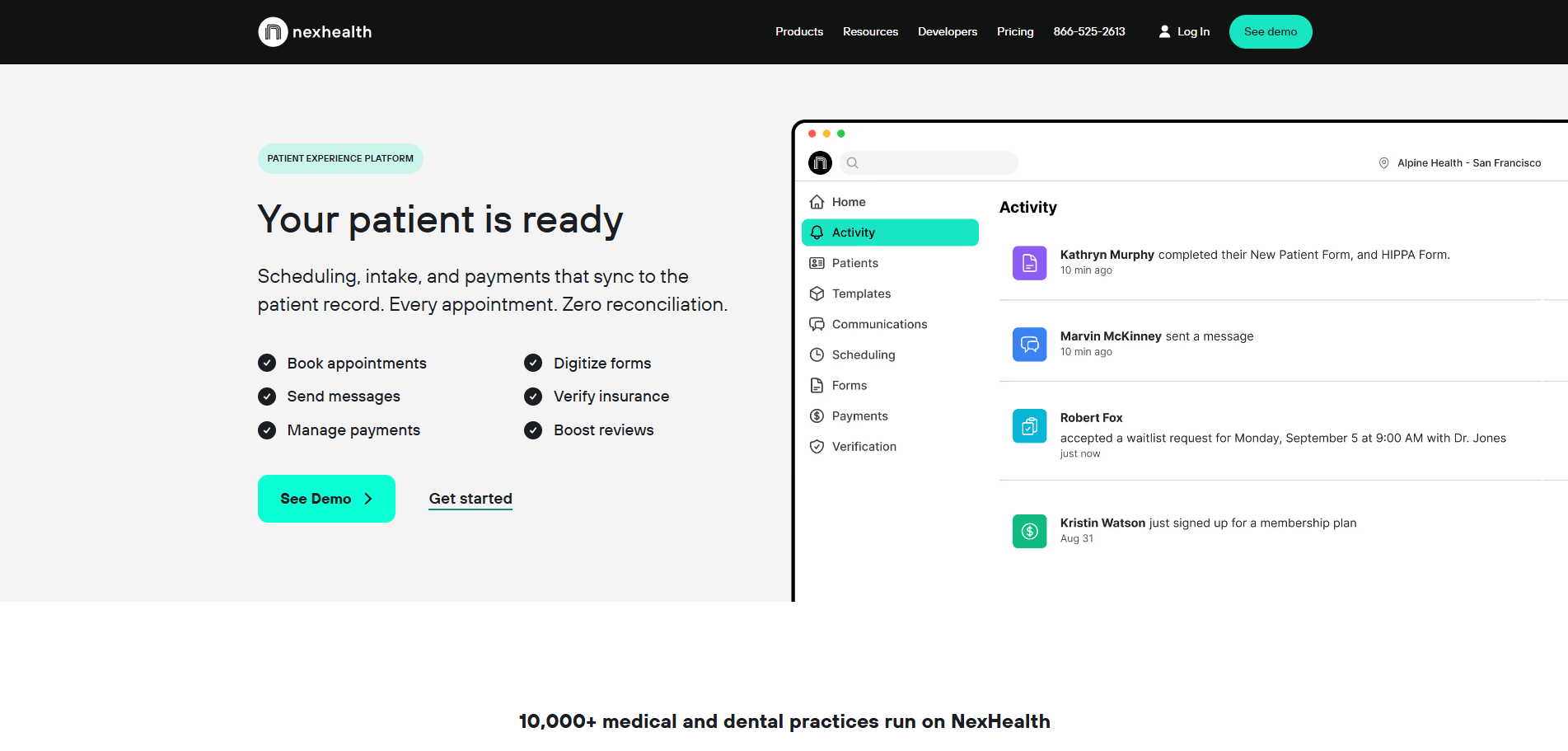
Best PMS-synced reminders for dental offices that also want online booking and digital forms from the same vendor.
Overview
NexHealth is built around a real-time Synchronizer that connects its patient-facing tools to the practice management system.
Reminders and confirmations go out by text and email, patients book online and complete forms before the visit, and everything writes to the PMS without re-keying. It also handles two-way messaging, payments, insurance checks, and review requests.
On Capterra, it holds 4.8 from 31 reviews, 94% of them positive; the company puts the time saved at about 30 hours a month per practice.
Key capabilities
- Text and email reminders with confirmation tracking synced to the PMS
- Online booking that lands in the PMS schedule as it happens
- Digital forms written to the patient record, two-way messaging, payments, and review requests
- Synchronizer support for Dentrix, Open Dental, Eaglesoft, athenahealth, DrChrono and others
- Standard BAA included in every customer contract; audited annually for HIPAA and SOC 2
Best for
Dental offices and small medical practices that want reminders, booking, and forms to feel like one product sitting on their existing PMS.
Watch for
Reviewers call the workflows inflexible and report disputes over contracts and cancellations.
Reminders are automated but not conversational; a patient who replies in free text still needs a person.
No public price sheet, with starting prices reported around $350 a month.
Pricing
Reported from about $350 per month with multi-month terms; no published pricing.
6. Klara
Best messaging-first reminders for specialty practices on ModMed, athenaOne, AdvancedMD, or Nextech.
Overview
Klara, owned by Modernizing Medicine, turns phone volume into messaging. Reminders, no-show engagement, digital intake, and post-visit follow-ups run as automated conversations, and staff work replies from a shared inbox with assignment, internal notes, and AI-powered routing.
It adds telemedicine with virtual waiting rooms and HIPAA-compliant document sharing.
Capterra rates it 4.6 across 211 reviews with 93% positive sentiment and lists it on the 2026 appointment scheduling shortlist.
Key capabilities
- Automated pre-visit reminders, no-show engagement, and post-visit follow-ups as two-way conversations
- Shared inbox with workflow assignment, internal notes, mentions, and AI-powered message routing
- Customizable forms with e-signature, secure document sharing, and video visits
- EHR interfaces including athenaOne, AdvancedMD, Intergy, ModMed, Nextech and Veradigm
- Reviewers cite read receipts, conversation assignment, and ease of onboarding
Best for
Dermatology, ophthalmology, orthopedics and other specialty practices whose EHR is on Klara's list and who want staff working conversations rather than a phone queue.
Watch for
Pricing isn’t published.
The EHR list is short, and the automation is conversation routing for staff rather than an agent that books the reschedule itself.
Pricing
Not published. Quote from Modernizing Medicine.
7. Emitrr
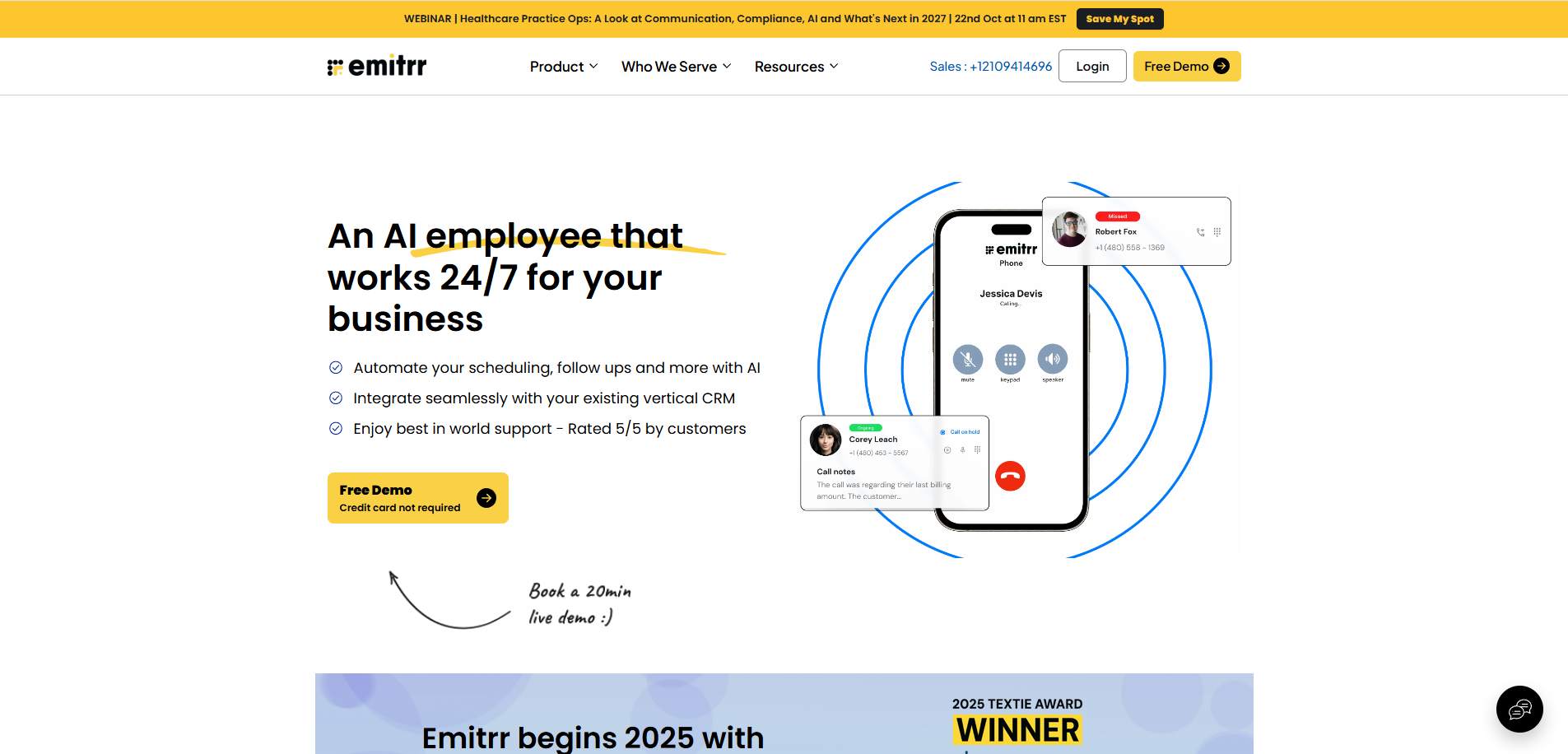
Best value for small practices that want reminders and two-way texting from the number patients already know.
Overview
Emitrr is a business texting and communication platform with a strong footing in dental and medical practices. It text-enables the practice's existing number, automates reminders, confirmations, and follow-ups, and adds a shared inbox, web chat, review requests, mass texting, and a VoIP phone option.
Capterra rates it 4.8 across 146 reviews with 99% positive sentiment, and it sits on Capterra's 2026 shortlists for HIPAA compliance, appointment reminders, conversational AI, and SMS marketing.
Key capabilities
- Automated appointment reminders, confirmations, and follow-ups by text, plus smart scheduling links
- Two-way texting from the existing office number with a shared team inbox
- Review requests, web chat, online forms and mass texting for recall or campaigns
- VoIP phone system with call routing; integrations with CRMs and practice systems
- Appears on Capterra's HIPAA compliance shortlist; Keragon agents can use it as a sending channel
Best for
Solo and small practices, and multi-location dental groups, that want reminders and texting at a low entry price without replacing the phone system.
Watch for
Entry plans are credit-based, so a busy practice will move up tiers quickly.
PMS integration depth varies by system, and reply handling is a human inbox, not an agent that reschedules on its own.
Pricing
Reported from $42 per month for 500 message credits; Emitrr doesn’t publish pricing.
8. Solutionreach
Best for practices that want reminders, recall, and waitlist inside a long-established engagement suite.
Overview
Solutionreach has sold patient engagement to practices for two decades and now also serves large health systems and retail networks.
The platform bundles two-way texting, automated reminders and recall, appointment confirmation, waitlist, missed-appointment messages, surveys, newsletters, marketing campaigns and team chat.
It’s one of the few vendors here with a published starting price.
Key capabilities
- Automated reminders, recall and confirmation with customizable templates and group messaging
- Waitlist and missed-appointment messaging to backfill cancellations
- Patient surveys, referrals, newsletters and marketing campaigns
- Two-way texting with HIPAA consent handling and message flagging
- Reports and analytics across the engagement suite
Best for
Practices and groups that want a broad engagement toolkit from a mature vendor and are comfortable with a flat monthly fee.
Watch for
Reviews are the weakest in this list: Capterra shows 3.8 across 236 reviews with 21% negative sentiment, and recurring complaints about support responsiveness and unresolved technical problems. Reminders are template-based.
Pricing
From $329 per month flat rate, per Capterra. No free trial.
9. DoctorConnect
Best for practices that want a 30-year reminders vendor with a documented API for AI agents.
Overview
DoctorConnect has sent appointment reminders since 1992 from Addison, Texas, and claims more than 150 EHR and PMS integrations and a compliance record with no HIPAA violations.
Its platform covers reminders, recall, digital forms, secure messaging, surveys, and eligibility checks.
In 2026, it introduced an AI Agent Gateway that exposes those workflows to AI agents and partner systems through OAuth 2.1 and REST, so a third-party agent can drive reminders and recall through DoctorConnect's established payer and EHR connections.
Key capabilities
- Multi-channel reminders and recall by text, voice, and email
- 150+ EHR and PMS integrations built over three decades
- Digital forms, secure two-way messaging, surveys, and benefits verification
- AI Agent Gateway with OAuth 2.1 and REST for agent platforms including OpenAI and Anthropic clients
- Live Keragon integration
Best for
Practices and integration partners that value a long compliance track record and broad legacy EHR coverage, and want an API surface for agents.
Watch for
Pricing is custom and not disclosed, the interface reflects its age, and the AI layer is a gateway for other agents rather than an agent of its own.
Pricing
Custom quotes based on practice requirements; not published.
Make and Zapier for reminders
A form-to-text zap is the most common reminder automation in small practices, which is why Make and Zapier appear in AI answers to this question.
Each can read a calendar and send an SMS. Neither can carry the message lawfully once it contains a patient name and an appointment reason.
Zapier states it won’t sign a BAA and doesn’t support medical data; Make has said in its own community that it’s neither HIPAA-certified nor willing to sign customer BAAs.
Reminders are the workflow most likely to be running on one of these tools today, so it’s the first one to move. Keragon's HIPAA-compliant Zapier alternative and Make alternative comparisons cover how.
How to choose an appointment reminder agent
Reminder tools look alike on a feature grid. These questions separate them.
What happens to a free-text reply?
Ask the vendor to send a reminder to your phone, then reply "running late, can I come at 3 instead?"
If a person has to read that, you’re buying a broadcast tool. If it comes back with real times and books one, you’re buying an agent.
Does the confirmation reach the day sheet?
Your front desk builds tomorrow from the scheduler, not from a vendor dashboard.
Confirm that confirmed, rescheduled, and canceled statuses write back to the system they actually use, and see it happen on your own test appointment.
Who controls cadence, quiet hours, and opt-outs?
Patients complain about reminders that arrive at 6 am or keep coming after they confirmed.
Make sure the practice, not the vendor default, sets timing per appointment type, enforces quiet hours, and stops on confirmation or opt-out.
Which channels do your patients answer?
Response rates differ by patient panel: some confirm only by text, some only pick up a call, some read email.
Look at your own reply data, buy for the mix you have, and check that voice reminders come with their own BAA if a third-party voice provider is involved.
Will it work when you add a location or change EHRs?
Groups outgrow reminder tools when the second location runs a different PMS. Platforms that sit above the EHR handle that; embedded modules do not.
Ask what an EHR migration would cost you.
Can you prove it worked?
Set a baseline of no-shows per hundred booked visits and confirmation rate before you start.
Insist on a trial or a short pilot long enough to measure both, and read the audit log or message history, not the vendor summary.
How to implement an AI reminder agent
A sequence that keeps patients from noticing anything except the fact that reminders got better.
Step 1: Measure the current loop
For two weeks, log how many reminders go out, how many replies come back, how long replies wait for a response, and how many patients no-show anyway.
That’s the number the agent has to beat.
Step 2: Connect the scheduler first, then messaging
The agent needs to read appointments and write status before it sends anything.
Get the EHR or scheduler connection working in a sandbox, then add the texting tool and, if you use it, the voice provider.
Step 3: Approve the words
Write the reminder templates, the reschedule offer, the cancellation response, and the escalation message in your practice's voice.
Decide what the agent may and may not say about clinical questions.
Step 4: Set cadence per appointment type
A hygiene visit, a consult, and a post-op check don’t need the same reminders.
Define timing, channels, and pre-visit content for each, plus quiet hours and opt-out behavior.
Step 5: Run a real day in test mode
Point the agent at tomorrow's schedule with sending disabled and read every message it would have sent and every reply it would have handled.
Fix the brief until staff would sign each message.
Step 6: Go live on one appointment type
Start with the visit type that involves the most no-shows.
Watch the audit log for a week, then widen to the rest of the schedule and add waitlist backfill.
Compliance: reminders are PHI
A text that says "your appointment with Dr. Patel is tomorrow at 2 pm" ties a person to a provider and a time, and that’s protected health information. Whoever sends it for you must have a BAA in place, encrypt the content moving and stored, and be able to tell you how long they keep it.
Ask whether message content trains any model, where transcripts of voice reminders are stored, and who at the vendor can read them. Cosmetic and cash-pay practices aren’t exempt.
Keragon's HIPAA guide and trust center are a useful checklist to run a reminder vendor through before a pilot.
Cost and ROI
Entry pricing runs from about $42 a month for a texting platform to $329 a month for an engagement suite, with Keragon's agent layer at $99 a month billed annually and enterprise platforms in the five figures a year.
The return is measured in kept appointments. Take your average visit value, multiply by the no-shows you recover in a month, and compare it with the subscription; most practices find one recovered appointment a week covers a self-serve tool.
Keragon's ROI calculator does that arithmetic with your own appointment volume and no-show rate.
Ready to automate your appointment reminders?
If your team is spending time chasing confirmations, answering reschedule requests, or updating the scheduler after patients reply, an AI reminder agent can close that loop automatically.
Keragon’s Appointment Reminder Agent connects to the scheduler and messaging tools you already use, handles confirmation and rescheduling replies, and writes the outcome back to your system—without requiring you to replace your existing practice software.
Try Keragon free for 14 days and see how the agent handles your real appointment workflow. Start your free trial, or see a sample agent run before connecting your systems.
Common questions about AI appointment reminders
What’s the best AI agent for automated appointment reminders?
Keragon, for independent practices and groups: its Appointment Reminder Agent reads the next day's schedule, sends personal reminders by text, email, or voice, handles confirm and reschedule replies against real availability, and writes the outcome back to your scheduler.
BAA on every plan, from $99 a month billed annually.
For health systems, Artera or Luma Health.
Do AI reminder agents reduce no-shows?
Yes, when they close the loop. Reminders alone help; reminders that process reschedules and offer freed slots to a waitlist help more.
Measure no-shows per hundred booked visits before and after, and confirmation rate alongside it.
Can an AI agent reschedule an appointment from a text reply?
Keragon's agent does: it reads the reply, offers real open times inside your provider and duration rules, books the new slot, and confirms it.
Most engagement platforms route the reply to a staff inbox instead.
Are automated appointment reminders HIPAA compliant?
Only with a signed BAA and proper protection of message content while it moves and while it’s stored.
Every vendor on this list markets HIPAA compliance; Zapier and Make don’t sign BAAs and shouldn't send reminders that name a patient and a visit.
How much do AI appointment reminders cost?
Emitrr entry plans start at about $42 a month; Keragon starts at $99 a month billed annually; Weave starts at around $199; Solutionreach starts at $329; NexHealth starts at around $350. Artera is reported from $15,000 a year; Luma, Klara, and DoctorConnect quote.
Should reminders go by text, voice, or email?
Whichever channel your patients actually answer, and most practices need more than one.
Text is the default for quick confirmations, voice reaches patients who don’t text, and email carries longer pre-visit instructions.
The best setup lets the practice set the channel by patient preference and appointment type.
Which appointment reminder agent should you choose?
Health systems that want one communications vendor should look at Artera or Luma.
Dental and optometry practices that want phones and reminders together should look at Weave or NexHealth.
Small practices on a tight budget can start with Emitrr.
If you run a practice or a group, already have a scheduler and a messaging tool, and want reminders sent, replies handled, and confirmations written back without adding another platform, start with Keragon.
Start Keragon’s 14-day trial or see a sample agent run on a schedule like yours.
Related Articles


Related Articles