


AI in Healthcare
10 mins
9 Best HIPAA-Compliant AI Receptionists for Dental Practices in 2026
Summary
Your Competitors Are Embracing AI – Are You Falling Behind?
A dental front desk answers the same call fifty times a day: Does the office take my insurance? Can I get in this week? Is this pain an emergency? The person answering might also be checking in a hygiene patient and running an eligibility check.
An AI receptionist earns its place by fully handling the first two questions and handing the third to a human with the right urgency, while entering every booking into the practice management system instead of writing it on a sticky note.
This guide ranks nine AI receptionists for dental offices that meet the compliance bar: a signed BAA and PHI handling a covered entity can defend.
Keragon leads for practices on Open Dental or Planet DDS that want the receptionist working beside eligibility, recall, and intake agents.
Arini, Viva AI, and Peerlogic are dental-specific voice platforms, while Weave folds a receptionist into its phone system, and the rest cover particular sizes and budgets.
TL;DR
- The two checks that sort the field: does the booking write into your PMS (Open Dental, Dentrix, Eaglesoft, Curve, Denticon), and will the vendor sign a BAA on the plan you will buy.
- Dental-specific voice platforms (Arini, Viva AI, Peerlogic, Rondah) book directly into dental systems. Generic receptionist services (Goodcall, Smith.ai) book into calendars and vary on BAAs.
- Emergency handling is the safety test: the receptionist should recognize the emergency language you define and hand off immediately, never judge urgency itself.
- Standalone dental AI receptionists typically run $200 to $800 a month for a single location; DSO contracts are quoted.
- Keragon's AI Receptionist Agent covers calls, texts, and web forms around the clock, books into Open Dental and Planet DDS, hands eligibility to a sister agent that checks pVerify or Availity before the visit, with a BAA included on all plans and pricing from $99 monthly on annual billing.
Comparison table
Scores are editorial against the criteria below. Pricing is from vendor pages or third-party comparisons as of September 2026 and moves often. BAA terms verified on vendor pages for Keragon and NexHealth; Viva AI and Rondah state BAAs in their own materials.
How we evaluated these receptionists
Dental receptionists live and die on the PMS integration and the emergency handoff. We weighted those criteria, then compliance, insurance handling, and price.
The 9 best HIPAA-compliant AI receptionists for dental practices
Here, we take a closer look at the nine best HIPAA-compliant AI receptionists for dental practices in 2026.
1. Keragon
Best AI receptionist for dental practices that want calls, texts, and forms handled and booked into the PMS, with eligibility and recall agents on the same platform.
Overview
Keragon is a HIPAA-compliant automation platform for healthcare, and its AI Receptionist Agent is tuned for the dental front desk.
It covers the three ways patients reach you: web forms and texts get an answer in seconds at any hour, an unanswered call gets a text back with a way to book, and phone calls are handled by a voice AI you connect, which the agent conducts against your real schedule so the caller can book live.
Front-office pains Keragon agents solve
Three calls that go wrong at dental front desks every day, and how the agent handles each.
1. "Do you take my insurance?" at 6 pm
The most common new-patient question arrives after hours or while the desk is checking someone in.
The agent answers from your approved plan list, captures the caller's details, and books the new-patient visit.
Before the appointment, the Insurance Verification Agent runs the eligibility check and flags anything inactive to staff, so coverage is confirmed by the time the patient sits down.
2. The "Is this an emergency?" call
A caller describes pain. The receptionist doesn’t decide how urgent it is; it recognizes the emergency language you defined, hands the call to your on-call protocol immediately with the conversation attached, and logs it.
That boundary separates an AI that helps a dental office from one that creates liability, and it follows the ADA's guidance on phoning patients in spirit: the practice, not the software, sets the rules.
3. The booking that never reaches the operatory schedule
A receptionist that writes to a shared calendar leaves a coordinator to re-key it into Open Dental.
The agent books directly into the PMS with the right provider, operatory, and appointment type, creates or matches the patient, and flags a duplicate rather than creating one. The day sheet the clinical team opens is already right.
Sample automation 1: New patient call to booked exam
Trigger: an inbound call to the practice line, answered by the connected voice AI, or a web form or text.
What the agent does: identifies the caller as new, answers the insurance question from your plan list, offers real new-patient exam slots inside your provider and operatory rules, books the one the caller picks in Open Dental, creates the patient record, and sends intake forms by text. It transfers anything clinical or urgent to staff before the agent continues.
Outcome: a new patient is on the schedule with forms out and a record created, from a call nobody at the desk had to take.
Sample automation 2: Missed call during check-in to same-week appointment
Trigger: a call goes unanswered while the desk is busy.
What the agent does: replies to the caller by text within sixty seconds, offering open times or a callback window; handles routine questions from the approved list; determines whether the caller is an existing patient or new; and records the call and the outcome in the PMS. A booking goes straight onto the schedule; a request for a person goes to staff with the thread attached.
Outcome: a caller the desk could not reach during check-in is on the schedule rather than on a competitor's.
A brief you can paste
Keragon's dental page publishes the receptionist prompt; here it’s adapted for a practice on Open Dental.
"Build an AI receptionist for my dental office. Reply to website forms and texts within seconds around the clock, and when a call goes unanswered, text the caller back with a way to book. On phone calls, work with the voice AI I have connected and read my Open Dental schedule so callers can book live."
"Only answer hours, services, and insurance questions from the list I approve. Recognize whether a caller is a new or existing patient and save their details to Open Dental. Send any emergency or clinical question to my team immediately, and never diagnose or decide how urgent something is."
What stays with your team
The agent runs the front desk, never the operatory. It doesn’t triage pain, diagnose, or decide urgency, and it presents eligibility results as information for staff rather than promises of coverage.
Records, images, and health histories count as PHI even in cash-pay dentistry, and the agent handles all of it under a BAA.
Feed last week's missed calls to the receptionist on the free trial, or see the dental agent handle a sample call before connecting anything.
Key capabilities
- Answers hours, services, and insurance questions strictly from your approved list, distinguishes new patients from existing ones, saves their details to the PMS, and sends emergencies and anything clinical to your team without attempting to judge urgency or diagnose
- Books into Open Dental, Planet DDS, and Dentalink directly, applying provider, hygienist, operatory, and appointment-length rules, and routes the request to your front desk where a system does not expose booking
- Answers insurance questions from your approved plan list and hands eligibility to the Insurance Verification Agent, which runs checks through pVerify, Availity, or Claim.MD before the visit
- Recognizes the emergency language you define and hands off to your team immediately with context; it never assesses how urgent something is
- Voice through Retell AI, Thoughtly or Bland; texting through Twilio, Weave, Emitrr, Podium or SimpleTexting; forms through Jotform, IntakeQ or Cognito Forms
- Every paid tier includes the BAA; the platform is SOC 2 Type II audited, records each call, text, and booking to an audit trail, and lets you place approval gates at any step where a person should confirm first
- Works alongside Keragon's scheduling agent for recall and no-show recovery and its intake agent for forms, so the receptionist is one piece of a full dental front office
Best for
Solo dentists through multi-location groups and DSOs on Open Dental or Planet DDS who want a receptionist as part of wider front-office automation, and who want a BAA without an enterprise contract.
Practices on Dentrix should confirm connector availability first.
Watch for
Voice runs through a connected provider, so full HIPAA coverage needs that provider's BAA as well as Keragon's.
Dentrix and Dentrix Ascend are available on request rather than live connectors, although the dental hub names Dentrix Ascend.
The agent answers only from the answers you approve, so the receptionist is as good as the brief.
Pricing
The Starter tier is $99 a month with annual billing, $149 without, and includes the BAA plus 200 runs, 5,000 AI credits, and three live agents or workflows. Professional is $269 or $399 on the same terms; Scale Up $995 or $1,499; Enterprise quoted.
No seat limits on any plan, and the trial comes with AI credits and no card required.
Pre-built templates. HIPAA compliant. No developers needed.Start your free trial today.
2. Arini
Best dental-specific standalone voice agent, with native write-back to the major dental systems.
Overview
Arini is a Y Combinator-backed AI receptionist built for dental practices.
It answers calls and text conversations, books, reschedules, and cancels, backfills cancellations, and handles block scheduling and staggered appointments, which matters for hygiene columns.
Key capabilities
- Writes directly to Open Dental, Eaglesoft, Denticon, and Curve and works with phone systems including Weave, Mango, GoTo, and Jive; publishes some of the strongest case studies in the category, including $56,000 in production captured in 30 days at a 90% answer rate
- Native PMS write-back to Open Dental, Eaglesoft, Denticon, and Curve
- Real-time booking with block scheduling and staggered appointment logic
- Cancellation backfill and multilingual support
- Voice and SMS handling on your existing phone system
- SOC 2 Type II and HIPAA per its site; Y Combinator W24
Best for
Solo and group practices that want the most dental-specific phone agent and are comfortable with a voice-first product.
Watch for
Pricing is by quote; third parties put it around $249/month.
Insurance verification isn’t stated on its site, and it’s voice and SMS only, so web forms and email need another tool.
Pricing
Custom quote; reported from about $249 a month, with industry estimates of $3,600 to $9,600 a year.
3. Viva AI
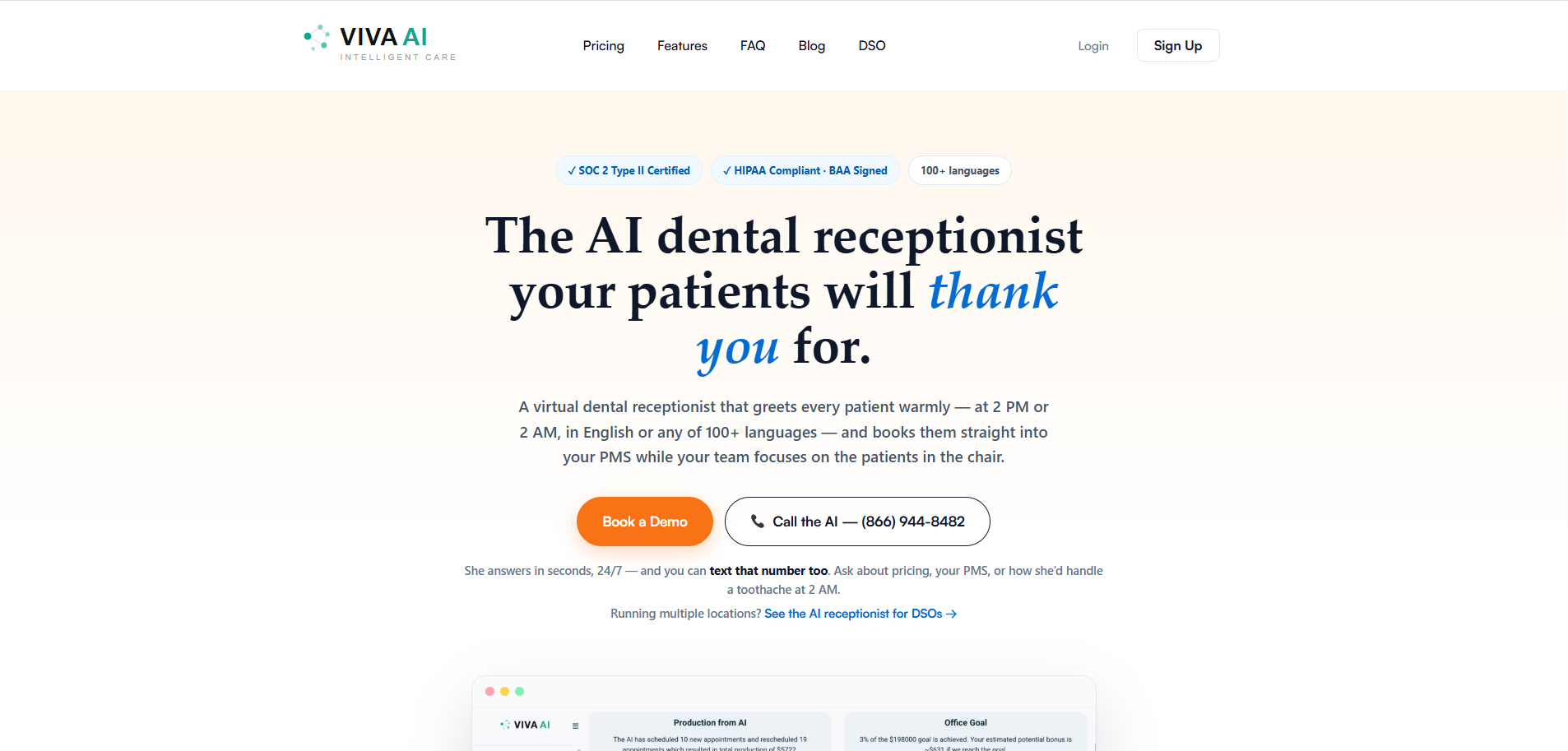
Best for DSOs that want inbound and outbound in one platform with audited compliance and 100+ languages.
Overview
Viva AI positions itself as an AI operating system for dental practices rather than a phone agent.
It answers calls, texts, email, and web chat, runs outbound recall and reactivation campaigns, speaks more than 100 languages with automatic detection, and writes back to Dentrix Ascend, CareStack, Cloud9, and other systems.
Key capabilities
- Bundles payments, digital forms, and a patient portal with a multi-location dashboard for DSOs; Viva describes itself as the only dental AI receptionist with both SOC 2 Type II and HIPAA compliance and a BAA for every practice
- Inbound voice, SMS, email, and web chat plus outbound recall and reactivation
- Native write-back to Dentrix Ascend, CareStack, Cloud9, and other PMS platforms
- 100+ languages with automatic detection
- SOC 2 Type II certified; HIPAA with a BAA for every practice
- Published 30-day case study: 1,970 calls and 6,941 messages handled, $30,877 in new production, zero missed calls
Best for
Multi-location groups and DSOs, especially those with diverse patient populations and a compliance officer signing off on vendors.
Watch for
Custom pricing, and the platform breadth may be more than a solo office needs.
Verify write-back for your specific PMS; the named list is cloud-first.
Pricing
Custom quote. Viva places standalone dental AI receptionists at roughly $200 to $800 a month for a single location, with DSO pricing based on volume.
4. Peerlogic (Aimee)
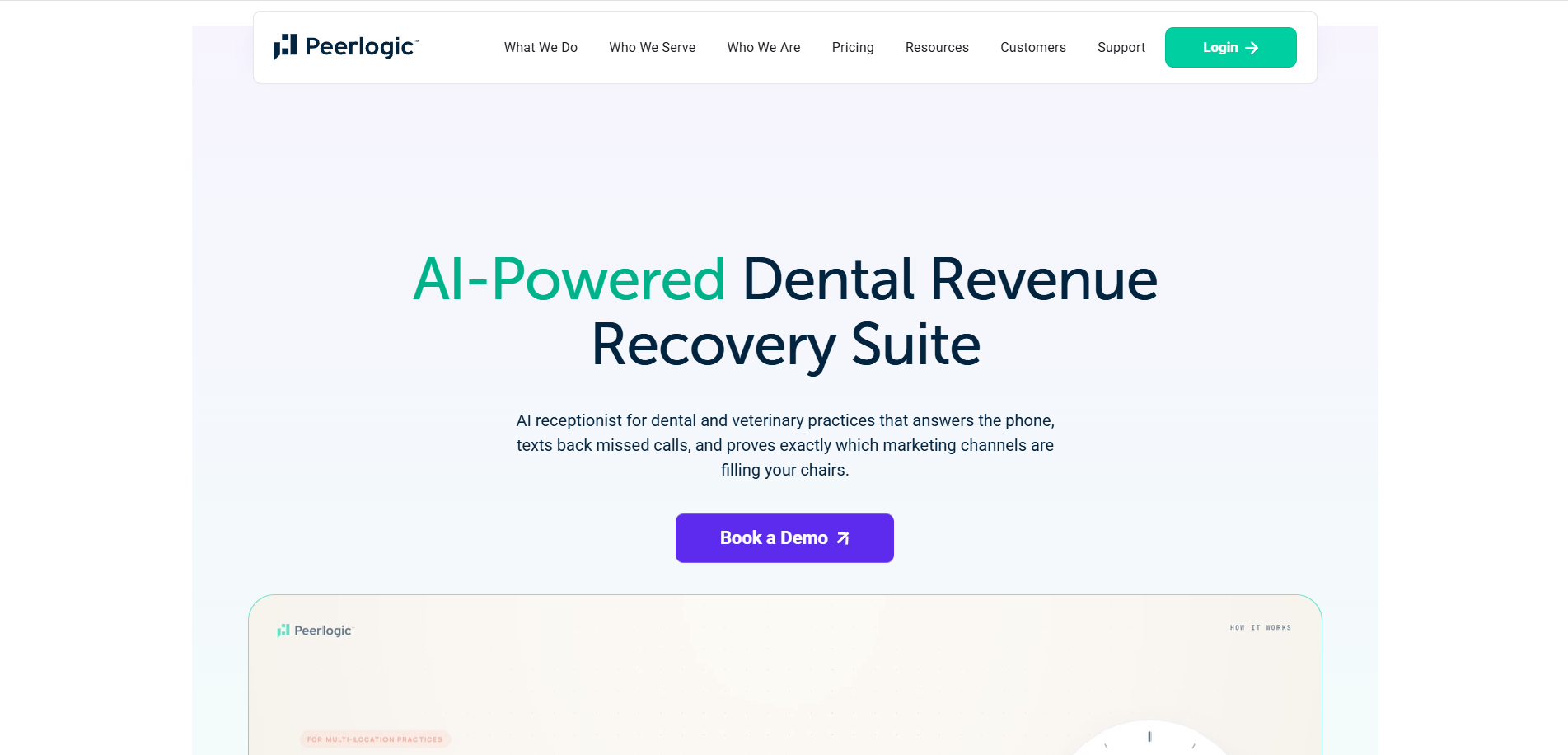
Best for groups that want call analytics and a receptionist from the same vendor.
Overview
Peerlogic began as dental call intelligence and added Aimee, an AI receptionist that answers calls, texts missed callers back, and books using the practice's real hours, FAQs, and policies.
It integrates with Dentrix, Dentrix Enterprise, Dentrix Ascend, Eaglesoft, Open Dental, Denticon, Curve, and CareStack, and reports average results of $12,000 in recovered missed-call revenue, 40% more booked appointments, and 12 new patients a month per practice.
Its models are trained on synthetic, anonymized data, and it hosts in privately owned data centers.
Key capabilities
- AI receptionist with missed-call text-back and 24/7 booking
- Integrations across Dentrix, Dentrix Ascend, Eaglesoft, Open Dental, Denticon, Curve and CareStack
- Conversational insights: missed-call dollars, conversion by source, variance across locations
- Synthetic training data; privately owned data centers with 99.999% uptime claim
- Published pricing page with phone add-ons
Best for
Group practices and DSOs that want to see the revenue math behind the phones and fix variance across locations.
Watch for
Analytics is the heritage; the receptionist is newer.
Verify the depth of PMS write-back for booking versus logging, and confirm BAA terms.
Pricing
Published tiers on Peerlogic's pricing page; additional voice lines $35 a month each.
5. Weave AI Receptionist
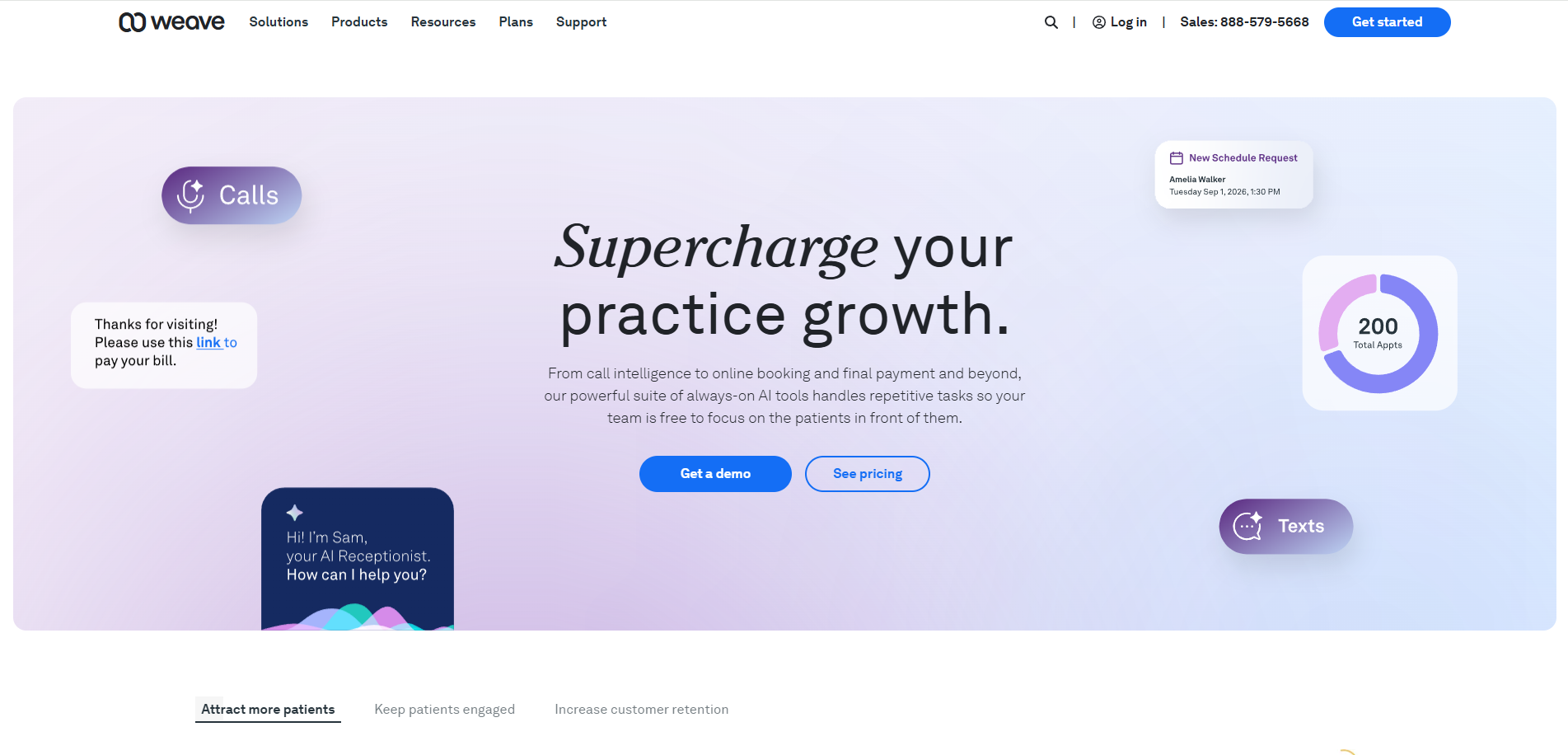
Best for offices already running Weave phones.
Overview
Weave acquired TrueLark in May 2025 and now sells its AI receptionist as part of its phone and communications platform.
The agent answers calls and replies to texts with full AI conversations, books into Dentrix and Eaglesoft, and, with Open Dental in early access, books from the Weave calendar; Weave says it meets and exceeds HIPAA standards.
For an office already on Weave phones, texting, payments, and reviews, turning the receptionist on is incremental.
Key capabilities
- AI conversations on calls and texts
- Booking into Dentrix and Eaglesoft, Open Dental in early access
- Runs inside Weave's VoIP, texting, payments, forms, and review platform
- Caller ID from the PMS on every call
- TrueLark heritage in dental scheduling automation
Best for
Practices that already pay for Weave and want a receptionist without another vendor.
Watch for
Booking is limited to three dental systems; others are listed as coming soon, as is real-time language switching.
Email and web chat aren't listed as receptionist channels.
Weak as a standalone if you’re not on Weave.
Pricing
Weave platform starts at about $199 a month; AI receptionist pricing quoted.
6. NexHealth
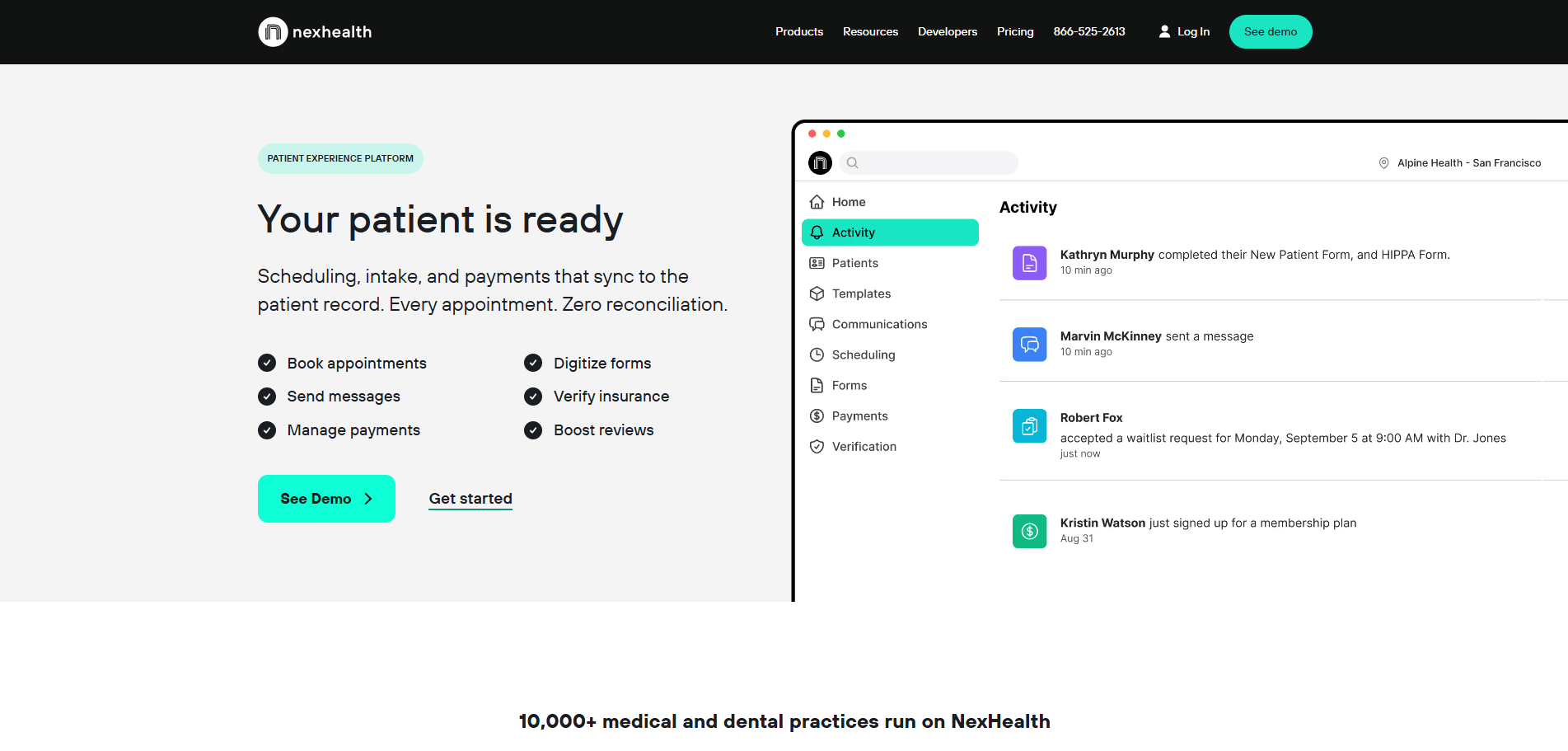
Best for practices whose patients prefer to book online, with eligibility verification built in.
Overview
NexHealth isn't a voice receptionist, but it handles the receptionist's booking work for patients who would rather not call.
Its on-premise Synchronizer keeps roughly 70 systems in sync, including Open Dental, Dentrix, Dentrix Ascend, Eaglesoft, Curve, and Denticon, so online bookings, forms, reminders, and payments land in the PMS in real time.
It verifies insurance eligibility automatically before appointments, which few receptionist tools state.
Key capabilities
- Real-time online booking into around 70 PMS and EHR systems
- Automatic eligibility verification before appointments
- Forms, reminders, texting, payments, and review collection bundled with booking
- A BAA is part of every customer agreement, with yearly HIPAA and SOC 2 audits
- Also a Keragon integration
Best for
Dental offices that want to move booking volume off the phone entirely and keep the PMS as the single source of truth.
Watch for
It doesn’t answer the phone.
Reviewers call the workflows rigid and note contract friction.
No public price sheet.
Pricing
Reported from about $350 a month.
7. Rondah AI
Best for DSOs that want a custom agent per practice and a portfolio-wide dashboard.
Overview
Rondah AI builds AI receptionists specifically for dental service organizations.
Each practice in a portfolio gets a customized agent that handles scheduling, complex call scenarios, and multiple simultaneous calls, while a single dashboard aggregates call activity, reasons for calling, and appointment conversion across locations.
Rondah raised a $1.8 million pre-seed in April 2025 and says it’s deployed across hundreds of practices with some of the largest DSOs in North America.
Key capabilities
- Custom AI receptionist per practice, scalable across a portfolio
- Handles complex booking scenarios and multiple calls at once
- Unified analytics across all locations
- HIPAA-compliant with BAAs and two-way encryption
- Multilingual support
Best for
DSOs and multi-practice groups that want front-office consistency and portfolio analytics.
Watch for
Early-stage company with a DSO focus; not aimed at a solo office.
Pricing is custom, and PMS write-back detail should be verified per system.
Pricing
Custom. Not published.
8. Goodcall
Best budget receptionist for a single dental office that wants a BAA and a flat, predictable bill.
Overview
Goodcall meters usage by the number of distinct patients who call in a month, not by minutes or call count, and it ignores robocalls and hang-ups. That model suits a small office where the same patient phones several times about one visit.
It publishes a BAA offer on its dental industry page, branches call types through no-code logic flows, and reaches scheduling tools mainly through Zapier and calendar connectors.
Key capabilities
- Billing by unique caller with no minute cap; spam and hang-ups excluded
- BAA advertised on the dental vertical page
- No-code logic flows to separate new-patient calls from rebookings
- Scheduling through Zapier and calendar tools
- Two-week trial
Best for
One-location dental offices that need compliance paperwork and a bill they can predict, without buying a platform.
Watch for
No direct dental PMS write-back, so bookings arrive in a calendar for staff to enter.
Each location is a separate agent subscription, and the entry tier retains only a week of call history.
Pricing
Starter: $79 per agent per month covering 100 unique callers; Growth: $129 covers 250; Scale: $249 covers 500.
9. Smith.ai
Best if you want a human receptionist one transfer away from the AI.
Overview
Smith.ai runs an AI receptionist and a bench of North America-based human agents under a single account, so the AI handles routine calls and passes delicate ones to a person.
Its newer free tier covers 25 AI-handled calls a month, with per-call billing above that, and its customer base skews to law firms and professional services.
Key capabilities
- Free AI tier for 25 calls a month; per-call billing above that
- Human agents on the same account for escalations
- Web chat with scheduling and lead capture
- Simulated test calls before launch
- Enterprise tier for multi-site groups
Best for
Dental offices that want to trial AI cautiously with a person always available to take over.
Watch for
Smith.ai doesn't name a BAA on any public page, which rules out PHI until one is provided in writing.
Bookings land in a calendar, not the PMS, and per-call charges add up on a busy line.
Pricing
Free for 25 calls a month, then $3 a call; Pro $150 for 75 calls; human receptionist plans from $300 a month.
What a dental AI receptionist must never do
Answering "Do you take Delta Dental?" from an approved list is fine. Deciding whether a cracked tooth can wait until Monday is not.
None of the tools above should assess urgency, interpret pain or swelling, advise on medications, quote a patient's out-of-pocket as a guarantee, or change instructions a dentist gave.
The right behavior is to recognize the emergency language your practice defines, hand off immediately with context, and treat every eligibility response as a status for staff.
Keragon's agent works that way out of the box; put the others through a scripted "my crown fell off, and it hurts" call before signing.
Choosing a dental AI receptionist: six checks
Six checks, in order.
Does it write into your PMS, with your rules?
Ask the vendor to book a test hygiene visit and show it in Open Dental or Dentrix with the right provider, operatory, and appointment length. A calendar entry or a texted link is not a booking.
Is the BAA available at your tier?
Several receptionist services reserve the BAA for custom tiers or never mention one. Insist on the signed document before the demo, and confirm it extends to call recordings and transcripts.
What happens when a caller says it hurts?
Call the demo line and describe a dental emergency. The only acceptable answer is a handoff to your protocol with context. Anything else is a liability.
How does it handle insurance questions?
It should answer from your plan list and never guarantee coverage. Better tools trigger an eligibility check before the visit, as Keragon and NexHealth do.
Which channels does it cover?
Voice is where dental offices lose most patients, but web forms and texts matter too. A voice-only agent leaves them for staff.
What does it cost at your volume?
Per-call, per-customer, per-minute, and flat plans price a 300-call month very differently. Run last month's call volume through each model before comparing headline prices.
Rolling out a dental AI receptionist in two weeks
A rollout most single offices can complete in two weeks.
Step 1: Measure the missed calls
Pull two weeks of call logs: missed calls, voicemails, after-hours attempts, and how many became appointments. That gap is the job.
Step 2: Write the approved answers and the emergency protocol
Hours, services, accepted plans, new-patient policy, what counts as an emergency, and who takes it. The agent may say these and nothing else.
Step 3: Connect the PMS before the phones
Prove the agent can read the schedule and write a booking with a dummy patient in Open Dental or Dentrix. Then connect texting and, if you use one, the voice provider.
Step 4: Rehearse on real calls
Replay last week's voicemails and texts with sending off. Read every response, especially the emergency handoffs. Adjust until the office manager would sign each one.
Step 5: Go live on missed calls and forms, then full voice
Missed-call text-back is the lowest-risk place to start. Add full call answering once staff trust the handoffs.
Step 6: Review the log every week
Which calls were booked, which were transferred and why, and which were dropped. The audit log drives the second month's improvements.
Compliance: recordings, texts, and PHI
A dental practice that bills insurance is a covered entity under HIPAA, and a receptionist vendor that hears a patient's name, complaint, and plan is a business associate.
The floor is a BAA, encryption of data moving and stored, and a retention policy for recordings and transcripts you have read. Ask whether call audio trains the vendor's models.
Texting a patient about an appointment requires prior express consent under the TCPA, and anything promotional needs written consent. About a dozen states are all-party consent states for call recording, so the greeting should say the call is recorded. Cosmetic and cash-pay dentistry is PHI too.
Keragon's HIPAA for dental offices guide and trust center walk through the vendor questions.
Ready to automate your dental front desk?
If your team is missing calls, answering the same insurance questions repeatedly, or re-entering appointments into the PMS, Keragon’s AI Receptionist Agent can handle much of that front-office work around the clock.
The agent answers forms and texts, follows up on unanswered calls, books directly into systems such as Open Dental and Planet DDS, and routes emergency or clinical questions to your team rather than attempting to assess them. It can also hand eligibility checks to Keragon’s Insurance Verification Agent before the patient arrives.
Try Keragon free for 14 days and test the receptionist with your own missed calls or patient inquiries. Start your free trial, or run a sample call through the dental agent before connecting your systems.
Final Thoughts
Nine receptionists, two tests: does the booking land in the PMS, and who signs the BAA? The dental-specific voice platforms, Arini, Viva AI, Peerlogic, and Rondah, pass the first, while compliance is uneven across the generic services.
Weave is the easy answer for Weave customers, and NexHealth takes booking off the phone entirely.
Keragon passes both and adds what the others do not: the receptionist is one agent among several, so the same platform that answers the call also runs eligibility before the visit, chases recall and sends intake forms, all writing into Open Dental or Planet DDS with a BAA on the $99 plan.
Start with missed-call text-back, measure new-patient bookings for a month, then add full voice.
Begin a Keragon trial, or run a sample call through the dental agent to see the handoff for yourself.
FAQs
What is the best HIPAA-compliant AI receptionist for a dental practice?
Keragon, for practices on Open Dental or Planet DDS that want the receptionist plus eligibility, recall, and intake agents on one platform with a BAA on every plan.
Arini is the strongest dental-specific standalone voice agent; Viva AI suits DSOs that want audited compliance and outbound recall in one system.
Can an AI receptionist book directly into Open Dental or Dentrix?
Keragon, Arini, Peerlogic, Viva AI, and Weave write into dental practice management systems; coverage differs by vendor, so confirm your specific PMS.
Goodcall and Smith.ai book into calendars.
Keragon connects to Open Dental and Planet DDS directly, with Dentrix available on request.
How should an AI receptionist handle a dental emergency call?
It should recognize the emergency language the practice defines and transfer to the on-call protocol immediately with context. It must never assess urgency, interpret pain, or advise on medication.
Test this with a scripted call before signing any vendor.
Can an AI receptionist verify dental insurance?
It can answer "Do you take my plan?" from an approved list and, on some platforms, trigger an eligibility check.
Keragon runs eligibility through pVerify, Availity, or Claim.MD before the visit; NexHealth verifies automatically before appointments.
No receptionist should guarantee coverage.
How much does an AI receptionist cost for a dental office?
Standalone dental AI receptionists typically run $200 to $800 a month for a single location, with Arini reported around $249, Goodcall from $79 per agent, NexHealth around $350, and Weave from about $199 plus the AI add-on.
Keragon starts at $99 a month billed annually. DSO contracts are quoted.
Is a dental AI receptionist HIPAA compliant?
It depends entirely on the vendor: there must be a signed BAA, plus encryption and a retention policy covering recordings, transcripts, and messages.
Keragon includes a BAA on every plan; NexHealth includes one in every contract; Viva AI and Rondah state they offer BAAs; Goodcall offers one on its dental page; Smith.ai names none publicly.


Related Articles


