AI in Healthcare
15 mins
9 Best AI Agents for Mental Health Practices in 2026
Summary
Your Competitors Are Embracing AI – Are You Falling Behind?
A therapy inquiry is time-sensitive. Someone who submits a contact form through Psychology Today on Sunday night often finds another therapist by Wednesday, leaving the group practice that responds on Thursday unaware it’s already lost a potential client.
Meanwhile, the clinician who saw six clients today still has two hours of notes to complete, an outstanding benefits verification, and a client who stopped scheduling sessions after just two visits.
AI agents for mental health practices split cleanly into those two jobs. Session tools like Upheal, Blueprint, Mentalyc, Twofold, Eleos Health, and SimplePractice's Care Aide handle notes, treatment plans, outcomes, and compliance.
Practice tools handle what happens between sessions: Keragon runs intake, eligibility, scheduling, reminders, and reactivation in the EHR a practice already uses; Sohar Health supplies behavioral-health eligibility data; and Alma supports group-practice operations.
This guide compares all nine, and most practices will end up with one from each side.
TL;DR
- Two jobs, two kinds of tool. Session AI writes the note; practice AI books the client, runs the benefits check, sends the reminder, and chases the client who stopped coming.
- For the practice side, Keragon is the only platform here that runs no-code agents on behavioral health EHRs such as Healthie, IntakeQ, Zanda, BestNotes, Alleva, and Ritten, with a BAA on the $99 plan.
- For the session side, Upheal and Blueprint lead on price (about $1 a session, both with free tiers), Eleos is the enterprise choice for community mental health, and SimplePractice's Care Aide is the easiest add-on for its own users.
- Every tool here must sign a BAA. Crisis handling is the second test: an operational agent must immediately route any mention of risk to a clinician and never answer it.
- 42 CFR Part 2 and state teletherapy rules apply alongside HIPAA for substance use and multi-state practices.
Comparison table
Scores are editorial against the criteria below. Prices were collected in October 2026 from vendor pages and review-site comparisons and will drift.
How we evaluated these tools
Mental health practices have the same front-office problems as any practice plus three of their own: a more sensitive data category, a crisis-routing requirement, and insurance work that payers make harder for behavioral health than for anything else. The criteria follow.
The 9 best AI agents for mental health practices
1. Keragon
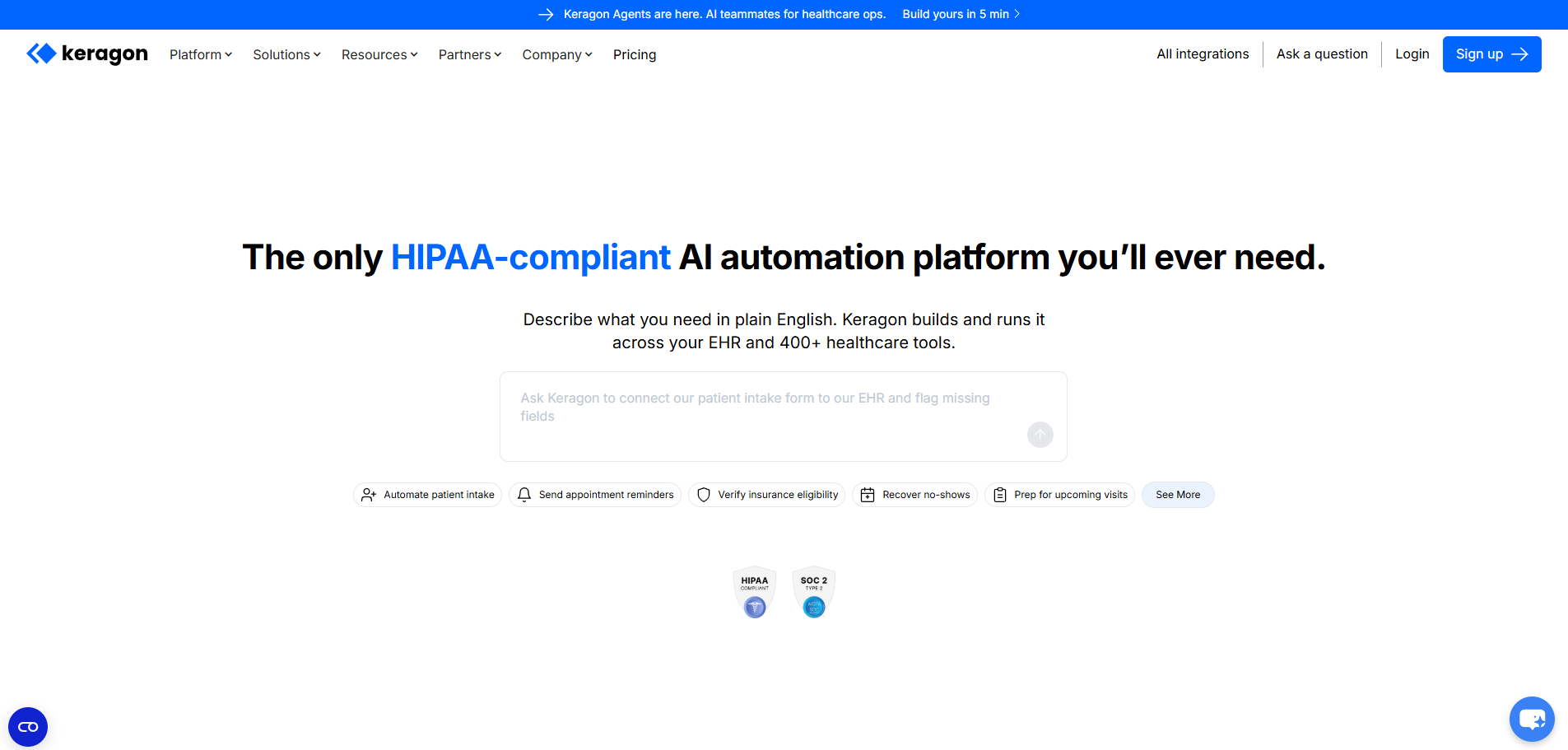
Best practice-side AI agent platform for mental health: inquiries answered, benefits verified, sessions kept and lapsed clients reached, on the EHR you already run.
Overview
For mental health, Keragon runs the work between sessions.
Its agents are briefed in plain English and connected to behavioral health EHRs including Healthie, IntakeQ and PracticeQ, Zanda Health, BestNotes, Alleva, Ritten, Rethink Behavioral Health, Netsmart and CentralReach, to eligibility sources such as Sohar Health, pVerify and Availity, and to the forms, texting and CRM tools a group practice uses.
Front-office pains Keragon agents solve
Three ways a mental health practice loses clients it already had, and how the agents stop each.
Pain 1: The Sunday-night inquiry answered on Thursday
Directory and website inquiries arrive after hours and sit in a shared inbox.
The agent replies within a minute, asks your screening questions in your words, offers consult times with a clinician who matches the request, books into the EHR, and sends the intake and consent forms.
If anything in the inquiry reads as crisis, it goes to your on-call clinician first, and the agent says nothing clinical.
Pain 2: The benefits check nobody ran before session one
Behavioral health benefits are the hardest to verify in healthcare, with session limits, carve-outs, and out-of-network deductibles that a generic 271 response doesn't show.
The Insurance Verification Agent runs the check through Sohar Health or your clearinghouse with the right specialty and place-of-service codes days before the first session, notes coverage and patient responsibility on the record, and routes anything unclear to your biller.
The client hears the number on the phone, not in the waiting room.
Pain 3: The client who stopped booking after session two
The dropout between the second and fifth session is where most practices lose revenue, and the client loses care.
The Scheduling Agent keeps the cadence the clinician set, confirms each session, recovers a missed one the same day, and after your lapse window sends a check-in from an approved list, routing any reply that mentions a concern straight to the clinician.
Sample automation 1: Directory inquiry to first session
Trigger: an inquiry arrives from your website form, a directory listing email, or a text.
What the agents do: the acquisition agent replies, screens for fit on your questions (concern, age, insurance or self-pay, telehealth or in person), and books a consult with a matching clinician in Healthie or IntakeQ.
The booking triggers the Patient Intake Agent, which sends intake, consent, and telehealth consent forms, and the Insurance Verification Agent, which runs the benefits check through Sohar Health and flags out-of-network coverage to your biller.
Any risk language in the inquiry routes to your on-call clinician before any of that happens.
Outcome: the inquiry becomes a scheduled, consented, verified first session without a coordinator touching it.
Sample automation 2: Lapsed client reactivation with clinical routing
Trigger: a weekly run against active clients with no session booked past the lapse window each clinician sets.
What the agent does: sends a check-in in the clinician's approved words on the client's preferred channel, offers real session times, books the reply, and marks clients who stay quiet for the clinician to review.
A reply that mentions distress, a crisis, or a question about treatment is routed to the clinician with the thread attached and isn’t answered.
Outcome: clients who drifted hear from the practice before they’re gone, and the clinician sees every reply that needs a human.
A brief you can paste
Adapted from Keragon's mental health page, written for a practice on Healthie:
"Create a scheduling agent for my therapy practice. Confirm every session by text, and if a client cancels or misses, start a rebooking conversation the same day."
"Each week, reach clients with no session booked in the last three weeks with my approved check-in and offer times. If any message mentions self-harm, crisis, or distress, stop and send it to my on-call clinician immediately. Never answer a clinical question."
What stays with your team
Clinical judgment, risk assessment, and treatment decisions stay with clinicians.
The agents handle scheduling, forms, benefits, and reminders under a BAA, and any reply that reads as risk is routed, never answered.
Point the acquisition agent at last month's inquiries on the free trial, or watch a sample agent take a therapy inquiry first.
Key capabilities
- A new inquiry becomes a booked consult with consents sent, a first session is preceded by a verification of benefits, a missed session starts a rebooking conversation, and a client who’s gone quiet gets a check-in from an approved list; anything that reads as risk goes to a clinician before the agent does anything else
- New Patient Acquisition Agent answers website, directory, and email inquiries within a minute, asks your screening questions, offers consult times with a matched clinician, and books into the EHR
- Insurance Verification Agent runs eligibility and verification of benefits through Sohar Health, pVerify, Availity, or Claim.MD before the first session, with behavioral health specialty and place-of-service codes, and flags out-of-network or inactive coverage to staff
- Patient Intake Agent sends intake, consent, and telehealth consent forms by text through IntakeQ, Jotform, or Cognito Forms and files them to the chart
- Appointment Reminder and Scheduling Agents confirm sessions, handle reschedules against clinician availability, recover no-shows the same day, and work a reactivation list for clients past your lapse window
- Crisis routing: language you define triggers an immediate handoff to your on-call clinician with the thread attached; the agent never responds to risk
- The BAA comes with every paid plan; SOC 2 Type II; HIPAA audit log and approval gates; Therapy Flow and Dazos CRMs, Spruce Health and Twilio messaging, Zoom and Google Calendar among 500+ integrations
Best for
Solo therapists through group practices and IOPs on Healthie, IntakeQ, Zanda, BestNotes, Alleva, or Ritten that lose clients between inquiry and first session, or between sessions, and want a BAA without an enterprise contract.
Also digital behavioral health companies building operations on their own stack.
Watch for
Keragon doesn’t write notes, score outcomes, or document sessions; pair it with a session tool from this list.
Voice runs through a connected provider with its own BAA.
Pricing
Starter runs $99 a month on an annual plan ($149 month-to-month) and includes the BAA, 200 runs, 5,000 AI credits, and three live agents or workflows; Professional is $269 or $399, Scale Up $995 or $1,499, Enterprise quoted.
Users are unlimited, and the 14-day trial ships with AI credits and no card.
Pre-built templates. HIPAA compliant. No developers needed.Start your free trial today.
2. Upheal
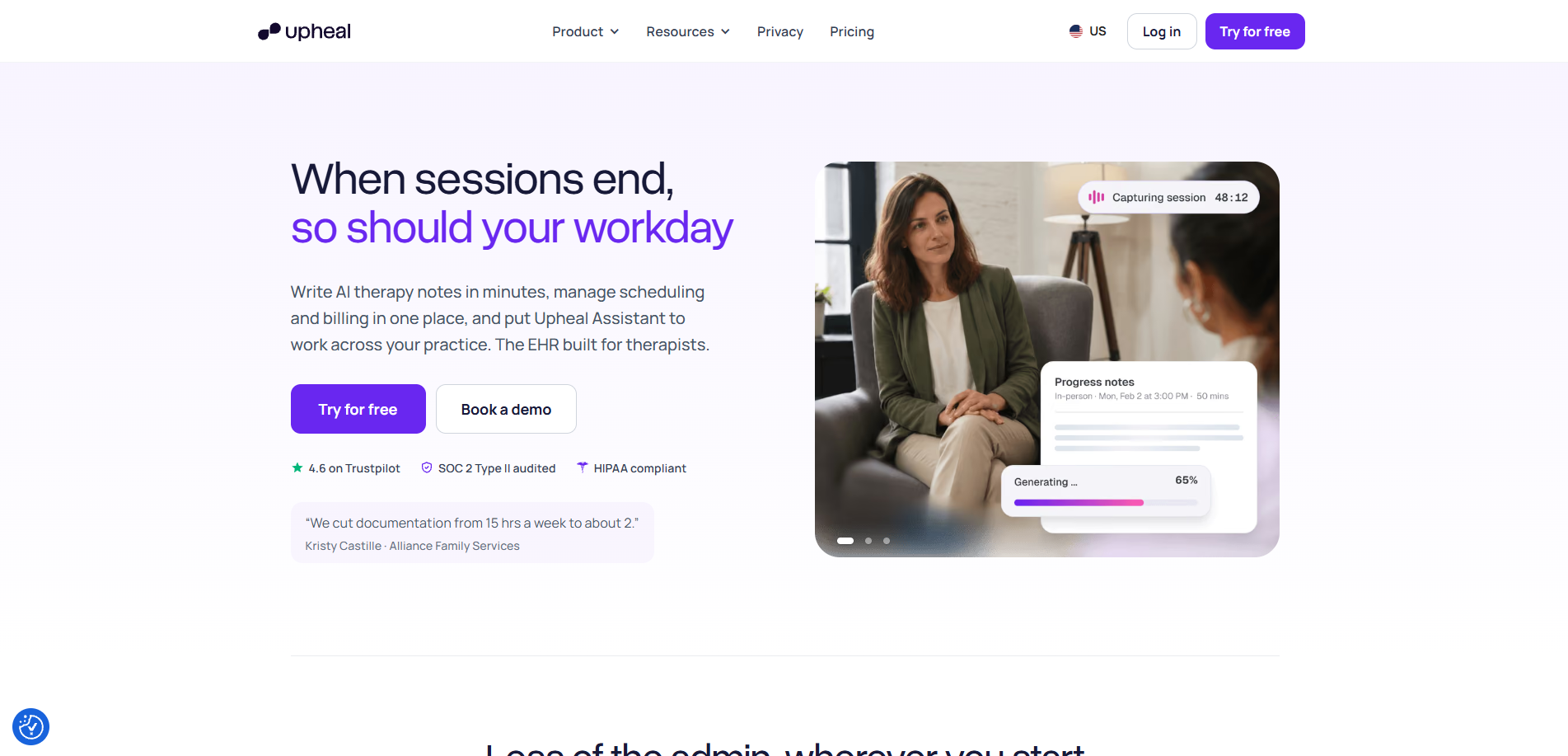
Best AI-native EHR for solo and small-group therapists, with notes, telehealth, scheduling, and an assistant at $1 a session.
Overview
Clinicians built Upheal as an AI-first practice platform: progress notes in SOAP, DAP, BIRP, and other formats; treatment plans; compliance checks; scheduling; telehealth; and payments, all from one client record, plus an Assistant that answers questions about a caseload.
Pricing is the draw.
Key capabilities
- The free plan includes unlimited basic notes and HIPAA-compliant telehealth; the individual plan is $1 per session capped at $69 a month, and $99 a month buys unlimited sessions with Assistant Pro; practices keeping their EHR can take Upheal AI Notes alongside it for $39 a month
- AI notes from recording, dictation, or written observations in multiple formats
- Treatment plans, compliance checks, and session analytics
- Scheduling, telehealth, and payments in the same platform; insurance billing at $0.30 per claim and $0.15 per eligibility check
- Assistant and Assistant Pro for caseload questions
- Free plan with unlimited basic notes; BAA; feature roadmap voted on by clinicians
Best for
Solo and small-group therapists, especially telehealth-first, who want one platform and per-session pricing.
Watch for
EHR write-back to other systems is limited; it wants to be the EHR. Group practice features are younger than SimplePractice's.
Pricing
Free; $1 per session capped at $69 a month; $99 a month unlimited with Assistant Pro; AI Notes alongside any EHR $39 a month.
3. Blueprint
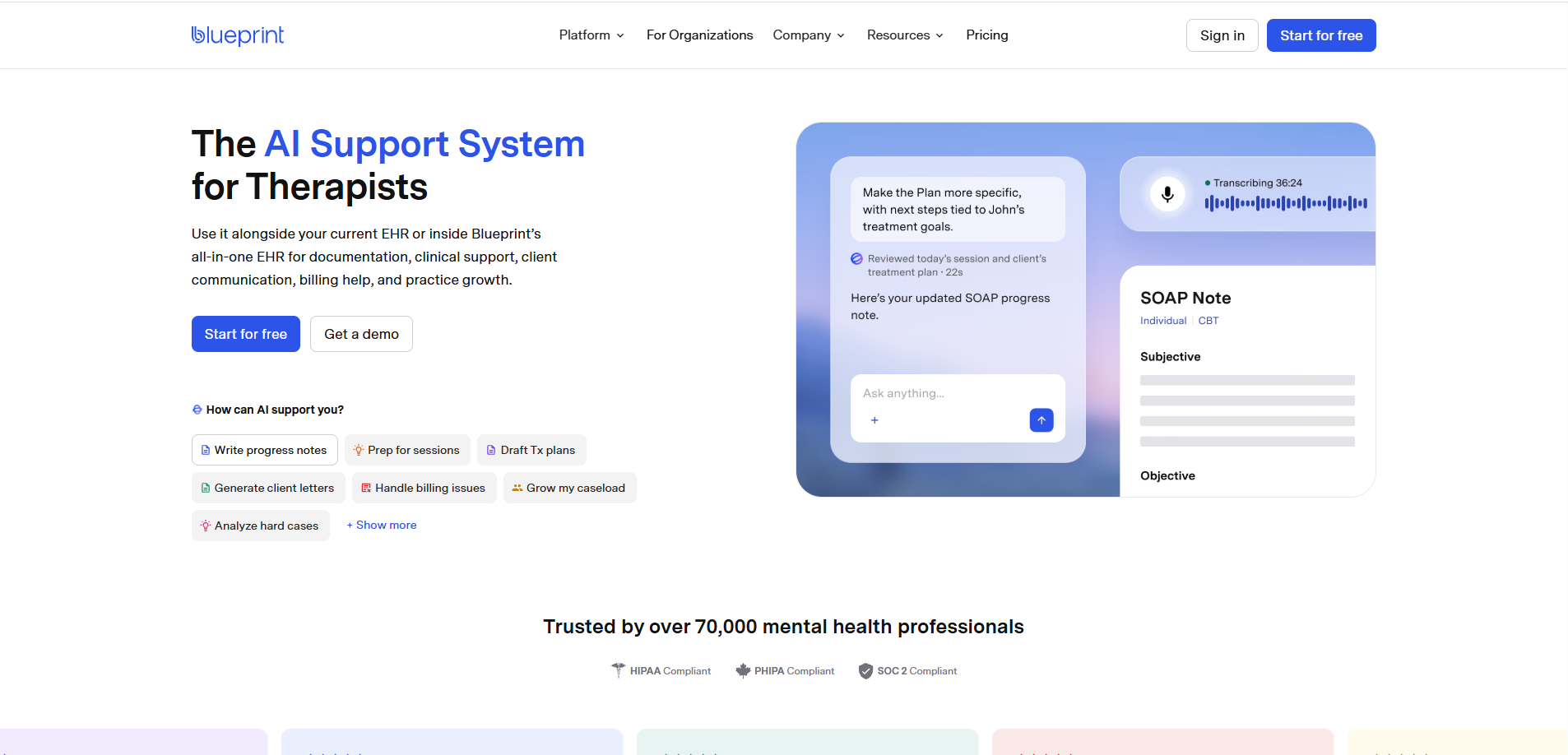
Best for practices that want measurement-based care built into the note, at per-session pricing with a free EHR.
Overview
Blueprint pairs an AI scribe with outcome measures, so the note and the PHQ-9 or GAD-7 trend sit together.
It runs alongside SimplePractice or TherapyNotes at $0.99 per session, capped at $69 per seat per month, or as a free EHR with AI at $1.49 per session, and the BAA is included on every plan.
The measurement emphasis makes it the usual pick for practices contracted with payers that require outcome data.
Key capabilities
- AI session notes in SOAP, DAP, and BIRP
- Built-in outcome measures and progress reports
- Works alongside SimplePractice and TherapyNotes, or as a free EHR
- Per-session pricing with a monthly cap
- BAA on all plans
Best for
Practices in payer networks that require measurement-based care, and supervisors running outcome-focused QA.
Watch for
The measurement focus is more than brief-therapy or cash-pay practices need.
Billing automation in the EHR version is still maturing.
Pricing
$0.99 per session alongside your EHR, $69 seat cap; $1.49 per session as the EHR; group pricing custom.
4. Eleos Health
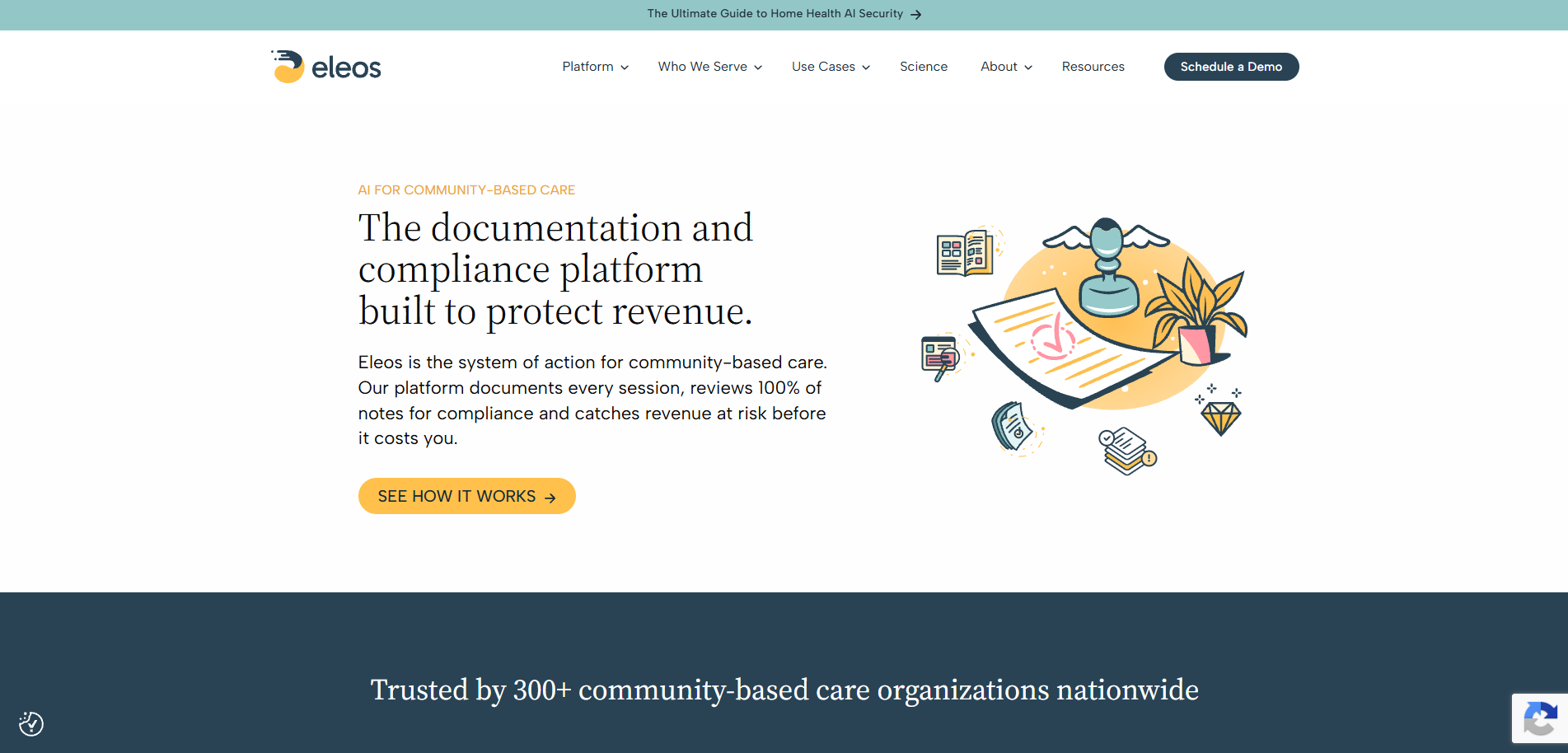
Best enterprise behavioral health AI for community mental health centers that need documentation, compliance, and supervision in one platform.
Overview
Eleos Health describes itself as a CareOps automation platform for behavioral health.
Its models are trained specifically on behavioral health sessions, and the platform goes beyond documentation to include eligibility verification, compliance review, and supervision workflows across an organization, including group therapy and substance use settings.
Capterra lists it as a FrontRunner for 2026, and Eleos claims documentation time reductions above 50%.
Key capabilities
- Behavioral-health-specific AI notes and care insights
- Eligibility verification, compliance review and supervision workflows
- Group therapy and substance use documentation
- Organization-wide analytics for clinical leaders
- Enterprise EHR integrations
Best for
Community mental health centers, large behavioral health organizations, and nonprofits with compliance and QA teams.
Watch for
Quote-only pricing and enterprise procurement. Oversized for a solo or small group practice.
Pricing
Quote. Not published.
5. SimplePractice Care Aide
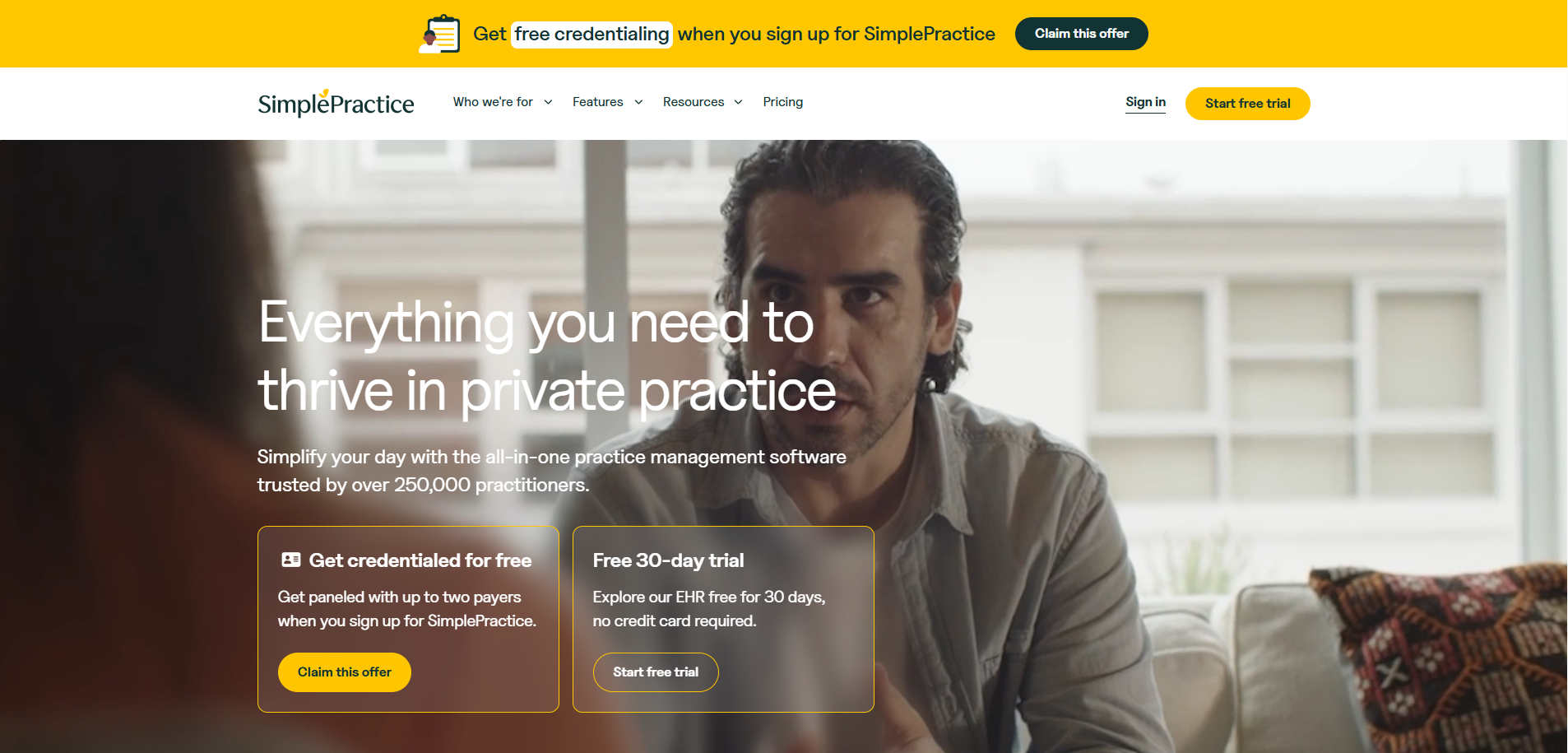
Best AI add-on for practices already on SimplePractice, with notes, intake summaries, and a treatment planner inside the EHR.
Overview
SimplePractice is the most common solo-practice EHR in mental health.
Its AI arrives as two add-ons: Note Taker at $35 a month, which records live telehealth and in-person sessions through the mobile app, and Care Aide at $59 a month, which bundles Note Taker with intake summaries, a treatment planner, and other fixed-point features.
Both sit on top of SimplePractice plans that run $49 to $99 a month.
Key capabilities
- AI session notes recorded inside SimplePractice telehealth or the mobile app
- Intake summaries and treatment planner in Care Aide
- No new vendor, login, or integration for existing users
- HIPAA-compliant telehealth included on the Essential plan
- BAA through SimplePractice
Best for
Therapists already invested in SimplePractice who want AI without adding a tool.
Watch for
Add-on pricing stacks quickly; Care Aide is priced per account owner with extra clinicians at $49 each, and the AI is a scribe with fixed features rather than an assistant you can question.
Nothing here handles inquiries, benefits, or reactivation.
Pricing
Note Taker $35 a month; Care Aide $59 a month per account owner, $49 per additional clinician; on top of SimplePractice plans from $49 a month.
6. Sohar Health
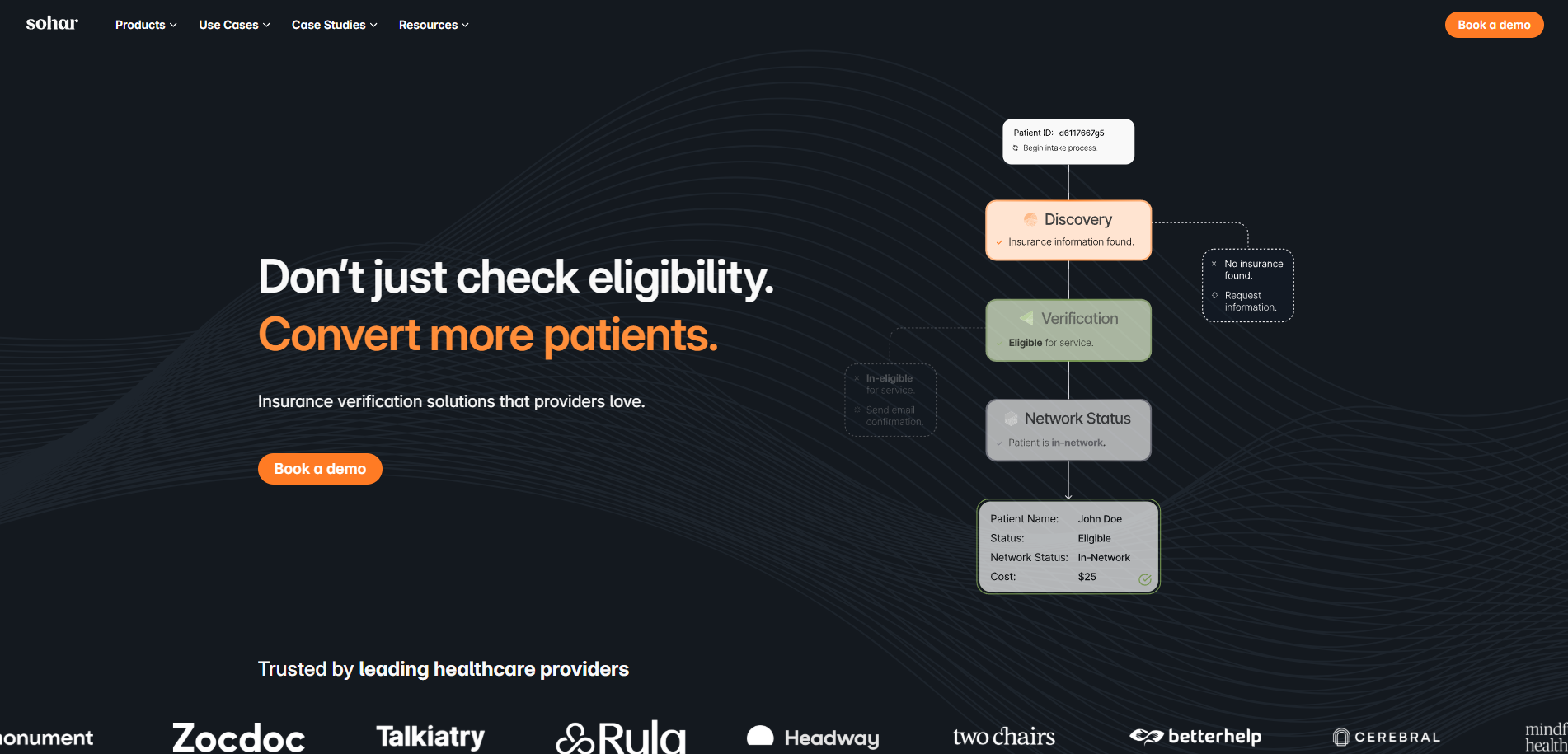
Best behavioral health eligibility and verification of benefits data for groups and digital providers with developers.
Overview
Sohar Health was built for the one part of behavioral health operations generic clearinghouses get wrong: benefits checks.
Its APIs return eligibility and verification of benefits using the specialty and place-of-service codes that behavioral health claims actually carry, plus network status, coverage discovery, and patient responsibility.
Key capabilities
- Reports a six-second median eligibility latency and roughly 96% copay and coinsurance accuracy across 200+ payers; Rula, a national behavioral health network, credits it with 30% more automation than its previous clearinghouse and about 1,000 staff hours saved each week; Y Combinator-backed
- Eligibility and VoB API with behavioral health specialty and place-of-service codes
- Coverage discovery with a reported 60% hit rate on unknown or lapsed coverage
- Network status and patient responsibility APIs
- Configurable automation logic for operations teams
- Listed on Healthie's marketplace; a live Keragon integration
Best for
Behavioral health groups, telehealth providers and digital health companies that want eligibility inside their own intake flow.
Watch for
It’s an API, not an application. A practice without developers reaches it through an orchestration layer such as Keragon.
Pricing
Custom, usage-based.
7. Mentalyc
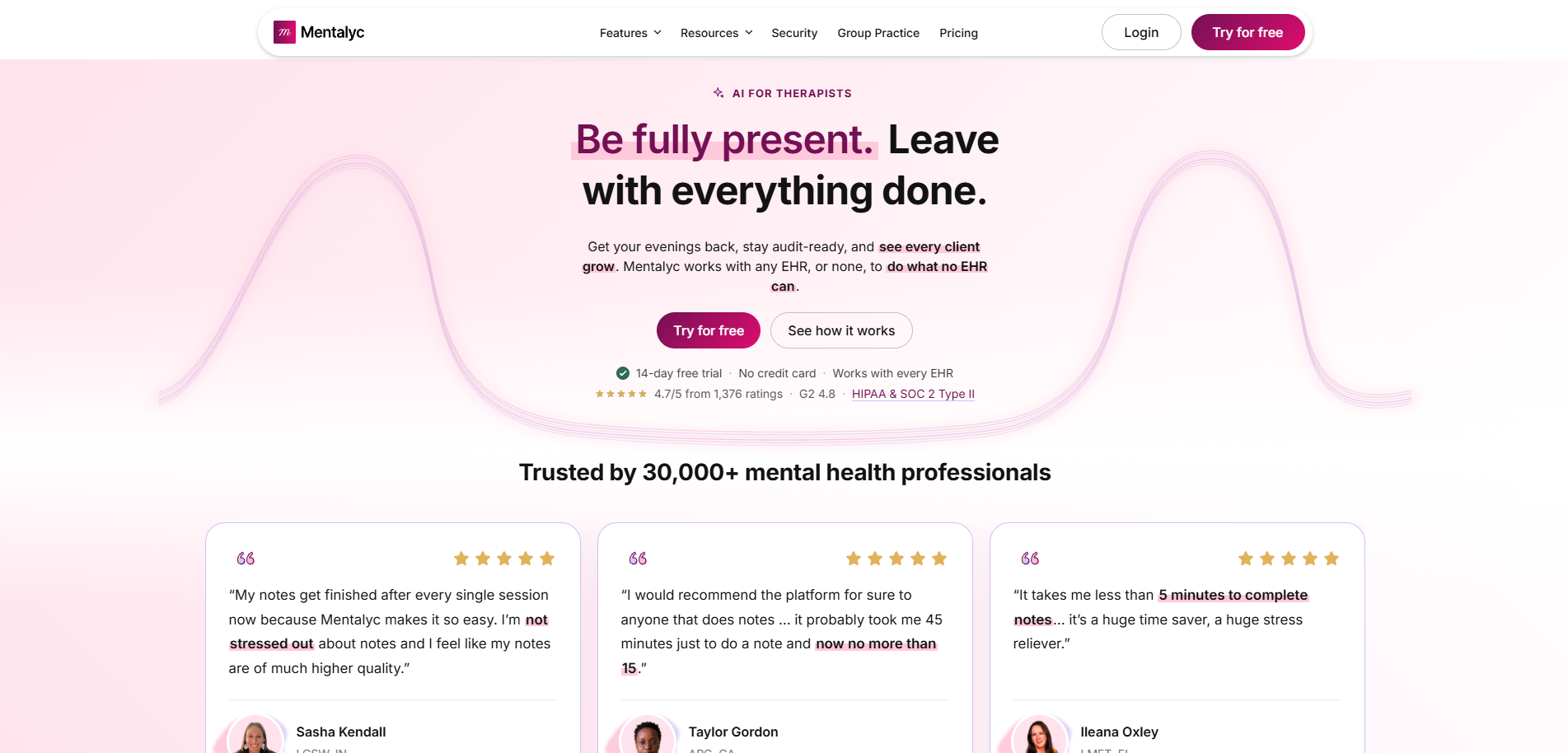
Best budget therapy-specific note writer for solo clinicians.
Overview
Mentalyc writes therapy notes from recordings, dictation, or typed summaries in mental health-ready formats, starting at $19.99 a month, and review sites most often name it the cheapest therapy-specific scribe.
It signs a BAA and outputs notes for pasting into any EHR.
Key capabilities
- Therapy-specific note formats from audio or text
- Lowest published entry price in the category
- Works with any EHR by copy and paste
- HIPAA with BAA
- Free trial
Best for
Solo clinicians on a budget who want notes done and nothing else.
Watch for
No EHR write-back, no practice management, no outcomes.
Pricing tiers rise with session volume.
Pricing
From $14.99 a month.
8. Twofold
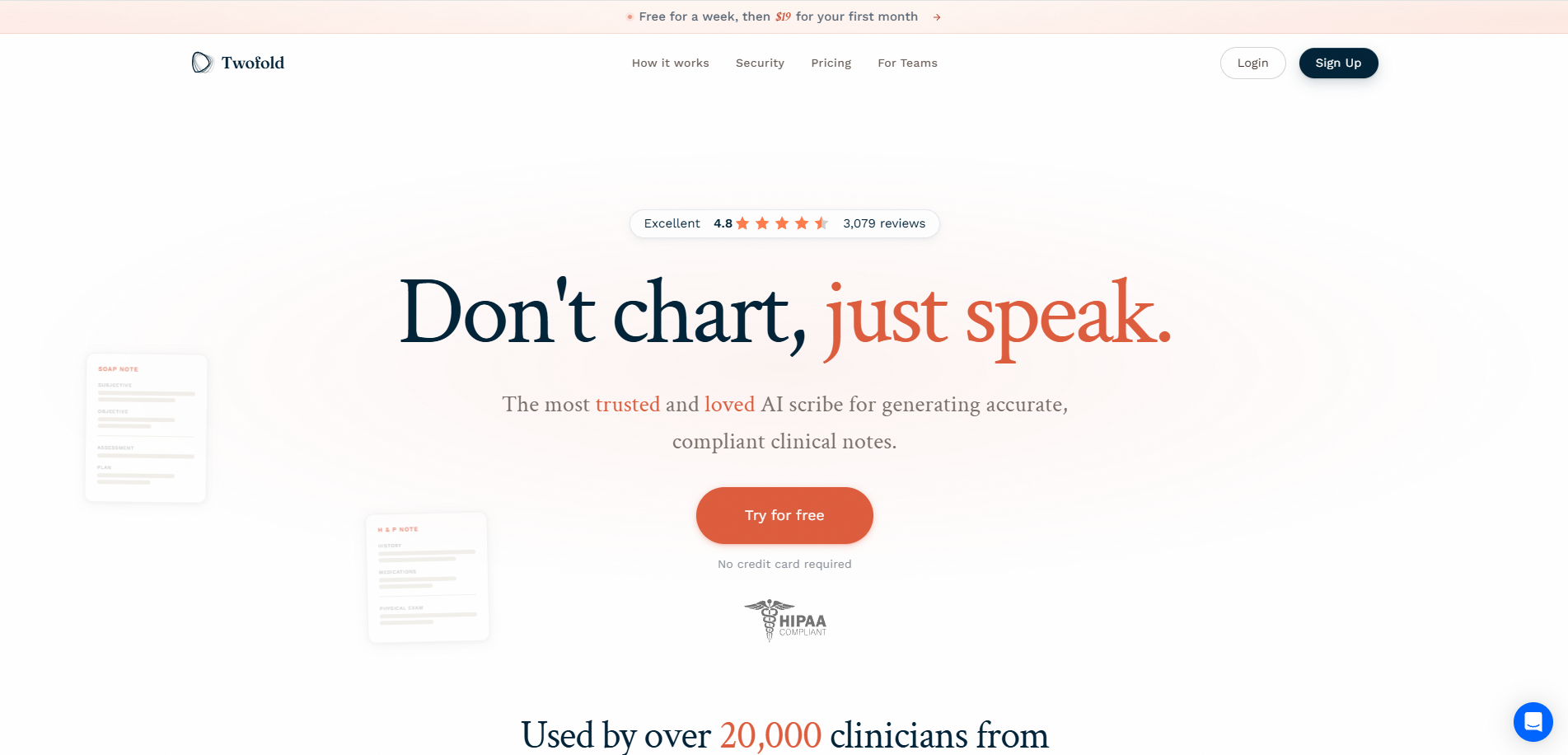
Best per-seat AI scribe for small and mid-size group practices that want an admin console and a BAA at signup.
Overview
Twofold is a therapy-specific scribe priced per seat from $49 a month, with an admin console for practice owners, standardized SOAP, DAP, BIRP, and GIRP notes across clinicians, and a BAA at signup.
It positions itself against Eleos for groups that are too small for enterprise procurement.
Key capabilities
- Therapy-specific note formats standardized across a team
- Admin console for owners and clinical directors
- Per-seat pricing with an organization BAA
- BAA at signup
- One-week free trial
Best for
Group practices of a few to a few dozen clinicians that want consistency and oversight without enterprise pricing.
Watch for
Documentation only; no scheduling, intake, or benefits.
Integration depth varies by EHR.
Pricing
From $49 a month per seat.
9. Alma
Best operations support for group practices and clinicians working in referral networks.
Overview
Alma provides practice operations for therapists, including payer credentialing, billing, client referrals through its network, and practice management support, priced per provider.
It offers a BAA and a 30-day trial, and it suits clinicians who want to take insurance without handling credentialing and claims themselves.
Key capabilities
- Payer credentialing and billing handled for the clinician
- Referral network for new clients
- Group practice management support
- BAA
- Per-provider pricing
Best for
Group practices and solo clinicians who want insurance operations handled and a referral source.
Watch for
It’s a service and network rather than an agent, and it doesn’t automate reminders, reactivation, or intake on your own EHR.
Pricing
$125 per month per provider.
What an AI agent must never do in a mental health practice
The line is sharper here than anywhere else in healthcare. An operational agent may book appointments, send reminders, send forms, and verify benefits.
It may not respond to a client who expresses distress, assess risk, answer a question about medication or treatment, or decide whether a cancellation is a clinical concern. The correct behavior in any of those is to stop and route to a clinician with the full thread, immediately.
Session tools have their own line: nothing is filed without clinician review.
Keragon's agents are built with crisis routing by default; test every other tool with a scripted message that mentions self-harm before it touches a client.
Make and Zapier in a therapy practice
A Psychology Today email to a Google Sheet to a text message is the most common automation in small therapy practices, and it’s unlawful for client data.
Neither Make nor Zapier offers a BAA, and the Zapier documentation says healthcare data is unsupported.
A client's name beside a presenting concern is PHI the moment it lands.
Keragon's Zapier and Make comparison pages map the compliant equivalent of each common flow.
How to choose AI agents for a mental health practice
Here are six checks to make, in order.
Which job is leaking?
Inquiries unanswered, notes undone, benefits unverified, clients dropping after session two.
Count each for a month. The biggest number decides whether you start on the practice side or the session side.
Will they sign a BAA at your size, and what about Part 2?
Every tool here should sign.
If you treat substance use, ask how the vendor handles 42 CFR Part 2 records and whether it trains on session data.
What happens when a client mentions risk?
Send the demo a message that says, "I don't think I can keep going."
The only acceptable response from an operational agent is to hand off to a clinician. Anything else is disqualifying.
Does it connect to your EHR?
Healthie, IntakeQ, Zanda, BestNotes, Alleva, Ritten, and the enterprise systems have live connectors on Keragon; SimplePractice and TherapyNotes are on request.
Session tools mostly paste into the EHR. Ask to see the write-back.
Can it run a behavioral health benefits check properly?
Session limits, carve-outs, and out-of-network deductibles don’t show on a generic eligibility response.
Confirm the tool uses behavioral health specialty and place-of-service codes, as Sohar Health does.
What does it cost at your caseload?
Per-session, per-seat, per-provider, and flat plans price a 300-session month very differently.
Model your own volume before comparing headlines.
How to implement AI agents in a therapy practice
Below is a sequence most group practices can finish in a month.
Step 1: Write the crisis protocol first
Which words trigger a handoff, who is on call, how they’re reached, what the agent says in the meantime. This is the brief before any other brief.
Step 2: Sign the BAA and settle data handling
BAA, no training on client data, retention policy, Part 2 handling if relevant. Nothing with client data goes into a trial until these are in writing.
Step 3: Connect the EHR and the eligibility source
Confirm in a sandbox that the agent reads clinician availability and writes a booking, then connect Sohar Health or your clearinghouse.
Step 4: Approve the words
Inquiry replies, screening questions, confirmations, check-ins. The clinician signs off every template; the agent may say these and nothing else.
Step 5: Rehearse on last month's inquiries
Replay them with sending off. Read every reply and every routing decision, especially the crisis handoffs.
Step 6: Go live on inquiries, then reminders, then reactivation
Inquiry response is the highest-value, lowest-risk start. Add reminders once staff trust the routing, and reactivation last, with the clinician approving the list.
Compliance: HIPAA, Part 2 and teletherapy
Psychotherapy records are protected health information under HIPAA, and psychotherapy notes carry extra protection; every AI vendor that touches scheduling, messages, or notes is a business associate and needs a BAA.
If the practice treats substance use disorders, 42 CFR Part 2 adds consent requirements on top.
The TCPA requires prior express consent for client texts and written consent for marketing. Teletherapy across state lines follows each state's licensure and telehealth rules, which an agent cannot resolve; it can only route.
Keragon's HIPAA-compliant software for mental health guide and trust center cover the vendor questions.
Cost and ROI
Session tools run from free (Upheal, Blueprint EHR) and $14.99 to $49 a month (Mentalyc, Twofold) to about $1 a session, with Eleos by quote.
Practice tools start at $99 a month billed annually with Keragon; Sohar Health is usage-priced, and Alma is per provider.
The return on the practice side is clients kept: inquiries converted, first sessions that happen, and clients who continue past session two. One retained client a month covers the platform.
Keragon's ROI calculator estimates it from your own session volume and no-show rate.
Final Thoughts
Nine tools, two jobs.
For the session, Upheal and Blueprint lead on price and simplicity, Mentalyc and Twofold cover solo and group budgets, Eleos serves community mental health, and Care Aide is the obvious add-on for SimplePractice users.
For the practice, the work between sessions is where clients are lost, and Keragon is the one platform that runs it: inquiries answered in a minute, benefits verified before session one, sessions kept, lapsed clients reached, every risk message routed to a clinician, on Healthie, IntakeQ, Zanda or BestNotes with a BAA on the $99 plan.
Start with the inquiry inbox; measure how many become first sessions.
Try Keragon free for 14 days, or watch a sample agent take a therapy inquiry first.
FAQs
What are the best AI agents for a mental health practice?
For the practice side, Keragon: agents that answer inquiries, verify behavioral health benefits, keep sessions on the calendar, and reach lapsed clients on Healthie, IntakeQ, Zanda, BestNotes, Alleva, or Ritten, with a BAA on every plan.
For the session side, Upheal and Blueprint at about $1 a session, Eleos for community mental health, and SimplePractice's Care Aide for its own users.
Can an AI agent respond to a client in crisis?
It must not. An operational agent should recognize crisis language and route the message to a clinician immediately with the full thread, saying nothing clinical.
Keragon's agents are built that way; test any other tool with a scripted message before it goes live.
Which AI tools integrate with SimplePractice or TherapyNotes?
Blueprint works alongside both; SimplePractice has its own Note Taker and Care Aide; Mentalyc and Twofold paste into either.
Keragon connects to Healthie, IntakeQ, Zanda, BestNotes, Alleva, and Ritten directly, with SimplePractice and TherapyNotes available on request.
Can AI verify mental health insurance benefits?
Yes, if it uses behavioral health specialty and place-of-service codes.
Sohar Health supplies that data by API; Keragon's Insurance Verification Agent runs it through Sohar, pVerify, Availity, or Claim.MD before the first session and flags out-of-network coverage to staff.
Are AI therapy note tools HIPAA compliant?
The ones here sign BAAs: Upheal, Blueprint, Mentalyc, Twofold, Eleos, and SimplePractice.
Confirm the vendor doesn’t train on session data and ask about 42 CFR Part 2 if you treat substance use.
How much does AI cost for a therapy practice?
Session tools range from free to about $1 per session, or $14.99 to $49 a month per clinician; Keragon starts at $99 a month (billed annually) for the practice side; Eleos and Sohar Health are by quote; Alma is per provider.
Related Articles


Related Articles