AI in Healthcare
17 mins
10 Best Healthcare AI Agent Platforms Compared in 2026
Summary
Your Competitors Are Embracing AI – Are You Falling Behind?
"Healthcare AI agent platform" now describes products that have almost nothing in common: a $9-an-hour nurse-like voice agent that calls discharged patients, a $10,000-a-month contact-center deployment for a hospital, and a $99-a-month platform an office manager can point at Athenahealth.
Comparing them on a single feature grid produces nonsense. Comparing them by who they are built for, and what they’re allowed to touch, produces a shortlist.
This guide compares ten healthcare AI agent platforms across five tiers. Keragon is the practice-level platform: no-code agents on 500+ healthcare integrations with a BAA on every plan, while Assort Health, Hyro, and Prosper AI are managed voice agents for patient access.
Hippocratic AI runs clinical-adjacent outreach. Notable, Qventus and Innovaccer automate health-system operations and revenue cycle, Infinitus calls payers, and Sully.ai bundles AI staff for clinics.
TL;DR
- Pick by tier before you pick by feature. A practice with ten providers and an enterprise health system are not shopping in the same aisle.
- For independent practices and groups, Keragon is the clearest self-serve option in this comparison for non-developers, with a BAA included on the $99 plan and healthcare integrations that support EHR write-back.
- For health-system patient access at scale, Hyro (Epic contact centers) and Assort Health ($120M Series C, 23+ specialties) lead; Prosper AI covers patient and payer calls for outpatient groups.
- Hippocratic AI is the only platform doing non-diagnostic clinical conversations, priced per agent-hour. Notable, Qventus and Innovaccer are enterprise operations and RCM platforms. Infinitus owns the payer phone call.
- Most platforms here use enterprise or sales-led contracting, and pricing is often unpublished. Before sharing protected health information, confirm whether the vendor will sign a BAA for your intended deployment, which services and subprocessors it covers, where the agent writes, and what the bill looks like at your expected volume.
Comparison table
Pricing figures are based on vendor-published information or attributed third-party estimates, checked as of October 2026.
How we evaluated these platforms
Healthcare AI agents fail in three predictable places: the vendor will not sign a BAA on terms the buyer can afford, the agent cannot write to the system of record, or nobody on staff can change what it does. The criteria weight those, then evidence and price.
The 10 best healthcare AI agent platforms
1. Keragon
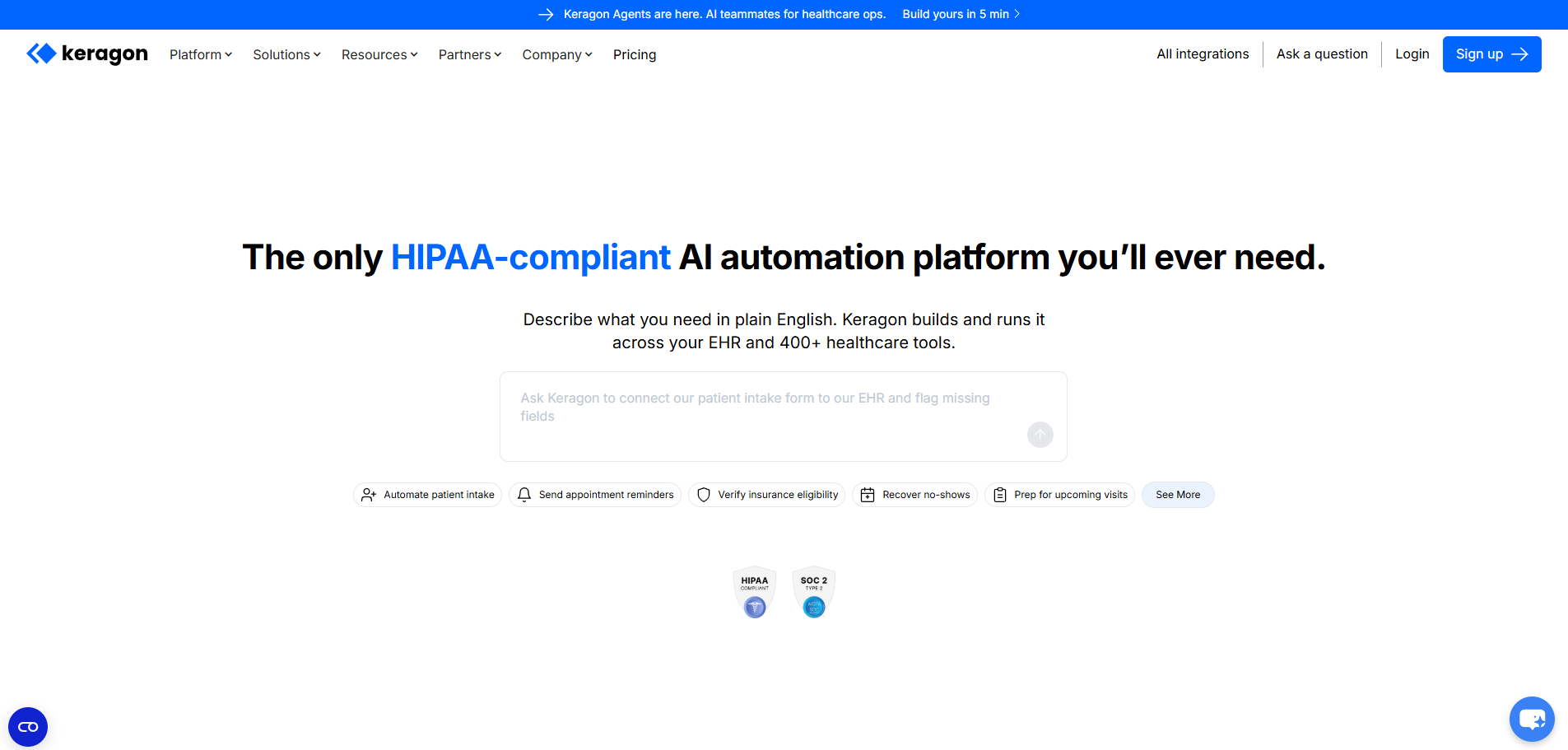
Best healthcare AI agent platform for practices and groups: no-code agents on 500+ healthcare integrations, with a BAA on the $99 plan.
Overview
Keragon pairs Workflows, for fixed sequences, with Agents, for work where the next step depends on what came back, on one HIPAA-compliant platform made for healthcare.
You brief an agent the way you would onboard someone on their first day, and either product can trigger the other.
Front-office pains Keragon agents solve
Three problems the enterprise platforms on this list leave with a practice, and how Keragon handles each.
Pain 1: The agent you cannot buy at your size
A ten-provider group cannot sign a five-figure monthly contract to get a phone agent.
Keragon's agents are self-serve on a $99 plan with the BAA included, so they answer compliance and budget questions before building the first agent.
Pain 2: The agent that only knows one system
Most platforms here own one conversation: the inbound call, the payer call, the discharge call. A practice's work crosses systems.
Keragon's agents move between the EHR, the CRM, the forms tool, and the eligibility service in one brief, so a new patient is booked, charted, verified, and reminded without three vendors and a spreadsheet.
Pain 3: The agent nobody on staff can change
When an enterprise deployment needs a new appointment type or a changed escalation rule, a ticket goes to the vendor.
A Keragon agent is a paragraph the office manager wrote and can edit. The brief changes; nothing gets rebuilt.
Sample automation 1: New patient inquiry to first visit, end to end
Trigger: a new patient submits a website form or texts the practice.
What the agents do: the New Patient Acquisition Agent answers within a minute, runs your qualifying questions, and places the visit on the correct provider calendar in the EHR, creating the record as it goes.
The Patient Intake Agent takes over, texts the forms, and files the answers in the chart.
Three days out, the Insurance Verification Agent checks coverage through pVerify or Availity and sends exceptions to staff.
The day before, the Appointment Reminder Agent confirms the visit and processes any reschedule.
Outcome: four front-desk jobs run as one chain, each agent handing to the next, with every step logged and staff receiving each clinical or urgent handoff.
Sample automation 2: Pre-visit readiness sweep
Trigger: a daily run covering the next two days of appointments.
What the agent does: the Pre-Visit Prep Agent checks each scheduled patient for incomplete forms, missing consents, unconfirmed appointments, and unresolved eligibility exceptions, then follows up on each gap through the patient's preferred channel and flags what remains open for staff.
Anything it cannot resolve, such as a patient who’s gone quiet or a coverage mismatch, lands on a short exception list.
Outcome: the front desk opens the day to a list of exceptions rather than a list of patients, and clinicians see complete charts.
A brief you can paste
Keragon's agents page publishes the Pre-Visit Prep prompt; adapted:
"Create a Pre-Visit Prep Agent that makes sure every patient arrives ready. Two days before each appointment, check my EHR for missing intake forms, unsigned consents, and unconfirmed visits. Send what is missing by text, remind once if it is not completed, and flag anything still open to my front desk the morning of the visit. Never answer a clinical question; route it to my team."
What stays with your team
Everything clinical stays with people.
Agents handle the administrative side of care, nothing else: no diagnosis, no triage, no treatment recommendations, no coverage guarantees, and emergency language you define triggers an immediate handoff with context.
Brief your first agent during the free two-week trial, or see a sample agent work a real case first.
Key capabilities
- Healthcare-native connectors mean an agent reads and writes the EHR, scheduler, forms tool, eligibility service, and messaging channels directly; the prebuilt roster spans intake, reminders, scheduling and no-show recovery, insurance verification, receptionist, pre-visit prep, and new patient acquisition
- No-code agents briefed in plain English, with approval checkpoints, scoped tool access, and dry runs on real cases before go-live
- 500+ integrations including 30+ EHRs (Athenahealth, Elation, Healthie, AdvancedMD, DrChrono, Tebra, eClinicalWorks, ModMed, Nextech, Epic), dental and med spa systems, forms, eligibility services and messaging tools, plus a universal HTTP connector
- Voice through a connected provider (Retell AI, Thoughtly, Bland), text and web natively
- Every paid plan ships with the BAA; SOC 2 Type II audited; customer data never trains models; each action lands in a HIPAA audit trail
- Keragon MCP, which lets a practice's own AI assistant work through the same connectors inside the BAA
Best for
Independent practices, multi-location groups, DSOs, MSOs and digital health companies that want agents touching patient data without an enterprise contract or an engineering team.
Not built for a hospital running a 200-seat contact center or for inpatient operations; the enterprise platforms below serve that.
Watch for
Keragon is front-office and administrative by design; it doesn't handle clinical conversations, documentation, or inpatient flow.
Voice is orchestrated through a connected provider, so phone coverage needs that provider's BAA too.
The agent roster is expanding; check during the trial that the agent you have in mind is available or can be written from a blank brief.
Pricing
Entry is the Starter tier at $99/month on annual billing ($149 month-to-month), which includes the BAA, 200 runs/month, 5,000 AI credits, and up to three live agents or workflows.
Above it sit Professional ($269 or $399; 2,000 runs, 15 agents), Scale Up ($995 or $1,499; 20,000 runs, 100 agents), and a quoted Enterprise tier with SSO, RBAC, always-on audit logs, and bring-your-own-LLM.
No seat limits, and the two-week trial includes AI credits without a card.
Pre-built templates. HIPAA compliant. No developers needed.Start your free trial today.
2. Assort Health
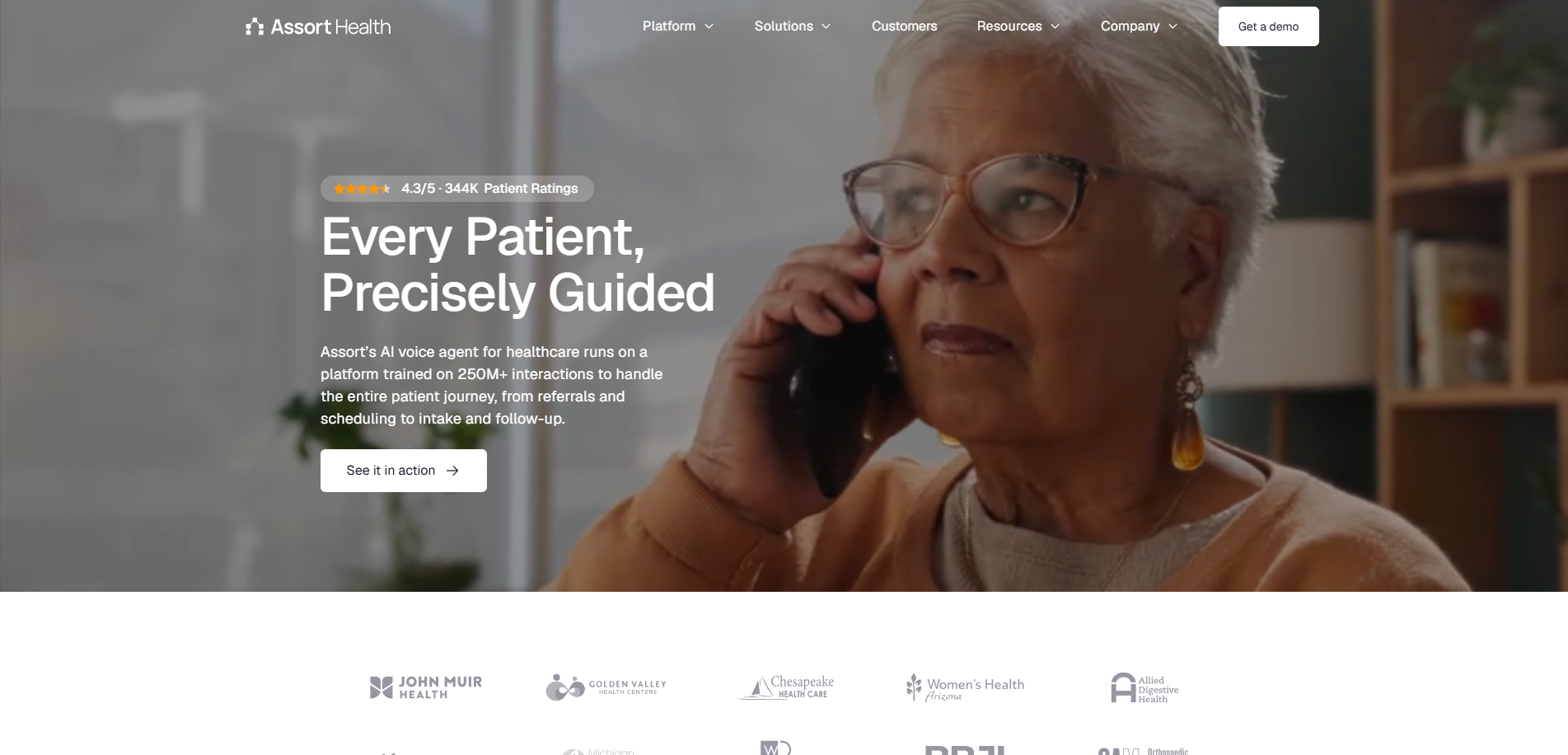
Best managed patient-access voice agent for specialty practices and groups, and the fastest-growing company in the category.
Overview
Assort Health builds specialty-trained AI phone agents for patient access: scheduling, intake, referrals, outreach, and care-gap closure.
The company reports training on more than 200 million patient interactions across 23+ specialties, and in June 2026 it closed a $120 million Series C led by Menlo Ventures at a $1.2 billion valuation after a Forbes Cloud 100 listing in 2025.
Key capabilities
- Specialty-specific scheduling logic across 23+ specialties
- Live two-way connections into 15+ EHR and PM platforms, with Athenahealth and Epic the deepest
- Scheduling, intake, referral, and outreach agents under one managed service
- HIPAA, SOC 2 Type II and BAA; most practices live within about six weeks
- Reported results: hold times from 11 minutes to one, abandonment from 41% to 8%
Best for
Multi-specialty groups, orthopedic, dermatology, and GI practices, and health systems that want a managed phone agent with built-in specialty logic.
Watch for
Enterprise sales motion and pricing, voice-first, and the agent is managed rather than self-built, so changes go through Assort.
A five-provider practice is below the typical entry point.
Pricing
Enterprise quote; third-party comparisons report entry pricing around $1,500 a month, but another report describes a $75,000 annual minimum quoted in one sales inquiry.
Neither figure is vendor-published pricing; confirm the minimum commitment and current pricing directly with Assort Health.
3. Hyro
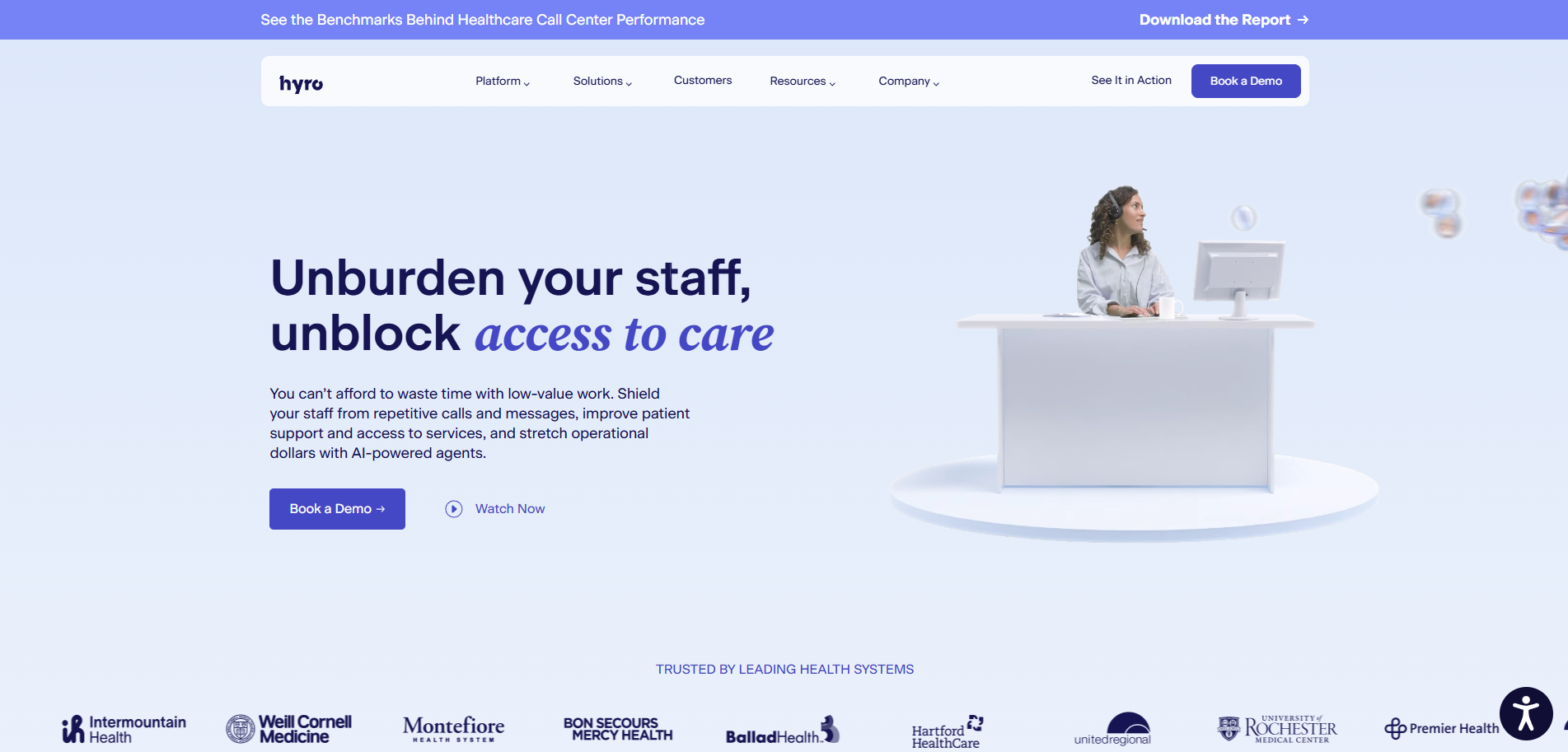
Best for health systems on Epic that want to automate a high-volume contact center.
Overview
Hyro is the enterprise patient-access play: conversational AI across phone, web, and SMS for health systems, with deep Epic and MyChart integration, a listing in the Epic Showroom, and deployments at more than 45 health systems including Intermountain and Novant.
Hyro positions itself on explainability for hospital IT, claims automation of 85% or more of routine call-center traffic, and is reported to handle 40 to 60% of scheduling calls at major systems.
Key capabilities
- Phone, web, and SMS agents with Epic, MyChart, eClinicalWorks, and Salesforce integration
- Automation of scheduling, prescription refills, FAQs, and outbound campaigns
- Explainable AI positioning for health-system governance
- Reported 85% resolution on routine calls; 40 to 60% of scheduling calls automated at Intermountain and Novant
- HIPAA, SOC 2 Type II; listed in the Epic Showroom
Best for
Health systems and large hospital networks standardizing patient access on Epic and an existing contact-center platform.
Watch for
Enterprise only, with reported pricing from around $10,000 a month and sales cycles to match.
Not a practice tool.
Pricing
Enterprise contract; third-party listings report a starting price of around $10,000 a month, but Hyro doesn’t publish an official rate card. Treat this as an indicative estimate, not a confirmed starting price, and request a quote for the intended deployment.
4. Hippocratic AI
Best, and only, platform doing non-diagnostic clinical conversations with patients at scale.
Overview
Hippocratic AI is the clear outlier on this list: its agents make clinical-adjacent calls rather than front-office ones.
Post-discharge follow-up, chronic-care check-ins, pre-op preparation, medication reminders, and screening outreach run through a library of more than 1,000 agents built on its Polaris safety architecture, with hard guardrails against diagnosing or prescribing and clinician-led safety testing.
Key capabilities
- The vendor advertises pricing as low as $9 per agent-hour of active patient interaction; enterprise terms apply. A $126 million Series C in November 2025 valued the company at $3.5 billion, with total funding exceeding $400 million
- 1,000+ pre-built agents for discharge follow-up, chronic care, pre-op prep, medication adherence, and screening
- Polaris safety architecture with explicit non-diagnostic, non-prescribing boundaries
- Usage-based pricing at roughly $9 per agent-hour
- Writes call summaries to the chart; AI Agent App Store for third-party agents
- $3.5B valuation; $404M+ raised
Best for
Health systems and payers running patient outreach programs at a scale where nurse hours are the constraint.
Watch for
Not a front-office or scheduling tool, and not for practices.
Usage pricing is hard to forecast, and every deployment is as much a clinical governance decision as a software one.
Pricing
Usage-based; the vendor advertises pricing as low as $9 per agent-hour. Actual rates and minimum commitments should be confirmed with the vendor.
5. Notable
Best for health systems automating registration, intake, referrals, and authorizations inside the EHR.
Overview
Notable is an intelligent automation platform for health systems that combines AI with robotic process automation to work inside existing EHR workflows, particularly Epic and Oracle Health.
It covers patient registration and intake, scheduling, referrals, prior authorizations, care-gap outreach, coding and revenue-cycle tasks, and its Flow Builder lets non-technical operators create workflows in natural language.
Customers include Intermountain Healthcare and CommonSpirit Health; TechCrunch reported a $100 million raise at a $600 million valuation.
Key capabilities
- AI plus RPA automation inside Epic and Oracle Health workflows
- Registration, intake, scheduling, referrals, prior auth, care gaps, coding and RCM
- Flow Builder for natural-language workflow creation
- Named customers include Intermountain and CommonSpirit
- HIPAA; enterprise deployment
Best for
Health systems with an Epic or Oracle Health footprint that want one platform across access and revenue cycle.
Watch for
Enterprise pricing and implementation.
Breadth means it’s rarely the deepest tool in any one lane.
Explicit BAA terms should be confirmed in contracting.
Pricing
Enterprise quote; not published.
6. Prosper AI
Best managed voice platform for outpatient groups that want patient calls and payer calls from one vendor.
Overview
Prosper AI is the one managed voice vendor here that covers patients and payers from the same platform.
Its patient-facing agents answer, schedule, and capture insurance details, while its payer-facing agents handle benefits, prior authorization, and claims follow-up, including talking to representatives and requesting EOBs.
Key capabilities
- Connects to more than 80 EHR, PMS, and clearinghouse systems, including Epic, athenahealth, and eClinicalWorks; runs in the cloud or on-premises
- Patient access agents: answering, scheduling, insurance capture
- RCM agents: benefits verification, prior auth, claims follow-up with IVR and hold navigation
- SOC 2 Type II certified, signs a BAA, and keeps LLM retention at zero days
- Reported: 60%+ appointments scheduled by AI, 89% abandonment reduction, 50% RCM cost reduction
Best for
Mid-size groups, dental organizations, billing firms, and regional health systems whose call volume justifies usage pricing.
Watch for
Voice-only and quoted.
A small practice with a few daily calls is oversized for it.
A live Keragon integration, so the two are complementary rather than competing.
Pricing
Usage-based with custom pricing. No published rate card.
7. Infinitus
Best platform for the payer phone call: benefit verification, prior-auth status, and claims follow-up at enterprise scale.
Overview
Infinitus owns one conversation: the call to the payer.
Its agents dial the right line, navigate the IVR, sit on hold, and pull benefit details from a live representative, backed by a knowledge graph the company says it built from over four million calls.
Key capabilities
- Electronic verification spans Medicare, Medicaid, Tricare, and commercial plans; Andreessen Horowitz led a $51.5 million Series C in October 2024 (total funding $102.9 million), and Memorial Hermann is both customer and investor
- Phone agents covering benefits, prior-auth status, claim status, and pharmacy follow-up
- Electronic verification path for government and commercial plans
- Coordination layer that restricts the LLM to approved topics
- SMART on FHIR launch and Salesforce Life Sciences Cloud integration
- HIPAA, SOC 2 Type II, HITRUST-certified cloud
Best for
Specialty pharmacy hubs, pharma manufacturers, health systems and large provider groups whose bottleneck is payer hold time.
Watch for
Enterprise only, with an annual platform fee plus usage.
It does one thing extremely well and nothing on the patient-facing side.
Pricing
Annual platform fee plus per-task or per-minute usage, or subscription; rates quoted.
8. Innovaccer
Best for health systems that want revenue-cycle and care agents grounded in a unified data platform.
Overview
Innovaccer is a healthcare data platform first and an agent vendor second.
Its agents run on data it has already unified across clinical, claims, and operational sources, which is the pitch: agents that see the whole record rather than one system.
Black Book ranked Innovaccer number one in its 2026 AI-powered revenue-cycle evaluation, based on feedback from 2,193 verified respondents across 18 KPIs. In January 2025, the company raised a $275 million Series F, bringing reported total funding to approximately $675 million.
Key capabilities
- Agents for revenue cycle, care management, patient outreach, and provider workflows
- Grounded in a unified data platform spanning clinical, claims, and operational data
- Black Book number one AI revenue cycle vendor, 2026
- Deployments across health systems and provider organizations
- $425M+ raised
Best for
Health systems, large provider groups and ACOs that want to deploy AI agents across workflows using a unified healthcare data foundation.
Watch for
The broad healthcare intelligence platform targets larger organizations, and pricing isn't publicly listed.
The value of its agent offerings depends on the data, integrations, and workflows included in the deployment.
Innovaccer also markets a separate Autonomy Network for independent primary-care practices, so smaller practices should assess that offering separately.
Pricing
Pricing is not publicly listed for the healthcare intelligence platform; it is available by inquiry.
Innovaccer also offers a separate Autonomy Network for independent primary-care practices, for which prospective customers should request current pricing.
9. Qventus
Best hospital operations platform: OR utilization, inpatient capacity, and discharge flow.
Overview
Qventus is an AI-first care operations platform for hospitals, founded in 2012, with more than 115 hospital clients including Northwestern Medicine, Banner Health, and ThedaCare. Its Surgical Growth and Inpatient Capacity solutions predict operational bottlenecks and automate remedies, and its AI Operational Assistants, launched in 2024, extend that into agentic workflows.
Qventus raised a $105 million Series D led by KKR in January 2025, bringing total funding to about $200 million, and reports a KLAS score of 92.5.
Key capabilities
- AI Operational Assistants for perioperative, inpatient, and discharge workflows
- EHR-integrated prediction and automation of operational bottlenecks
- 115+ hospital clients; KLAS score 92.5
- Published results: 36,000+ excess inpatient days eliminated; $95M annualized contribution margin from Surgical Growth in 2024
- HIPAA; enterprise deployment
Best for
Hospitals and health systems whose constraint is capacity and flow rather than the phone.
Watch for
Hospital-only. Nothing here applies to an outpatient practice, and pricing is an enterprise conversation.
Pricing
Enterprise quote. Not published.
10. Sully.ai
Best per-provider bundle of AI staff for clinics that want receptionist, scribe, coder and intake together.
Overview
Sully.ai sells a roster of AI staff rather than one agent: receptionist, scribe, coder, intake, pre-charting, prescription refills, and referrals.
It reports that it’s used by more than 100,000 providers, speaks 19 languages, and integrates with 50+ EHRs including Epic, Cerner, MEDITECH, athenahealth, and Tebra.
Deployment is cloud or self-hosted, and it holds HIPAA, SOC 2 Type II, and ISO 27001.
Key capabilities
- AI receptionist, scribe, coder, intake, pre-charting, refill, and referral agents
- 50+ EHR integrations across enterprise and practice systems
- 19 languages; cloud or self-hosted
- HIPAA, SOC 2 Type II, ISO 27001
- Reported pricing per provider rather than per practice
Best for
Clinics and groups that want several AI roles from one vendor and are comfortable with per-provider pricing.
Watch for
Per-provider pricing adds up across a large group.
Depth varies by role; the scribe is the mature product.
Reported entry pricing is third-party.
Pricing
Custom pricing based on clinic size, number of agents, call or usage volume, and workflows. Sully.ai discusses pricing during a demo or pilot; no standard rates or subscription tiers are publicly listed.
Make, Zapier, and the general-purpose builders
Any search for healthcare AI agents will surface Make, Zapier, and the no-code agent builders. They belong in a different article.
None of the general platforms sign a BAA on terms a practice can buy, and none has native EHR connectors, so an agent built on them cannot lawfully touch patient data or write to the chart.
Keragon's comparison of no-code AI agent builders for healthcare covers that category; this list is the healthcare-native platforms.
How to choose a healthcare AI agent platform
Here are six questions to ask, in the order that narrows the field fastest.
Which tier are you buying in?
A practice, a group, a hospital contact center, a pharma hub, and an inpatient operations team each have one or two platforms on this list and should ignore the rest.
Decide the tier first, and the feature grid gets short.
Will the vendor sign a BAA on your plan?
Most platforms in this comparison use enterprise or sales-led contracting, and pricing is often unpublished. Don’t assume a BAA is available, or unavailable, based solely on the vendor's customer base or HIPAA compliance claims.
Confirm whether the vendor will sign a BAA for your intended deployment, which products and services it covers, whether relevant subprocessors are covered, and what the full contract costs.
Keragon has a BAA included on its $99 plan.
Where does the agent write?
A call summary in a vendor dashboard is not a booking in the EHR.
Ask for a demo that ends with a record in your system, created by the agent, with your appointment type and provider rules applied.
Who changes it when your practice changes?
Managed platforms route changes through the vendor. Self-serve platforms let your staff edit the brief.
Neither is wrong, but the answer sets your run-rate cost and your speed to adapt.
Is it clinical, administrative, or both?
Only Hippocratic AI is built for clinical-adjacent conversations, and it’s governed accordingly.
Everything else here is administrative, and an administrative agent that starts answering clinical questions is a liability.
What does the bill look like at your volume?
Agent-hours, calls, tasks, providers, and flat tiers price the same organization very differently.
Take one real month of volume and model it on each before comparing anything else.
How to implement a healthcare AI agent platform
Follow this sequence that holds across tiers.
Step 1: Choose a workflow you can measure
Missed calls, intake completion, eligibility denials, discharge follow-up rate. Measure it for a month so the agent has something to beat.
Step 2: Settle the BAA and the data path before the demo
Which systems the agent reads, which it writes, where recordings and transcripts live, whether anything trains a model, and who signs. Finish that before anyone is impressed by a demo.
Step 3: Start with the EHR connection
EHR or PMS before messaging, messaging before voice. Prove read and write in a sandbox.
Step 4: Define the handoffs
What counts as urgent, what counts as clinical, who receives each, and where a person must approve. Write it down; it becomes the agent's guardrails.
Step 5: Rehearse on real data with sending off
Replay last week. Read every action the agent would have taken. Adjust until the team would sign each one.
Step 6: Go live narrow, then widen
One channel, one workflow, one location. Read the audit log weekly for the first month; the second workflow's brief will come out of it.
Compliance: every agent is a business associate
Under HIPAA, a vendor that creates, receives, maintains, or transmits protected health information (PHI) on behalf of a covered entity may qualify as a business associate. Where HIPAA's business associate rules apply, the relevant parties must have appropriate written agreements in place.
Check the complete data path, including the AI platform, model provider, voice provider, and other subprocessors. Confirm which parties handle PHI, which require a business associate agreement (BAA), and whether the necessary agreements are in place.
Also review encryption, access controls, audit logging, data retention, and whether customer data is used for model training. A vendor's HIPAA compliance statement alone does not establish that the contractual requirements for your deployment have been met.
Voice agents add further considerations: call-recording consent requirements under applicable state laws, including all-party consent laws, and the TCPA for outbound calls and texts.
Consent requirements depend on the type and purpose of the communication, the technology used, and applicable exceptions. Healthcare-related calls aren’t automatically exempt, and telemarketing generally faces stricter consent requirements.
Ask for the subprocessor list and confirm that any subcontractor handling PHI is covered by the required contractual safeguards. A BAA with the primary vendor does not, by itself, establish that the vendor's downstream subcontractors have the required agreements in place.
Keragon's HIPAA explained guide and trust center cover the vendor questions.
Cost and ROI
Published and reported pricing on this list ranges from $99 a month for Keragon on annual billing and third-party estimates of $79 to $99 per provider for Sully.ai to usage-based pricing advertised as low as $9 per agent-hour by Hippocratic AI.
Third-party sources report entry estimates of around $1,500 a month for Assort Health and $10,000 a month for Hyro; neither figure is a vendor-published starting price.
Notable, Innovaccer, Qventus, Infinitus, and Prosper AI use sales-led or custom pricing.
Confirm all rates, minimum commitments, implementation fees, and usage charges directly with the vendor.
The return is measured in the workflow you picked in step one: appointments kept, calls answered, denials prevented, discharges followed up.
For a practice, a single appointment recovered each week pays for a self-serve platform several times over; Keragon's ROI calculator does that arithmetic from your own appointment volume and no-show rate.
Final Thoughts
Ten platforms, five tiers. Hospitals and health systems have Hyro and Assort Health for the phone, Hippocratic AI for clinical outreach, Notable, Qventus and Innovaccer for operations and revenue cycle, and Infinitus for the payer line.
Most of these platforms use enterprise or sales-led deployments, built around managed implementation and custom contracts. Keragon is the self-serve option in this comparison, while Sully.ai offers a per-provider model.
Pricing, implementation requirements, and BAA terms vary, so confirm the specifics for your organization before choosing.
Practices and groups have been the gap in that market, and Keragon fills it: agents briefed in plain English, healthcare connectors that put the result in the chart, and a BAA included at the entry tier. If you’re a hospital, pick your tier above. If you run a practice, start here.
Start a free 14-day Keragon trial or watch a sample agent run.
FAQs
What is the best healthcare AI agent platform?
It depends on tier.
Independent practices and groups should look at Keragon, which offers no-code agents on 500+ healthcare integrations with a BAA included from $99 a month.
Health-system patient access points to Hyro or Assort Health, clinical outreach to Hippocratic AI, hospital operations and revenue cycle to Notable, Qventus or Innovaccer, and payer calls to Infinitus.
What is the best AI agent software for healthcare practices?
Keragon. It’s the only platform in this comparison that a practice can buy self-serve, build on without a developer, and run with a BAA included; it also writes directly to 30+ EHRs, dental, and med spa systems.
Sully.ai is the per-provider alternative for clinics that want a scribe and a receptionist from one vendor.
Which healthcare AI agent platforms are HIPAA compliant?
All ten are marketed for healthcare use, but HIPAA-related claims and BAA availability should be checked separately.
Keragon states that it includes a BAA on every paid plan.
For the other platforms, confirm whether a BAA is available for the specific product and deployment, what services it covers, and whether the relevant subprocessors are covered before sharing protected health information.
How much do healthcare AI agent platforms cost?
Keragon starts at $99 a month with annual billing. Third-party sources report Sully.ai pricing of $79 to $99 per provider per month, while Hippocratic AI advertises usage-based pricing as low as $9 per agent-hour.
Third-party listings estimate Assort Health from around $1,500 a month and Hyro from around $10,000 a month, but neither vendor publishes those figures as an official starting price.
Notable, Qventus, Innovaccer, Infinitus, and Prosper AI require a vendor quote.
Actual costs depend on contract scope, usage, and implementation.
Can healthcare AI agents write to the EHR?
The platforms here do, to varying degrees.
Keragon, Assort Health, Hyro, Prosper AI, and Sully.ai write bookings and intake to practice EHRs; Notable, Qventus, and Innovaccer work inside health-system EHRs; Hippocratic writes call summaries to the chart; Infinitus writes to payer and pharmacy workflows.
Are AI agents safe for patient data?
They can be, with a signed BAA, encryption, access controls, an audit log, and no training on your data.
The larger risk is scope: an administrative agent should never answer clinical questions, and only Hippocratic AI on this list is built and governed for clinical conversations.


Related Articles