
AI in Healthcare
14 mins
8 Best EliseAI Alternatives in 2026: Top Picks for Healthcare & Patient Access
Summary
Your Competitors Are Embracing AI – Are You Falling Behind?
EliseAI is a capable front-office automation platform. Its VoiceAI answers calls, books appointments, sends reminders, and handles billing questions around the clock, and teams in housing and healthcare lean on it to take routine conversations off staff plates.
But the product was built for property management first. Healthcare came later, layered on top of workflows that were designed for leasing offices.
Practices weighing EliseAI alternatives usually hit one of three walls: pricing you cannot see without a sales call, clinical features that feel bolted on, and automation that stops at the conversation instead of finishing the job inside your EHR.
If you’re searching for the best EliseAI alternatives, you’re probably standing at one of those walls right now.
This guide compares eight alternatives for healthcare and patient access in 2026, ranked by how much of the patient workflow each automates, how deeply it integrates with your tools, and how transparent it is to buy and run.
EliseAI Alternatives Comparison & Ratings Chart
Here’s a quick EliseAI alternatives comparison before the detailed breakdowns.
Every platform below is HIPAA-compliant and built for healthcare communication or operations, so the real differences come down to how much of the workflow each one automates and how it prices that work.
8 Best EliseAI Alternatives in 2026
These are the strongest EliseAI alternatives for healthcare teams this year.
We weighted automation depth, EHR integration, HIPAA posture, and how quickly a non-technical team can get to value.
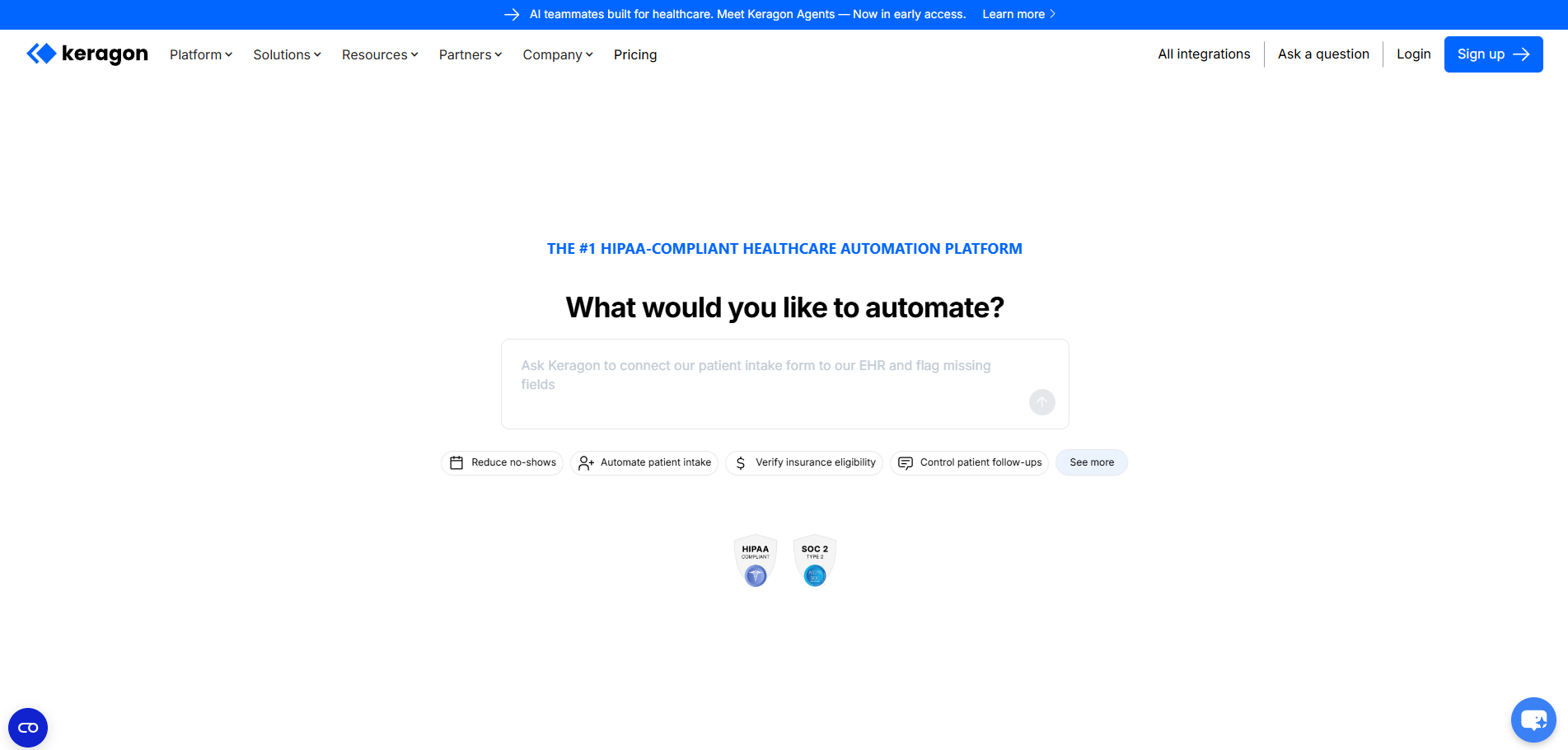
1. Keragon
Best Overall
Product Overview
Keragon is a HIPAA-compliant healthcare automation platform that connects 300+ healthcare tools, including EHRs like Athenahealth, Healthie, DrChrono, Elation, and ModMed, plus schedulers and communication apps, with no engineering team required.
Where EliseAI automates the conversation, Keragon Agents automate the whole workflow behind it, and the data lands in your EHR, not just in a call log. Here are the three problems those agents are built to solve.
Pain 1: Manual intake and insurance verification bury the front desk
Staff lose hours rekeying patient forms and chasing coverage details.
Keragon's Patient Intake Specialist greets new patients, collects forms, and lands the data in your EHR before the first visit, while the Insurance Verification Specialist confirms coverage, benefits, and copays for every scheduled patient ahead of arrival.
The front desk stops doing data entry and starts doing patient care.
Pain 2: No-shows and missed appointments quietly drain revenue
Every empty slot is lost revenue and a care gap.
The Appointment Reminder Agent sends reminders by text, email, or voice that patients actually respond to, then confirms attendance back to your scheduler.
When a visit is missed anyway, the No-Show Recovery Specialist reaches out, finds a new time on your calendar, and rebooks the patient automatically.
Pain 3: Inbound leads and pre-visit prep slip through the cracks
Website inquiries go cold, and clinicians walk into appointments unprepared.
The New Patient Acquisition Agent picks up inbound leads, qualifies them, and books them straight onto a provider's calendar, while the Pre-Visit Prep Specialist reads intake responses, prior notes, medications, and recent labs to deliver a structured patient brief before every visit.
Pros & Cons
Pros:
- Healthcare-native platform with SOC 2 Type II and HIPAA compliance, not a housing product adapted for clinics.
- 300+ healthcare integrations cover EHRs, schedulers, forms, and communication tools out of the box.
- AI agents and no-code automation handle the full workflow: intake, reminders, no-show recovery, insurance verification, and pre-visit prep.
- Plain-English setup means front-desk and ops staff can build automations without developers.
- Free plan and published paid pricing make it easy to evaluate without a sales call.
- Human-in-the-loop controls and HIPAA audit logs keep your team in control.
Cons:
- Purpose-built for healthcare, so it is not a fit for property management or other industries.
- Teams that only want a single voice bot may not need a full automation platform.
- Some of the newest agent capabilities are expanding quickly, so the roadmap is still maturing.
Pricing
Keragon offers a free trial to get started, plus published paid tiers that scale with usage, starting from $99/mo.
Setup
Most teams are live within an afternoon. Pick a trigger, describe the task in plain English, connect your EHR and comms tools, run a test, and switch it on. No IT project required.
Tradeoffs
Keragon is the best overall choice when you want to automate operations end-to-end rather than answer a phone.
It’s the strongest fit for practices and digital health teams that want intake, scheduling, reminders, no-show recovery, and verification working together.
If your only goal is a single outbound call bot, this is more platform than you need.
Pre-built templates. HIPAA compliant. No developers needed. Start your free trial today.
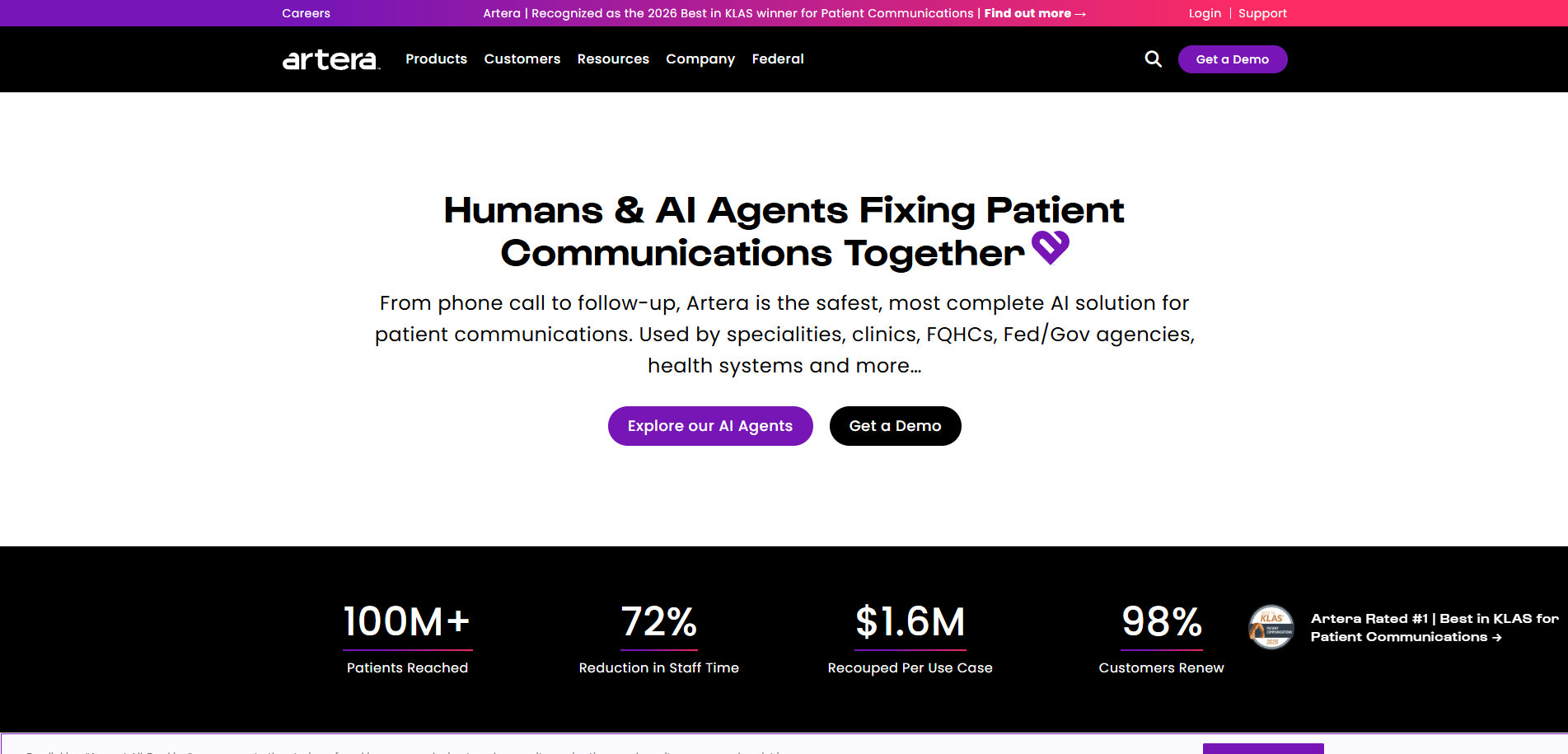
2. Artera
Best for: Enterprise Patient Communication
Product Overview
Artera (formerly WELL Health) is a patient communication hub that unifies voice, text, email, and chat in one platform. It was named 2026 Best in KLAS for Patient Communications and is deployed across more than 1,000 healthcare organizations.
Its virtual agents handle scheduling, pre-visit intake, digital forms, billing communication, and patient self-service, with multilingual messaging in the patient's preferred channel.
Pros & Cons
Pros:
- Best in KLAS recognition and a large enterprise install base.
- True omnichannel hub that consolidates patient messaging across departments.
- Strong multilingual support and proven scale for health systems.
Cons:
- Pricing is not public and requires a sales conversation.
- Built as a communication layer, so deep workflow automation into the EHR is more limited than a platform like Keragon.
- Enterprise focus can be heavy for small or independent practices.
Pricing
Custom pricing based on organization size and message volume. Contact the Artera sales team for a quote.
Setup
Implementation is an enterprise project measured in weeks, with vendor onboarding and integration support.
Tradeoffs
Artera is the natural pick when KLAS validation is a procurement requirement, and you need patient communication at a health-system scale.
It’s less suited to teams that want to automate operational workflows beyond messaging or that need transparent, self-serve pricing.
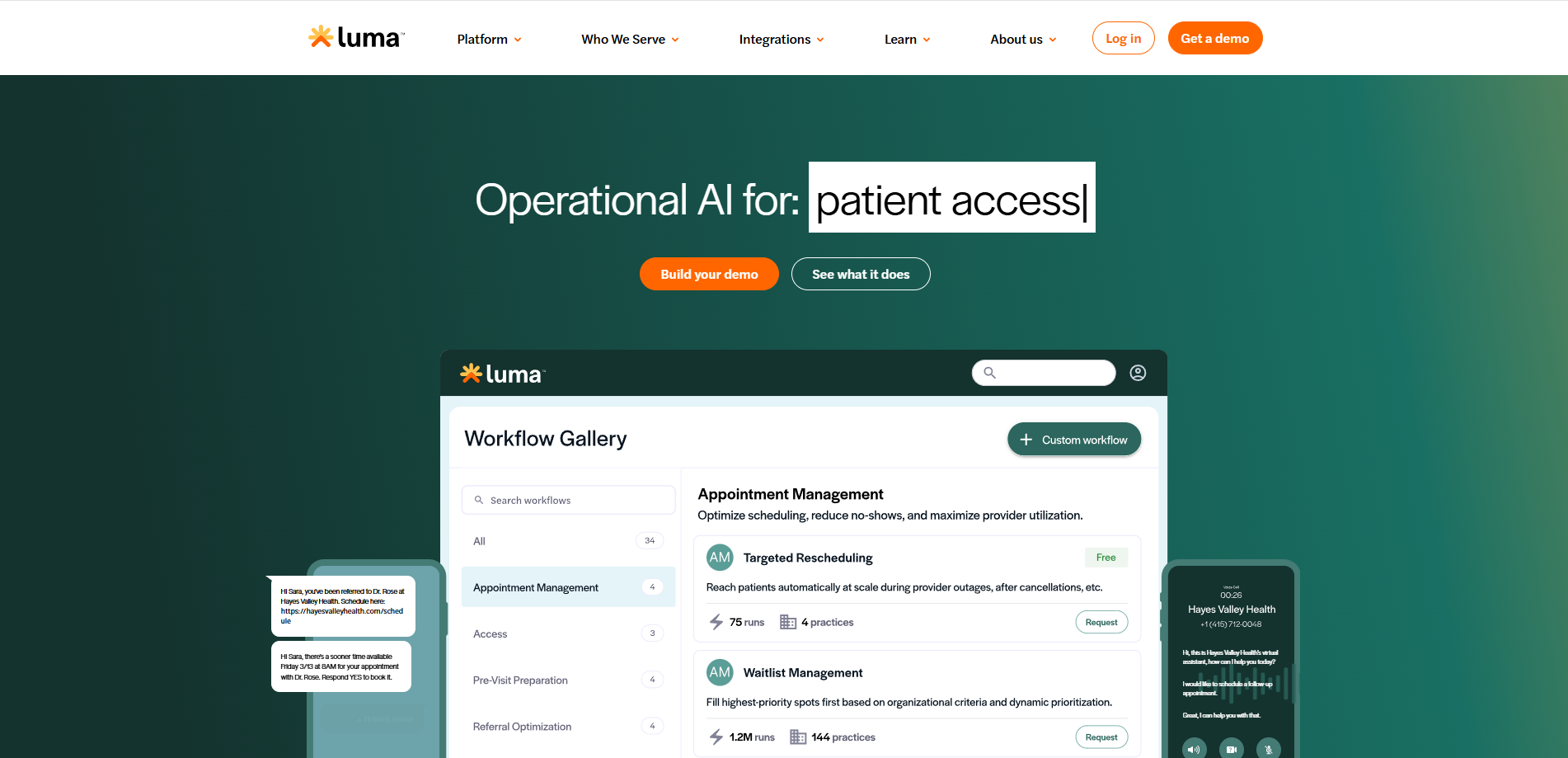
3. Luma Health
Best for: Patient Access on Epic
Product Overview
Luma Health is a patient access and engagement platform. Its ARIA AI handles scheduling, referrals, appointment reminders, intake, and waitlist management, and it’s known for deep Epic integration alongside other major EHRs.
The platform focuses on closing gaps in patient access, getting more patients booked, prepped, and shown up for their visits.
Pros & Cons
Pros:
- Deep, well-regarded Epic integration plus other major EHRs.
- Strong scheduling, referral, and waitlist automation.
- Established presence across community health centers and larger systems.
Cons:
- Pricing is quote-only.
- Best value shows up on Epic-based systems; lighter footprints may not need the full platform.
- Oriented to access and engagement rather than broad operational automation.
Pricing
Custom pricing. Contact Luma Health for a quote based on your EHR and patient volume.
Setup
Typically, a multi-week implementation with EHR integration and configuration support.
Tradeoffs
Luma Health is the right choice for health systems and large groups on Epic that want to fix patient access at scale.
For smaller practices or teams that want to automate operations beyond scheduling and reminders, lighter or broader tools may be a better fit.
4. Hyro
Best for: Large Health System Call Centers
Product Overview
Hyro is conversational AI built for health systems. It automates calls and web conversations, connects to enterprise EHRs through HL7 and FHIR, and is designed to deflect high volumes of routine inquiries away from the call center.
It’s widely viewed as an enterprise-grade option with strong Epic connectivity and real-time analytics on patient interactions.
Pros & Cons
Pros:
- Among the deepest enterprise EHR integrations in this list.
- High call deflection on routine scheduling and FAQ inquiries.
- Real-time analytics and explainability for large operations.
Cons:
- Aimed at large health systems, not small or midsize practices.
- Pricing is custom and enterprise-weighted.
- Implementation requires IT involvement and a longer timeline.
Pricing
Custom enterprise pricing. Contact Hyro for a quote.
Setup
Enterprise deployment with IT and integration work; expect a structured rollout.
Tradeoffs
Hyro is the gold standard for enterprise health-system call automation, but it’s out of reach for most independent practices.
If you run thousands of beds on Epic, it belongs on your shortlist; if you run a single clinic, it’s overkill.
5. Notable Health
Best for: Clinical and Administrative Automation
Product Overview
Notable Health builds AI agents that span both administrative and clinical workflows: scheduling, intake, registration, and prior authorization, with automation that reaches into the EHR.
It positions itself as a broad automation layer rather than a single-purpose communication tool.
Pros & Cons
Pros:
- Combines patient-facing and back-office workflow automation.
- EHR-connected agents for scheduling, registration, and prior auth.
- Strong fit for larger groups, standardizing repetitive processes.
Cons:
- Pricing is not public.
- Heavier platform that suits mid-market and enterprise more than solo practices.
- Implementation effort is higher than for a plug-in messaging tool.
Pricing
Custom pricing. Contact Notable for a quote based on scope and volume.
Setup
Implementation is a guided project with EHR integration and workflow configuration.
Tradeoffs
Notable is a strong EliseAI alternative when you want to automate clinical and administrative tasks together.
Smaller teams that just need patient messaging or a single agent will find it more platform than they require.
6. Klara
Best for: Small Practice Messaging
Product Overview
Klara (ModMEd) is a patient communication and messaging tool that’s now part of ModMed. It centers on secure two-way messaging, web chat, and light automation for reminders and follow-ups.
It’s a practical option for practices that mainly want to text patients and consolidate conversations.
Pros & Cons
Pros:
- Simple, approachable two-way messaging.
- Fast to adopt for small and midsize practices.
- Tight fit for ModMed users.
Cons:
- Lighter automation and shallower integrations than platform-grade tools.
- Less suited to complex multi-step workflows.
- Pricing is quote-based.
Pricing
Custom pricing. Contact Klara or ModMed for current rates.
Setup
Quick to deploy; most teams are messaging patients within days.
Tradeoffs
Klara is a good entry point for practices that want better patient messaging without a large project. If you need to automate intake, verification, and no-show recovery as connected workflows, you’ll outgrow it.
7. Phreesia
Best for: Patient Intake and Registration
Product Overview
Phreesia specializes in digital patient intake and registration, with tools for forms, payments, surveys, and scheduling. It’s one of the most established names in front-end patient workflows.
Practices use it to move check-in, demographics, and consent online before the visit.
Pros & Cons
Pros:
- Mature, widely adopted intake and registration platform.
- Built-in payments and patient surveys.
- Reduces front-desk data entry and check-in friction.
Cons:
- Focused on intake and registration rather than full conversational automation.
- Pricing is custom.
- Less of a fit if your priority is voice or proactive outreach.
Pricing
Custom pricing. Contact Phreesia for a quote.
Setup
Guided implementation to digitize intake forms and connect to your EHR.
Tradeoffs
Phreesia is the specialist for digital intake and registration.
If intake is your bottleneck, it’s excellent; if you need broader automation across reminders, verification, and recovery, pair it with a platform or choose one that covers more ground.
8. Cedar
Best for: Patient Billing and Payments
Product Overview
Cedar focuses on the patient financial experience: clearer statements, AI-guided billing support, and flexible payment plans that lift collection rates.
It addresses the billing-question volume that EliseAI also targets, but as a dedicated financial engagement platform.
Pros & Cons
Pros:
- Purpose-built for patient billing and payments.
- Improves collections and the post-visit financial experience.
- Clear, patient-friendly statements and plans.
Cons:
- Narrowly focused on billing, not scheduling or intake.
- Pricing is custom and enterprise-oriented.
- Not a general patient communication or automation platform.
Pricing
Custom pricing. Contact Cedar for a quote.
Setup
Enterprise implementation tied to your billing and revenue cycle systems.
Tradeoffs
Cedar is the right call when patient billing and collections are the problem you most need to solve.
For scheduling, intake, and outreach, you’ll need a different or broader tool.
Why Choose the Alternatives to EliseAI Software
When you line up EliseAI competitors and alternatives side by side, the real differences show up in four places. These are the reasons healthcare teams move.
Healthcare-native design
EliseAI was built for property management and added healthcare later, so its core workflows reflect leasing offices.
Healthcare-native platforms like Keragon were designed around EHRs, HIPAA, and clinical operations from day one.
Transparent pricing and faster evaluation
EliseAI's healthcare pricing isn’t public, which slows down evaluation for smaller practices.
Alternatives with free plans and published tiers let you test the fit before you ever talk to sales.
Automation that reaches into your EHR
Answering a call is only half the job. The platforms worth switching to finish the workflow: they update the chart, verify the insurance, and rebook the no-show, not just log the conversation.
Deeper, healthcare-specific integrations
Connections to Athenahealth, Epic, Healthie, DrChrono, and your scheduler matter more than generic channel support. The best alternatives treat those integrations as the foundation, not an add-on.
How to Choose the Right EliseAI Alternatives
Use these steps to shortlist the right platform for your practice or system.
Step 1: Map the workflows you actually need to automate
List the tasks eating staff time: intake, reminders, no-show recovery, insurance verification, and billing follow-up.
Choose a tool that covers most of them, not just the phone line.
Step 2: Check integration depth with your EHR and stack
Confirm native, two-way integration with your EHR and scheduler.
Shallow or one-way connections create manual cleanup that erases the time you hoped to save.
Step 3: Confirm HIPAA and security posture
Require a signed BAA, HIPAA compliance, and ideally SOC 2 Type II. Ask to see the audit log and how protected health information is handled end-to-end.
Step 4: Weigh AI conversation against full workflow automation
Decide whether you need a conversational front end or a platform that completes the work. A voice bot resolves a call; an automation platform resolves the task behind it.
Step 5: Test setup time and who can run it
Find out whether your own team can build and adjust automations, or whether every change needs the vendor or IT.
Self-serve, plain-English setup keeps you fast and independent.
Key Features to Look for When Exploring EliseAI Competitors
These are the capabilities that separate a real healthcare automation platform from a basic chatbot.
HIPAA compliance and a signed BAA
Non-negotiable for any tool touching patient data. Look for HIPAA compliance backed by SOC 2 Type II and a clear data-handling policy.
Native EHR and scheduler integration
The platform should read and write to your EHR and calendar so automations actually update the source of truth.
Multichannel patient communication
Voice, SMS, email, and chat in one place, so patients reach you on their preferred channel and conversations stay unified.
No-code automation and AI agents
Plain-English builders and prebuilt agents let your team automate intake, reminders, and recovery without writing code.
Audit logs and human-in-the-loop controls
You should be able to review what an agent did, set guardrails, and require human approval on sensitive steps.
Transparent, predictable pricing
Published plans and usage that you can forecast beat quote-only pricing that hides the real cost until late in the cycle.
Cost Comparison: EliseAI vs Competitors
EliseAI doesn’t publish healthcare pricing. You cannot see what it costs without a sales call, which makes it hard for smaller practices to evaluate quickly.
Most enterprise patient-communication platforms in this guide, including Artera, Luma Health, Hyro, Notable, Phreesia, and Cedar, are also custom-quoted and weighted toward mid-market and enterprise budgets.
Keragon is the clear outlier on cost transparency. It offers a free trial plan plus published paid tiers, so a practice can start automating, see real value, and only then decide where to scale. That removes the procurement friction that slows down most of this category.
The practical takeaway: if budget predictability and a low-commitment start matter, prioritize platforms with public pricing.
If you’re an enterprise buyer with a formal procurement process, custom quotes are normal, and the deciding factor becomes integration depth and automation breadth rather than the sticker price.
Which EliseAI Alternative Is Right for Your Business?
A quick note first: if you searched for EliseAI alternatives property management software, EliseAI's leasing product is a separate offering from its healthcare suite, and the platforms in this guide are healthcare-focused. For housing, you would compare property management AI tools instead.
For healthcare and patient access, match the tool to your situation:
- Small or independent practice that wants to automate operations: Keragon, or Klara if you only need messaging.
- Health system on Epic that needs patient access at scale: Luma Health or Hyro.
- Enterprise with a KLAS requirement for patient communication: Artera.
- Team that wants to automate the whole workflow, not just calls: Keragon.
- Billing and collections as the priority: Cedar. Intake and registration as the priority: Phreesia.
Final Thought on EliseAI Alternatives
EliseAI built its name in property management and extended into healthcare later, which is exactly why teams shop around. The platforms worth evaluating are the ones designed around EHRs, HIPAA, and clinical operations from day one, not retrofitted from a leasing office.
The right alternative depends on what you actually need to fix. Artera wins on enterprise-scale patient communication and KLAS validation. Luma Health and Hyro lead for health systems on Epic that need patient access and call deflection at volume. Notable Health spans clinical and administrative automation for larger groups. Klara fits small practices that mainly want better messaging. Phreesia owns digital intake, and Cedar owns patient billing.
If you are an independent practice or a smaller group that wants to automate operations end to end, intake, reminders, verification, no-show recovery, and EHR updates, Keragon is the most direct fit, and the published pricing lets you prove value before you commit to a sales cycle.
Map the workflows that are eating your staff time, confirm integration depth with your specific EHR, demand a signed BAA, and pick the platform that finishes the task rather than just answers the call. Done in that order, the shortlist gets short fast.
FAQs
What are the main limitations of EliseAI that lead teams to evaluate alternatives?
Teams cite three issues most often: pricing is not public, so evaluation requires a sales call; the platform was built for property management first, with healthcare features added later; and automation often stops at the conversation rather than completing the workflow inside your EHR.
Which EliseAI alternatives integrate with Yardi, RealPage, Entrata, or AppFolio?
Yardi, RealPage, Entrata, and AppFolio are property management systems, so those integrations matter for housing, not healthcare. EliseAI's leasing product connects to them.
Healthcare alternatives like Keragon, Luma Health, and Artera integrate with EHRs and schedulers such as Athenahealth, Epic, and Healthie instead.
Are there cheaper alternatives to EliseAI for small or independent operators?
Yes. EliseAI is priced for mid-market and enterprise buyers with no public rates.
Keragon offers a free trial plan and published paid tiers, and Klara serves smaller practices affordably. Both give independent operators a clearer, lower-commitment starting point than a custom enterprise quote.
Can these tools handle resident communication beyond leasing (renewals, maintenance, delinquency)?
Resident communication for renewals, maintenance, and delinquency is a property management use case handled by EliseAI's housing product and housing-focused alternatives.
The healthcare platforms in this guide focus on patient communication instead: scheduling, reminders, intake, no-show recovery, and billing follow-up.
Which EliseAI alternative is best for senior living, student housing, or single-family rentals?
Those are housing segments, not clinical settings, so property management AI tools fit better than the healthcare platforms here.
If a senior living operator needs clinical or patient-facing automation, Keragon handles HIPAA-compliant healthcare workflows like intake, reminders, and records updates.
How do AI leasing assistants stay fair-housing compliant?
AI leasing assistants stay fair-housing compliant by applying consistent screening criteria, avoiding discriminatory language, and logging every interaction for audit. That’s a housing requirement.
In healthcare, the parallel is HIPAA compliance, which platforms like Keragon support with SOC 2 Type II controls and full audit logs.


Related Articles