Healthcare Automations
13 mins
Top 12 Healthcare Automation Companies in 2026
Summary
Your Competitors Are Embracing AI – Are You Falling Behind?
Healthcare automation companies build the software that eliminates manual, repetitive work across clinical and administrative workflows. The category spans everything from no-code workflow integration platforms that connect EHRs to billing systems, to AI-powered coding engines that translate clinical notes into claims, to robotic process automation (RPA) tools that handle insurance verification and prior authorization.
The challenge for healthcare organizations isn't whether to automate. It's choosing which company solves the right problem for their specific operational bottleneck, while meeting HIPAA compliance requirements and integrating with their existing systems.
We evaluated 12 healthcare automation companies across six criteria: operational impact, compliance and security, integration depth, validation and scale, pricing transparency, and support quality.
This guide covers the full spectrum of healthcare workflow automation software companies, from purpose-built healthcare platforms to enterprise RPA vendors with healthcare divisions.
| Platform | Best For |
|---|---|
| Keragon | Workflow Integration |
| AKASA | RCM Automation |
| CodaMetrix | Autonomous Coding |
| Abridge | Clinical Documentation |
| UiPath | Enterprise RPA |
Best Healthcare Automation Companies: Quick Comparison Table
| Company | Best For | HIPAA | Pricing | Category | G2/Cap | Score | Key Differentiator |
|---|---|---|---|---|---|---|---|
| Keragon | Workflow integration | Yes + SOC2 | From $99/mo | Integration | 4.8/5 | 9.2/10 | 400+ healthcare connectors, no-code |
| AKASA | RCM automation | Yes | Enterprise | RCM | 4.5/5 | 8.8/10 | ML-powered coding + claims |
| CodaMetrix | Autonomous coding | Yes | Enterprise | RCM | N/A | 8.6/10 | #1 KLAS for autonomous coding |
| Abridge | Clinical documentation | Yes | Enterprise | Documentation | 4.8/5 | 8.6/10 | Ambient AI scribe, EHR-integrated |
| Notable Health | Patient engagement | Yes | Enterprise | Patient Access | 4.5/5 | 8.4/10 | Intake, scheduling, prior auth |
| UiPath | Enterprise RPA | Yes* | From $420/mo | RPA | 4.6/5 | 8.2/10 | Largest RPA platform, healthcare bots |
| Waystar | RCM platform | Yes | Enterprise | RCM | 4.3/5 | 8.0/10 | Full revenue cycle, denial management |
| Olive AI | Operations automation | Yes | Enterprise | Operations | 3.5/5 | 7.6/10 | Cross-departmental AI automation |
| Automation Anywhere | Enterprise RPA | Yes* | Custom | RPA | 4.5/5 | 7.6/10 | Cloud-native RPA, AI agents |
| Thoughtful AI | RCM automation | Yes | Custom | RCM | N/A | 7.4/10 | End-to-end RCM AI agents |
| Fathom | Clinical documentation | Yes | Enterprise | Documentation | N/A | 7.4/10 | AI-powered clinical notes |
| Siemens Health. | Clinical workflows | Yes | Enterprise | Clinical | N/A | 7.2/10 | Imaging + lab workflow automation |
Our Scoring Methodology
| Criterion | Weight | What We Measured |
|---|---|---|
| Operational Impact | 25% | Measurable efficiency gains. Staff time recovered. Error reduction. Revenue impact. Production deployment outcomes. |
| Compliance & Security | 20% | HIPAA certification. SOC 2. BAA availability. Encryption. Audit trails. Healthcare-specific architecture vs. add-on compliance. |
| Integration Depth | 20% | EHR connectors. Billing/scheduling integration. API extensibility. Number of pre-built healthcare connectors. |
| Validation & Scale | 15% | Number of healthcare customers. Named deployments. Clinical validation where applicable. |
| Pricing & TCO | 10% | Billing model transparency. Implementation cost. Scaling economics. Hidden costs. |
| Reviews & Support | 10% | G2/Capterra ratings. Support tiers. Onboarding. Documentation. Healthcare-specific support. |
Top 12 Healthcare Automation Companies in 2026
Here are the top 12 healthcare workflow automation companies, looking at operational impact, compliance and security, integration depth, validation and scale, pricing transparency, and support quality.
#1. Keragon: Best Healthcare Automation Company for Workflow Integration

Score: 9.2/10. Highest marks for integration depth (10/10), compliance (10/10), and operational impact (9/10). Scored lower on clinical AI (N/A, automation platform) and review volume (7/10).
Keragon is a HIPAA-compliant, no-code workflow automation platform built specifically for healthcare. It connects 400+ healthcare tools, including EHRs, billing platforms, scheduling systems, CRMs, and communication tools, enabling healthcare organizations to automate cross-system data flows without custom engineering.
Best for healthcare organizations with multiple disconnected systems that need to automate data handoffs between EHRs, billing, scheduling, and communication tools without custom development or HIPAA risk.
Product Overview
Pain 1: Patient data is trapped in disconnected systems.
The average practice runs 10-15 software systems that do not talk to each other. Staff manually re-enter data across platforms, creating errors, delays, and compliance risk.
Keragon's no-code builder connects tools like Athenahealth, DrChrono, Elation Health, Healthie, ModMed, Salesforce, Slack, and GoHighLevel into unified, automated workflows.
Pain 2: Generic automation tools are not HIPAA compliant.
Zapier, Make, and n8n lack BAAs, healthcare-specific connectors, and the compliance infrastructure required for PHI.
Keragon is built from the ground up for healthcare: SOC 2 Type II certified, HIPAA compliant, encrypted, with audit logging and a 7-day data retention policy.
Pain 3: Custom integrations take months and cost tens of thousands.
Point-to-point integrations between healthcare systems require months of engineering and ongoing maintenance.
Keragon's drag-and-drop builder lets teams deploy compliant automations in days. New API connectors are built in 1-2 weeks on request.
Pricing
- Free 14-day trial. Paid plans from $99/month. Volume-based pricing.
Integrations
- 400+ healthcare integrations. Pre-built workflow templates for intake, scheduling, billing, and referrals.
Tradeoffs
- Workflow automation platform, not a clinical AI tool. Best paired with clinical tools (Abridge, CodaMetrix) for end-to-end automation.
- Fewer general SaaS integrations than Zapier, but deeper healthcare-specific coverage.
Case Study
The Autism Center of Illinois deployed Keragon to automate intake workflows connecting IntakeQ, Google Drive, Slack, and Monday.com. Result: 10 hours/week reclaimed, 2-3 days faster onboarding, full HIPAA compliance.
Pre-built templates. HIPAA compliant. No developers needed. Start your free trial today.
#2. AKASA: Best Healthcare Automation Company for Revenue Cycle Management
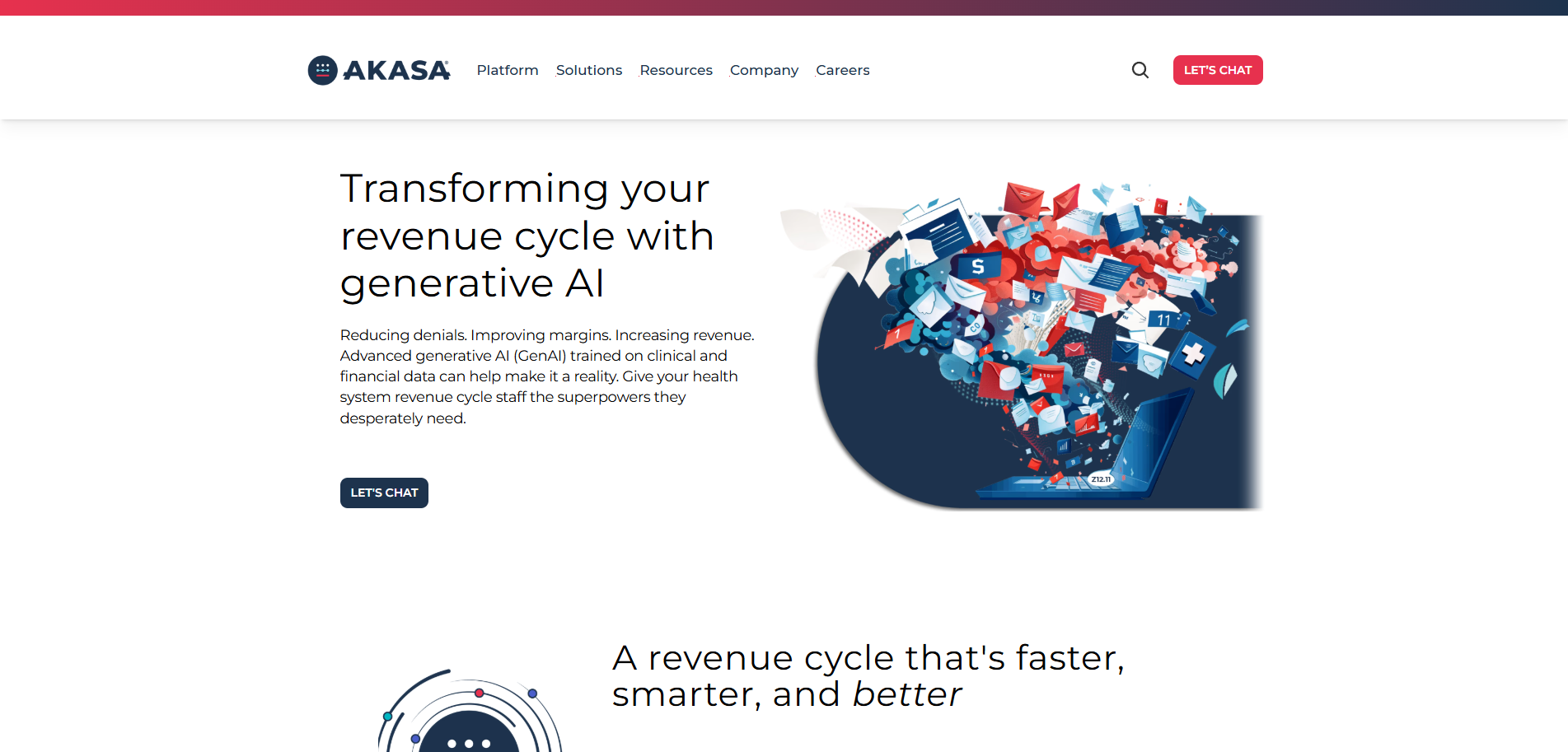
Score: 8.8/10. Highest for RCM automation (9/10) and ML accuracy (9/10). Lower on pricing transparency (5/10).
AKASA uses machine learning to automate medical coding, claims submission, prior authorization, and denial management. Unlike rule-based RPA, AKASA's models learn from an organization's specific payer patterns and improve accuracy over time.
Among the top healthcare RCM automation services companies for health systems processing high claim volumes.
Best for health systems and large practices automating billing, coding, and claims at scale.
Tradeoffs
- Enterprise-focused. Requires integration with existing RCM infrastructure. Not suited for small practices.
#3. CodaMetrix: Best for Autonomous Medical Coding
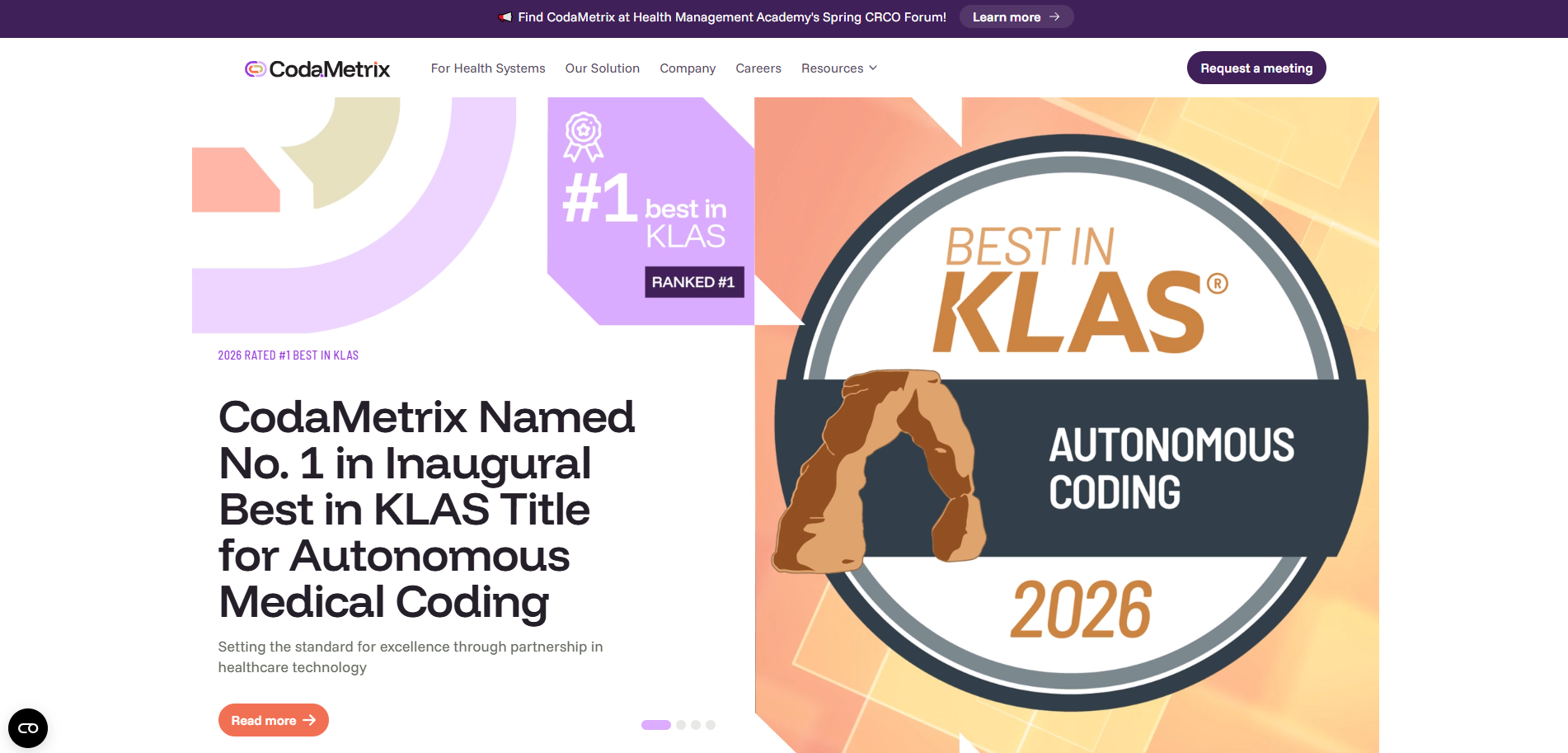
Score: 8.6/10. Highest for coding accuracy (10/10) and clinical validation (9/10). Lower on breadth beyond coding (5/10).
CodaMetrix's CMX CARE platform is an AI-powered coding automation system rated #1 in the 2026 Best in KLAS segment for autonomous coding. It transforms clinical documentation into accurate medical codes across multiple specialties, claiming up to 70% reduction in manual coding effort and 60% fewer coding-related denials.
Trusted by Mass General Brigham, UC San Diego Health, Yale Medicine, and Mayo Clinic.
Best for health systems and large groups seeking autonomous coding to reduce denials and accelerate revenue.
Tradeoffs
- Focused specifically on coding. Does not cover broader RCM, scheduling, or patient engagement workflows.
#4. Abridge: Best for Clinical Documentation Automation
Score: 8.6/10. Highest for physician adoption (9/10) and documentation impact (9/10). Lower on pricing transparency (5/10).
Abridge uses ambient AI to transform doctor-patient conversations into structured clinical notes in real-time, integrating directly into the EHR. Addresses the physician documentation crisis, where clinicians spend roughly two hours on admin for every hour of patient care.
For a deeper look at AI documentation tools, see our guide to AI tools in healthcare.
Best for health systems and practices, reducing physician documentation burden and burnout.
Tradeoffs
- Enterprise pricing. Requires microphone hardware. Documentation quality depends on audio clarity.
#5. Notable Health: Best for Patient Engagement Automation
Score: 8.4/10. Strong for patient access (9/10) and workflow breadth (8/10). Lower on brand recognition (6/10).
Notable Health automates patient intake, scheduling, registration, insurance verification, and prior authorization using AI. Its platform pre-fills forms from EHR data, verifies eligibility in real-time, and routes patients through digital workflows that reduce front-desk workload.
Used by health systems, including CommonSpirit Health.
Best for health systems and large practices automating patient access and front-office workflows.
Tradeoffs
- Enterprise-focused. Strongest in patient access; less coverage for RCM back-end or clinical documentation.
#6. UiPath: Best Enterprise RPA Platform for Healthcare
Score: 8.2/10. Highest for RPA breadth (10/10) and enterprise scale (9/10). Lower on healthcare-specific design (6/10).
UiPath is the largest robotic process automation platform globally, with pre-built healthcare bots for insurance verification, claims processing, patient scheduling, and prior authorization.
As a healthcare robotic process automation company, UiPath provides the broadest RPA toolkit, but requires configuration for healthcare-specific workflows and HIPAA compliance.
Best for large health systems with dedicated IT teams that need enterprise-scale RPA across clinical and administrative workflows.
Pricing
From $420/month (Automation Developer). Enterprise pricing custom.
Tradeoffs
- Not healthcare-specific by default. HIPAA compliance requires proper deployment configuration.
- Requires technical expertise to build and maintain bots. Steeper learning curve than no-code healthcare platforms.
#7. Waystar: Best Full-Stack RCM Platform
Score: 8.0/10. Strong for RCM breadth (9/10). Lower on clinical automation (4/10).
Waystar provides a cloud-based platform covering the full revenue cycle: claim management, denial prevention, patient payments, insurance verification, and analytics. Its AI-powered denial management module identifies denial patterns and automates appeals.
One of the leading healthcare RCM automation services companies for mid-to-large organizations.
Best for mid-to-large healthcare organizations needing a comprehensive RCM platform.
Tradeoffs
- Focused on revenue cycle. Does not address clinical documentation, patient engagement, or cross-system workflow automation.
#8. Olive AI: Best for Cross-Departmental Operations Automation
Score: 7.6/10. Strong for breadth (8/10). Lower on recent trajectory and reviews (5/10).
Olive AI applies artificial intelligence to repetitive healthcare operations tasks: insurance verification, claims processing, prior authorization, and supply chain management.
Its healthcare AI automation approach targets the administrative back office across departments, not just the revenue cycle.
Best for health systems seeking AI-driven automation across multiple operational departments.
Tradeoffs
- Has undergone organizational restructuring. 3.5/5 G2 rating suggests a mixed user experience. Verify the current product roadmap before committing.
#9. Automation Anywhere: Best Cloud-Native RPA for Healthcare
Score: 7.6/10. Strong for cloud-native architecture (8/10). Lower on healthcare-specific features (5/10).
Automation Anywhere is a cloud-native RPA platform with healthcare use cases in claims processing, patient onboarding, eligibility verification, and compliance reporting. Its AI-powered bots can be deployed across clinical and administrative workflows.
Like UiPath, it is a general-purpose RPA vendor with healthcare applications rather than a healthcare-first company.
Best for healthcare organizations already invested in RPA seeking a cloud-native platform.
Tradeoffs
- Not healthcare-specific. Requires configuration for HIPAA compliance. Enterprise complexity.
#10. Thoughtful AI: Best for End-to-End RCM AI Agents
Score: 7.4/10. Strong for RCM AI innovation (8/10). Lower on track record and reviews (5/10).
Thoughtful AI builds AI agents that automate specific RCM tasks end-to-end: eligibility verification, claims submission, payment posting, and denial management.
Each agent is designed to handle a complete workflow rather than just assisting a human worker, positioning Thoughtful as a next-generation healthcare workflow automation software company.
Best for RCM teams seeking autonomous AI agents for specific billing and claims workflows.
Tradeoffs
- Newer company with less track record than established RCM platforms. Limited public reviews.
#11. Fathom: Best for AI-Powered Clinical Notes
Score: 7.4/10. Strong for documentation efficiency (8/10). Lower on enterprise scale (5/10).
Fathom uses AI to generate clinical documentation from patient-provider conversations, similar to Abridge. It listens to encounters and produces structured notes for review.
Fathom targets smaller practices and individual providers, as well as health systems.
Best for individual providers and smaller practices seeking AI-powered documentation without enterprise-scale commitments.
Tradeoffs
- Less established than Abridge in large health system deployments. Narrower EHR integration coverage.
#12. Siemens Healthineers: Best for Clinical and Imaging Workflow Automation
Score: 7.2/10. Strong for clinical workflow depth (8/10). Lower on administrative automation (4/10).
Siemens Healthineers automates clinical workflows in radiology, laboratory, and imaging environments. Its AI-powered tools optimize scan protocols, automate image analysis, streamline lab processing, and coordinate clinical workflows across departments.
A healthcare automation company focused on clinical operations rather than administrative or financial workflows.
Best for hospitals and imaging centers seeking clinical workflow optimization in radiology and lab.
Tradeoffs
- Focused on clinical workflows, not administrative or financial automation. Enterprise-only. Significant implementation investment.
How to Choose the Best Healthcare Automation Company
The right healthcare automation company depends on where your biggest operational bottleneck is. Here’s how to narrow the field:
1. Identify Your Primary Automation Need
Are you losing the most time to manual data entry between systems (workflow integration)? Claim denials and coding errors (RCM)? Physician documentation burden (clinical AI)? Insurance verification (RPA/patient access)?
Start with the category that addresses your most expensive operational problem.
2. Verify HIPAA Compliance Architecture
Any platform handling PHI must be HIPAA-compliant, including a BAA, encryption, and audit logging.
Healthcare-first platforms like Keragon (SOC 2 Type II + HIPAA) build compliance into their architecture. General-purpose RPA tools (UiPath, Automation Anywhere) require separate compliance configuration.
See our guide to HIPAA-compliant workflow automation software.
3. Evaluate Integration Coverage
Does the platform connect to the specific EHR, billing system, and scheduling tool your organization uses?
Pre-built connectors dramatically reduce deployment time and cost compared to custom integration work.
4. Assess Total Cost of Ownership
Enterprise pricing without public benchmarks makes comparison difficult. Factor in implementation costs, integration work, training, and ongoing maintenance alongside the subscription.
No-code platforms typically have lower TCO than custom RPA deployments.
5. Start Small, Measure, Expand
The most successful automation deployments start with a single high-impact workflow, measure the results (hours saved, errors reduced, revenue recovered), and expand from there.
Pre-built workflow templates provide a practical starting point.
Which Healthcare Automation Company Is Right for You?
Before deciding on a healthcare automation company, ask yourself what your priority is:
- Need to connect and automate workflows across EHRs, billing, and scheduling: Keragon. No-code, HIPAA-compliant, 300+ integrations.
- Need AI-powered revenue cycle management: AKASA (ML-based coding/claims) or Waystar (full-stack RCM platform).
- Need autonomous medical coding: CodaMetrix. #1 KLAS-rated, trusted by Mayo Clinic and Mass General Brigham.
- Need ambient clinical documentation: Abridge (health systems) or Fathom (smaller practices).
- Need patient intake and scheduling automation: Notable Health. Digital workflows for front-office operations.
- Need enterprise-scale RPA across departments: UiPath (largest platform) or Automation Anywhere (cloud-native).
- Need clinical/imaging workflow automation: Siemens Healthineers. Radiology, lab, and imaging-focused.
Key Takeaways
Healthcare automation isn’t a single product category. It spans workflow integration, revenue cycle management, clinical documentation, patient access, and enterprise RPA. The top healthcare automation companies in 2026 each address a different piece of this operational puzzle.
The most effective implementations don’t stop at deploying a single tool. They connect automation outputs to downstream workflows. A coded claim should submit automatically. A completed intake form should update the EHR. A flagged denial should trigger an appeal workflow.
That operational layer is where platforms like Keragon bridge the gap between point solutions and end-to-end workflow execution across 300+ healthcare integrations.
Start with a free 14-day trial to test integrations with your actual systems.
For a broader look at how AI is transforming healthcare administration, see our full guide.
Frequently Asked Questions
What are automation companies?
Healthcare automation companies build software that eliminates manual, repetitive tasks in clinical and administrative workflows.
This includes platforms for workflow integration (connecting EHRs to billing and scheduling), revenue cycle management (automating coding and claims), clinical documentation (AI-powered note generation), robotic process automation (bots for insurance verification and data entry), and patient engagement (digital intake and scheduling).
What are the best healthcare supply chain automation companies in 2026?
Leading companies in healthcare supply chain automation include Siemens Healthineers (clinical supply workflows), GE Healthcare (imaging and lab supply management), and Tecsys (a healthcare-specific supply chain management platform).
For connecting supply chain data to your EHR and operational systems, workflow integration platforms like Keragon can automate the data handoffs between supply chain tools and clinical systems.
What are the best healthcare robotic process automation companies in 2026?
The leading healthcare robotic process automation companies are UiPath (the largest RPA platform with healthcare bots), Automation Anywhere (cloud-native RPA), and Olive AI (healthcare-focused operations automation).
UiPath and Automation Anywhere are general-purpose RPA vendors with healthcare deployments; Olive AI is built specifically for healthcare operations.
What are the top healthcare AI automation companies in 2026?
The top healthcare AI automation companies include Keragon (AI-powered workflow automation), AKASA (ML-driven RCM), CodaMetrix (autonomous medical coding, KLAS #1), Abridge (ambient clinical documentation), Notable Health (AI patient engagement), and Thoughtful AI (RCM AI agents).
For a comprehensive list, see our guide to AI tools in healthcare.
Which healthcare automation companies are best for outpatient clinics?
For outpatient clinics, the best healthcare automation companies are Keragon (connecting EHR, billing, and scheduling with no-code workflows, starting at $99/month), Fathom (AI clinical documentation for smaller practices), and Notable Health (patient intake automation).
These platforms offer practical automation without enterprise-scale commitments or dedicated IT teams.
Which healthcare automation companies are best for large hospital systems?
Large hospital systems typically benefit from a combination: AKASA or CodaMetrix for RCM automation, Abridge for clinical documentation, UiPath or Automation Anywhere for enterprise RPA, and Keragon for connecting these tools to downstream EHR, billing, and communication workflows. Siemens Healthineers addresses clinical workflow automation in imaging and lab departments.
What features to look for in a healthcare automation platform?
Prioritize HIPAA compliance (BAA, encryption, audit logging), integration depth (pre-built connectors to your specific EHR and billing system), no-code or low-code deployment, bi-directional data sync, error handling and monitoring, scalability across locations, and responsive support with healthcare expertise.
Are healthcare automation platforms HIPAA compliant by default?
No. General-purpose automation tools such as Zapier, Make, and n8n are not HIPAA-compliant.
Enterprise RPA platforms (UiPath, Automation Anywhere) require specific deployment configurations for HIPAA compliance.
Purpose-built healthcare platforms like Keragon (SOC 2 Type II + HIPAA certified) are compliant by design.
Always verify BAA availability and compliance architecture before deploying any tool that handles PHI. See our guide to HIPAA-compliant workflow automation software.
How do healthcare automation tools integrate with existing systems?
Integration approaches include API-based connections (FHIR, HL7), no-code middleware platforms (Keragon provides 300+ pre-built connectors), and custom point-to-point integrations. No-code platforms offer the fastest deployment. Custom integrations provide maximum control but require engineering resources.
For more, see our guide to EHR integration.
Can healthcare automation work for multi-location organizations?
Yes. Cloud-based platforms like Keragon, AKASA, and Notable Health are designed to scale across multiple locations.
The key is choosing a platform that supports multi-tenant workflows and can connect to different EHR systems across locations, which is common in organizations that have grown through acquisition.
What is the difference between healthcare automation and digital health solutions?
Healthcare automation focuses on eliminating manual, repetitive tasks in clinical and administrative workflows (data entry, coding, claims processing, scheduling).
Digital health is a broader category that includes telehealth, remote patient monitoring, wearable devices, patient portals, and clinical decision support.
Automation is a subset of digital health focused specifically on operational efficiency.
What is the difference between healthcare automation companies and RPA vendors?
Healthcare automation companies build platforms specifically for healthcare with pre-built clinical and administrative connectors, HIPAA compliance, and healthcare domain expertise.
RPA vendors (UiPath, Automation Anywhere) provide general-purpose bot-building platforms that can be configured for healthcare but require additional compliance configuration and healthcare-specific development.
How do companies validate clinical AI accuracy and handle liability concerns?
Clinical AI validation involves peer-reviewed studies, FDA clearance (where applicable), KLAS ratings, and documented production outcomes.
For coding and documentation AI, accuracy is measured against human coder benchmarks.
Liability is typically addressed through physician-in-the-loop review processes, where AI generates recommendations and clinicians approve.
Organizations should request accuracy data and understand the human oversight model before deploying clinical AI.
Related Articles
_%20Use%20Cases%20%26%20Benefits.png)