
AI in Healthcare
20 mins
8 Wedge Alternatives in 2026: Top Picks for Healthcare AI Automation & Governance
Summary
Your Competitors Are Embracing AI – Are You Falling Behind?
Wedge launched out of Y Combinator's Summer 2025 batch as "the trust layer for healthcare AI," with an ambitious pitch YC itself shorthands as "Palantir for healthcare AI agents."
The model: forward-deploy engineers inside hospitals, health plans, and multi-physician organizations to custom-build agentic AI, then monitor and maintain those deployments indefinitely, with five agent products spanning records, claims, coding, payments, and governance.
For organizations evaluating that pitch in 2026, the Wedge alternatives search is real.
The recurring drivers are consistent: Wedge is very early, a 2025 launch backed by a $500K pre-seed, which risk-averse healthcare buyers weigh heavily; the forward-deployed engineering model means every deployment is a custom services project with the sales cycle to match; pricing is unpublished; and organizations that want to build and own their automation directly need a product, not an embedded engineering team.
A quick disambiguation is also in order, because several companies share the name: this guide covers Wedge the healthcare AI company, not the HR video-interviewing tool or the consumer payments card.
This guide compares 8 alternatives to Wedge software across the two jobs its pitch combines: healthcare AI automation (agents that execute back-office work) and AI governance (the oversight, auditability, and monitoring that make AI safe to run in a healthcare organization).
Each option is scored on the same weighted criteria, so health system AI leaders, practice operations teams, and digital health builders can match their constraints to the right platform.
A note on category framing. The Wedge competitors below split into three groups:
- Governed enterprise AI platforms (Qualified Health, Credo AI) are the most credible direct alternatives for health systems buying the trust-layer thesis at scale.
- Forward-deployed data and AI platforms (Palantir) offer the engineering-embedded model Wedge borrows, with a decade of enterprise track record.
- Back-office healthcare AI agents (Cair Health, LunaBill, Plena, Adentris) compete with Wedge's five agent products directly.
One option, Keragon, is positioned differently.
Keragon is not a forward-deployed services firm and not an observability layer for third-party AI; it’s the self-serve, HIPAA-compliant automation platform where the agents and the governance ship together as product: human-review checkpoints, scope-locked tools, test-before-publish, a HIPAA audit log, and zero AI data retention on every workflow.
For organizations that want to deploy, govern, and scale their own AI agents without hiring anyone's engineers, Keragon is the automation option.
Wedge Alternatives Comparison & Ratings Chart
The table summarizes the eight alternatives, the category each occupies, the use case each fits best, pricing, and our weighted score.
Details are accurate as of mid-2026 and change quickly at this end of the market; confirm current capabilities directly with each vendor.
8 Best Alternatives to Wedge Software in 2026
The alternatives below are organized by the decision that drives the choice: self-serve automation with governance built in, enterprise-wide governed AI platforms, governance systems of record, the forward-deployed engineering model, or focused back-office agents.
Each entry covers product overview, pros and cons, pricing, setup, and tradeoffs.
#1. Keragon: Best Wedge Alternative for Self-Serve Healthcare AI Automation With Built-In Governance
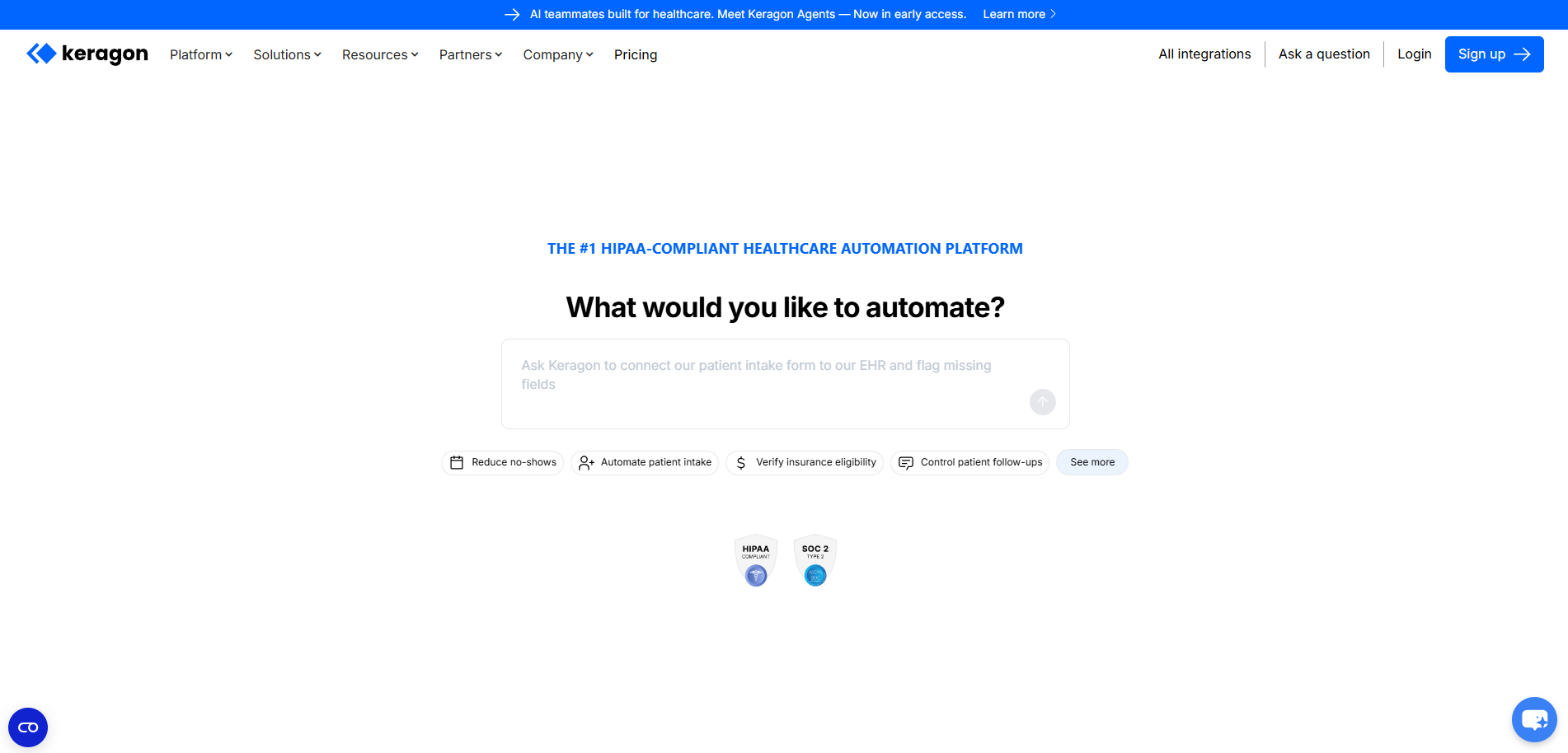
Keragon is not a like-for-like replacement for Wedge. Wedge embeds its own engineers in your organization to custom-build and then permanently maintain AI deployments; Keragon gives your team the platform to build, govern, and scale those agents yourselves, in plain English, without engineering.
The two models answer the same question (how does a healthcare organization run AI safely?) with opposite theories of ownership.
What makes Keragon a credible answer to the trust-layer pitch is that the governance isn’t a separate layer: every agent runs inside guardrails as a product feature.
Test runs preview exactly what an agent will do before it touches a live system, human-review checkpoints hold sensitive actions for sign-off, scope-locked tools restrict each agent to the systems and data you grant it, every action lands in a HIPAA audit log, and zero AI data retention keeps PHI out of model training, all under a signed BAA on every paid plan.
Score: 9.3/10. Highest marks for self-serve deployment speed (10/10), integration breadth (10/10), built-in workflow governance (9/10), and pricing accessibility (10/10).
Scored lower on enterprise-wide AI inventory and third-party model monitoring (not offered; that is the governance-platform category) and public review volume (7/10).
Product Overview
Keragon is a HIPAA-compliant, SOC 2 Type II healthcare automation platform with a no-code visual builder and AI agents, trusted by 500+ healthcare companies.
Teams describe a job in plain English (recover no-shows, run intake, verify insurance, chase unpaid balances), connect their tools, set the guardrails, and the agent runs it, with named agents covering patient intake, appointment reminders, no-show recovery, insurance verification, new patient acquisition, and pre-visit prep.
Against Wedge's five back-office agents (records, claims, coding, payments, governance), Keragon covers the records, communication, and revenue-adjacent workflows through its agent roster and 300+ integrations, and covers the governance job through the controls above rather than through a separate monitoring product.
Agents and deterministic workflows run on one platform with one audit trail, and each can trigger the other, so predictable steps stay predictable while judgment work goes to agents.
Pricing
Keragon publishes its pricing, with a 14-day free trial and a signed BAA on every paid plan:
- Starter: $149/month ($99/month billed annually), 200 workflow runs/month, 3 published workflows.
- Professional: $399/month, 2,000 workflow runs/month, 15 published workflows.
- Scale Up: $1,499/month, 20,000 workflow runs/month, 100 published workflows.
- Enterprise: custom pricing with custom volume, custom BAA terms, and a dedicated account manager.
Published pricing is a structural contrast with every other option on this list, all of which are quoted. Confirm current plans on the Keragon pricing page.
Integrations
300+ HIPAA-compliant integrations across 30+ EHRs (Athenahealth, DrChrono, Elation Health, ModMed, Healthie), scheduling, billing, forms, CRM, and communication tools, plus a universal HTTP connector for any API and a secure MCP layer that lets AI agents act across those integrations under HIPAA-compliant controls. Explore the integrations.
Setup
Hours, not an embedded engineering engagement. Sign the BAA, connect your tools, brief the agent in plain English, run it on real cases in test mode, and publish with review checkpoints where judgment matters. Most teams ship their first agent within an afternoon.
Pros and Cons
Pros:
- Governance ships with the automation: test runs, human-review checkpoints, scope-locked tools, HIPAA audit log, zero AI data retention.
- Self-serve and no-code, so the team that owns the workflow owns the agent.
- 300+ healthcare integrations plus a universal connector.
- Published pricing with a free trial, in a category of custom quotes.
- SOC 2 Type II, HIPAA, and a signed BAA on every paid plan.
Cons:
- Not an enterprise AI inventory or third-party model monitoring product; it governs the agents you run on Keragon, not every AI system in the organization.
- Not a services firm: teams wanting engineers embedded on site should look at Wedge's or Palantir's model.
- Reviewers note a learning curve on the most complex multi-branch automations.
Tradeoffs
Choose Wedge or Palantir when you want another company's engineers to build and maintain custom AI inside your walls.
Choose Qualified Health or Credo AI when the mandate is governing every AI system across an enterprise, including third-party models.
Choose Keragon when your team wants to deploy, govern, and scale its own healthcare AI agents as product, in days, at published pricing.
Support
24/7 live chat and help desk, a documentation hub, an active user community, and a directory of certified automation experts for hands-on implementation, with healthcare-specific onboarding on enterprise plans.
Mini Case Study
A representative pattern from multi-location groups: operations wanted AI agents for intake, reminders, and no-show recovery, but could not accept a black-box deployment.
On Keragon, each agent was tested on real cases before publish, sensitive actions were gated behind human-review checkpoints, and every action landed in the HIPAA audit log, giving compliance the oversight it required while the front office shipped agents the same week.
Pre-built templates. HIPAA compliant. No developers needed. Start your free trial today.
#2. Qualified Health: Best Wedge Alternative for Enterprise Health System AI Governance at Scale
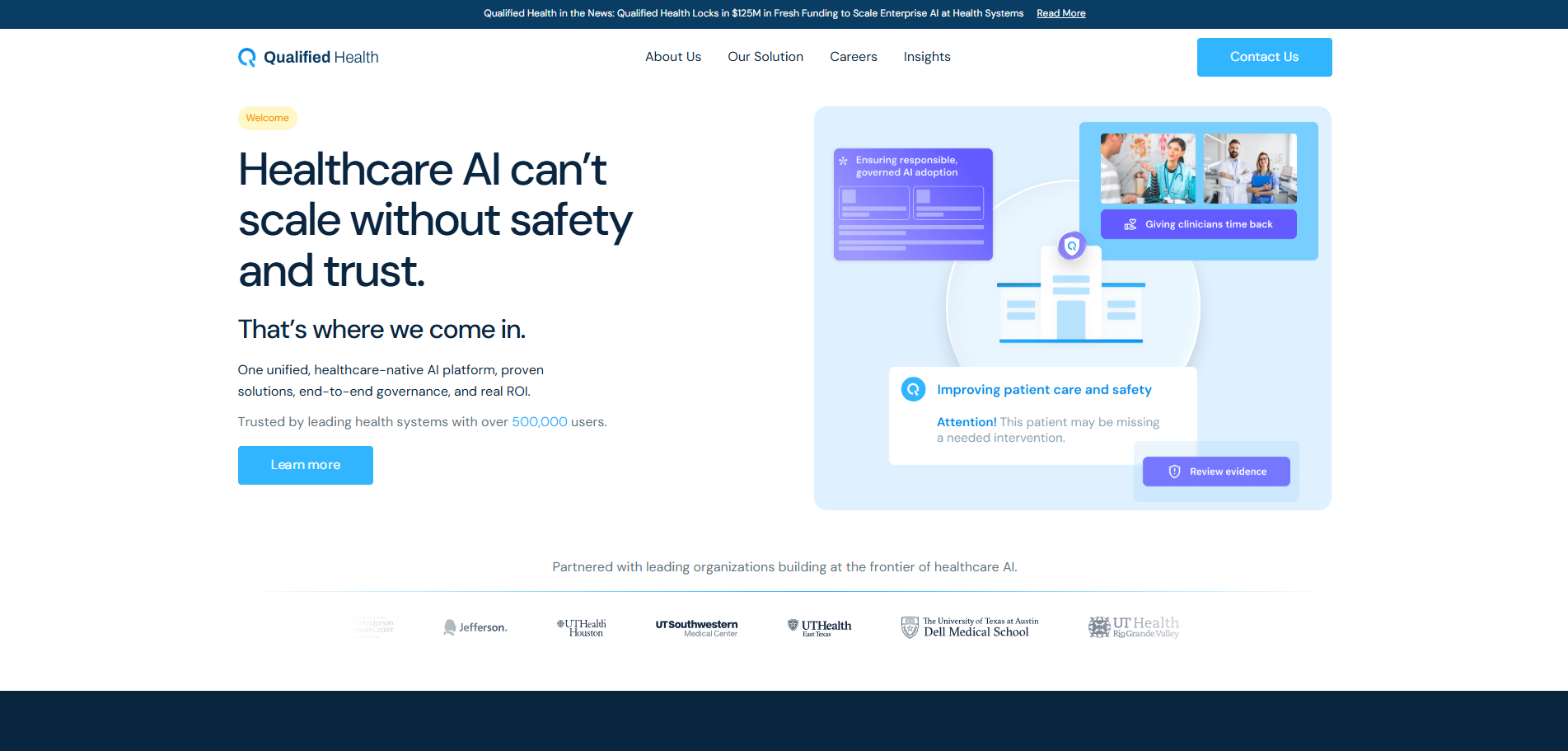
Qualified Health is the most credible direct alternative to Wedge's thesis for large health systems, executing the same trust-layer idea with enterprise scale behind it.
Score: 8.8/10. Highest marks for enterprise governance depth (10/10), health system traction (10/10), and platform breadth (9/10).
Scored lower on accessibility below enterprise scale (4/10) and pricing transparency (3/10).
It raised a $125 million Series B led by NEA in March 2026, with participation including Anthropic's partner fund, and supports more than 500,000 users across systems representing roughly 7 percent of US hospital revenue (Fierce Healthcare).
Product Overview
Qualified Health is a healthcare-native enterprise AI platform that unifies workflows, use cases, and models under a single governed operating layer.
Governance is built in rather than bolted on: clinician oversight, full auditability and traceability of decisions, source attributions, continuous post-deployment monitoring, and role-based access controls, alongside builder tools for teams to create their own agents on the governed foundation.
Customers include Emory Healthcare, Jefferson Health, University of Rochester Medicine, Mercy, and all eight University of Texas System institutions.
Pros and Cons
Pros:
- Enterprise-proven at flagship health systems, with governance and monitoring as the core product.
- Deep pockets and momentum: one of the largest healthcare-AI Series B rounds on record.
- Agent builder tools sit on the governed foundation, covering both automation and oversight.
Cons:
- Built for health system enterprise deployments, not practices or startups.
- Custom pricing and organization-wide implementation programs.
- A platform commitment: this is an infrastructure decision, not a tool purchase.
Pricing
Enterprise custom. Contact Qualified Health.
Setup
Enterprise program spanning data integration, workflow embedding, and workforce enablement; measured in months.
Tradeoffs
Choose Qualified Health when a health system wants one governed platform for its entire AI footprint.
Choose Credo AI when the need is a governance system of record across AI you buy and build.
Choose Keragon when a team wants to ship governed automation itself this week, at published pricing, without an enterprise program.
#3. Credo AI: Best Wedge Alternative for an AI Governance System of Record
Score: 8.2/10. Highest marks for governance framework depth (10/10), regulatory mapping (10/10), and analyst recognition (9/10).
Scored lower on healthcare workflow automation (not offered, 2/10) and mid-market accessibility (4/10).
Product Overview
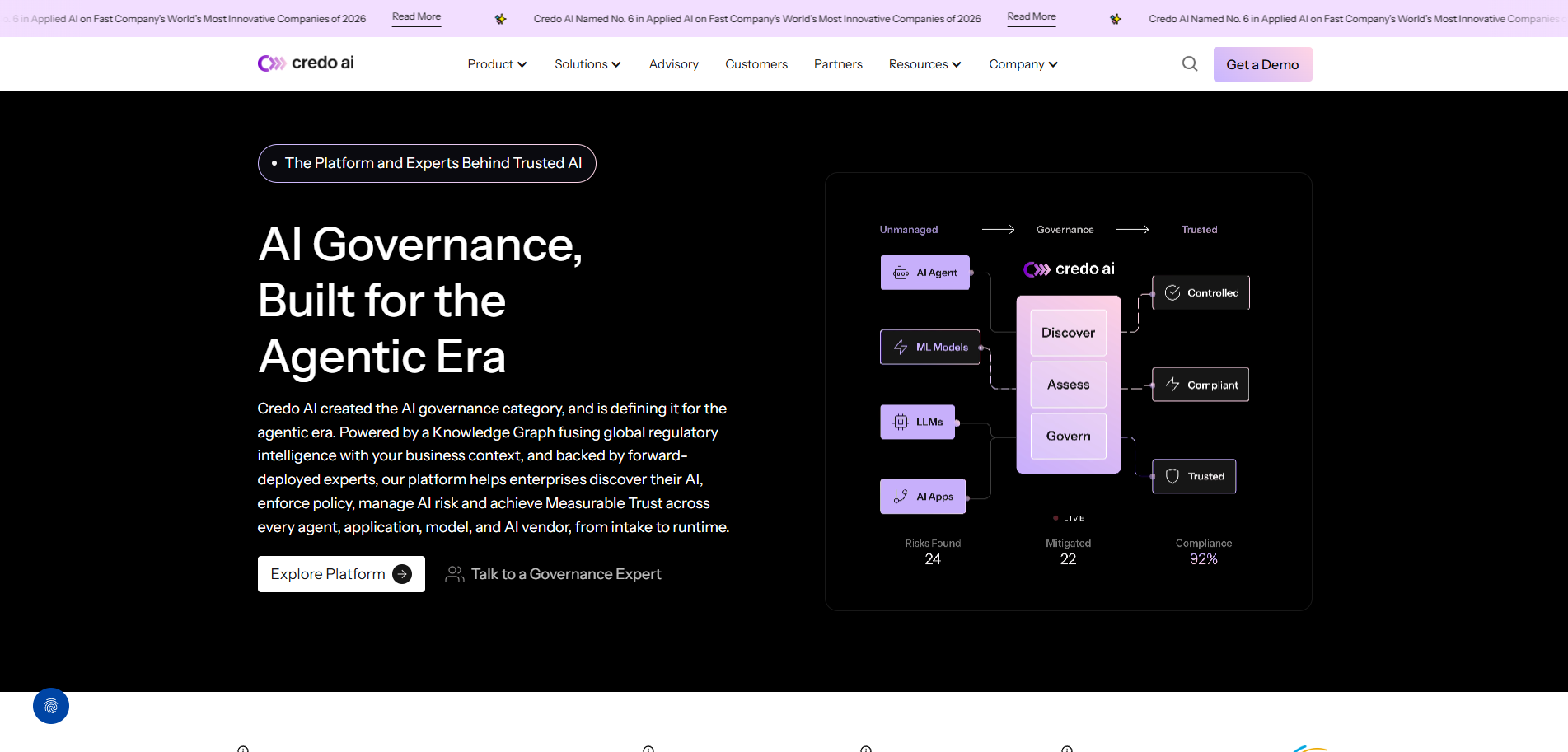
Credo AI is the enterprise AI governance platform recognized by Forrester and Gartner, and in 2026, it extended formally into healthcare by joining the Coalition for Health AI (CHAI) Partner Program.
Its TrustOS platform acts as the system of record for AI governance: inventorying every AI system an organization runs (built, bought, and shadow), enforcing policy, triaging vendor risk, and producing audit-ready evidence, with a healthcare policy pack mapping controls to HIPAA, HITRUST, NIST AI RMF, ISO 42001, state insurance AI rules, and The Joint Commission's Responsible Use of AI guidance.
Pros and Cons
Pros:
- The strongest pure-governance answer: one source of truth across overlapping AI regulations.
- CHAI partnership operationalizes the emerging healthcare AI standards directly.
- Covers third-party and shadow AI, which automation platforms do not see.
Cons:
- Governance only: it monitors and enforces, but does not run any workflow itself.
- Enterprise custom pricing.
- General-purpose platform; healthcare depth arrives through the policy pack rather than native workflows.
Pricing
Enterprise custom. Contact Credo AI.
Setup
Enterprise governance rollout: AI inventory, policy configuration, and workflow integration over weeks to months.
Tradeoffs
Choose Credo AI when the mandate is governing every AI system the organization touches, especially for audit and regulatory evidence.
Choose Qualified Health when you want governance fused with a healthcare-native operating platform.
Choose Keragon when the immediate need is running governed automation, with the audit trail generated by the platform doing the work.
#4. Palantir: Best Wedge Alternative for Forward-Deployed Enterprise Data and AI

Score: 7.8/10. Highest marks for the forward-deployed model at scale (10/10), data platform depth (9/10), and enterprise track record (9/10).
Scored lower on healthcare-native workflow specificity (5/10), accessibility (2/10), and cost (2/10).
Product Overview
Wedge's own positioning invites the comparison: Palantir invented the forward-deployed engineer model that Wedge applies to healthcare AI.
Palantir Foundry gives enterprises a data integration and operations platform, with its AI Platform (AIP) layering LLM-driven workflows on top, and Palantir engineers embedding with customer teams to build to the organization's exact shape.
It’s deployed across health systems, payers, and government health agencies.
Pros and Cons
Pros:
- The original, battle-tested version of the embedded-engineering model Wedge emulates.
- Enterprise-grade data foundation underneath the AI layer.
- Deep security posture and government-scale deployments.
Cons:
- Enterprise pricing at the top of the market.
- Not healthcare-specific; workflows are built, not bought.
- Vendor-embedded engineering creates its own long-term dependency.
Pricing
Enterprise custom. Contact Palantir.
Setup
Enterprise engagements with embedded engineers; months, scaling with scope.
Tradeoffs
Choose Palantir when you want the forward-deployed model with a decade of enterprise proof and a data platform underneath it.
Choose Wedge when you want that model healthcare-first and are comfortable with an early-stage partner.
Choose Keragon when you want the outcome (governed healthcare automation) without embedding anyone's engineers at all.
#5. Cair Health: Best Wedge Alternative for Revenue Cycle AI Agents
Score: 7.4/10. Highest marks for RCM agent breadth (8/10) and traction for its stage (8/10, 100+ practices per company figures).
Scored lower on scope beyond revenue cycle (4/10) and pricing transparency (4/10).
Product Overview
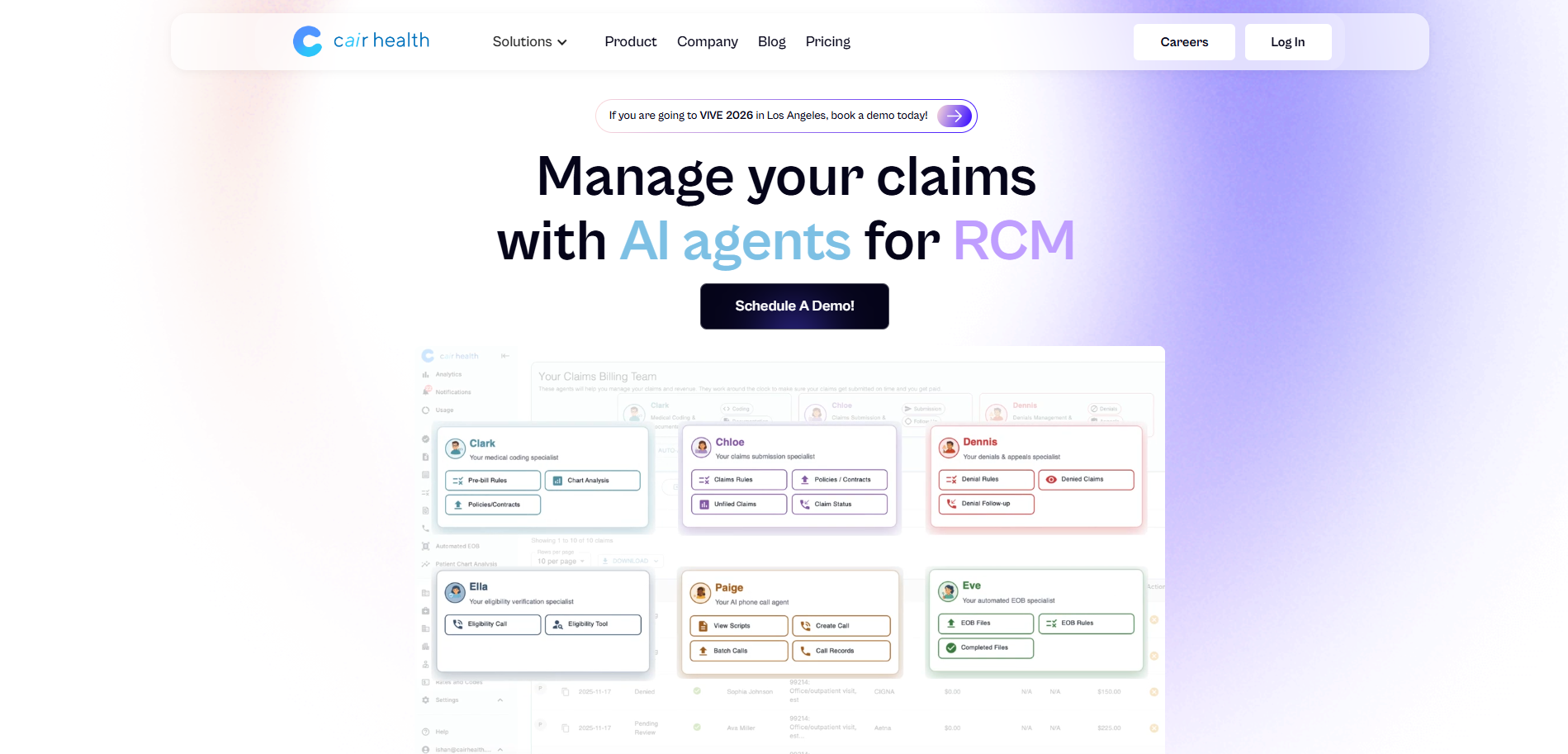
Cair Health builds AI agents for revenue cycle management, serving billing companies, provider groups, EHRs, specialty pharmacies, and offshore BPOs.
Its agent suite streamlines RCM operations while keeping teams in control of core workflows, which maps directly onto the claims, coding, and payments portion of Wedge's agent roster.
The company reports 100+ practices on the platform, backed by Y Combinator and Foundation Capital.
Pros and Cons
Pros:
- Focused depth on revenue cycle, the densest back-office pain.
- Serves the RCM ecosystem itself (billing companies, BPOs), not only providers.
- Human-in-control design over core workflows.
Cons:
- RCM-scoped; intake, communication, and operations workflows sit outside it.
- Early-stage vendor with custom pricing.
- Not a governance product.
Pricing
Custom. Contact Cair Health.
Setup
Integration with billing systems and EHRs; weeks, varying by footprint.
Tradeoffs
Choose Cair Health when revenue cycle is the specific job, and you want agents built for it.
Choose LunaBill when the bottleneck is specifically claim follow-up calls.
Choose Keragon when you want one governed platform running RCM-adjacent workflows alongside intake, reminders, and the rest of the front office.
#6. Plena: Best Wedge Alternative for a Specialty Practice AI Operating Layer
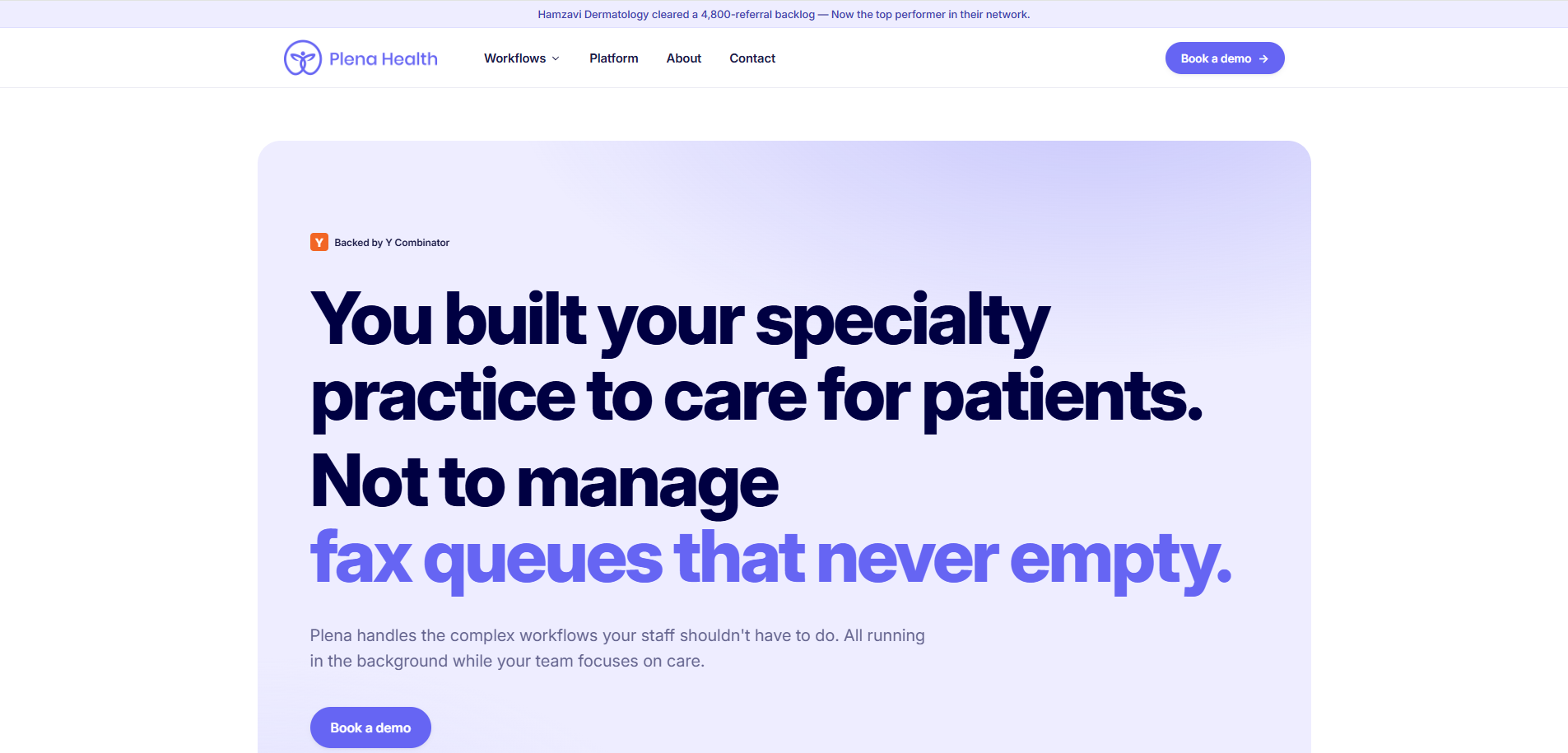
Score: 7.2/10. Highest marks for end-to-end practice workflow coverage (8/10) and operating-layer ambition (7/10).
Scored lower on maturity (5/10) and governance tooling (4/10).
Product Overview
Plena positions itself as the AI operating system for specialty medical practices, automating referrals, fax intake, scheduling, procedure compliance, and collections end-to-end across the systems a practice already uses.
Like Wedge, the pitch is an operating layer rather than a point solution; unlike Wedge, it targets specialty practices rather than hospitals and health plans.
Pros and Cons
Pros:
- End-to-end coverage of specialty-practice administrative workflows.
- Works across existing systems rather than replacing them.
- Right-sized for practices that enterprise platforms ignore.
Cons:
- Specialty-practice focus; not built for health systems or payers.
- Early-stage with custom pricing.
- Governance controls are not the product's center.
Pricing
Custom. Contact Plena.
Setup
Practice onboarding across existing systems; weeks.
Tradeoffs
Choose Plena when you run a specialty practice and want its specific workflow set automated as a managed layer.
Choose Keragon when you want to build and control the automation yourself, with governance features and published pricing, across any healthcare organization type.
#7. LunaBill: Best Wedge Alternative for AI Voice Claim Follow-Up
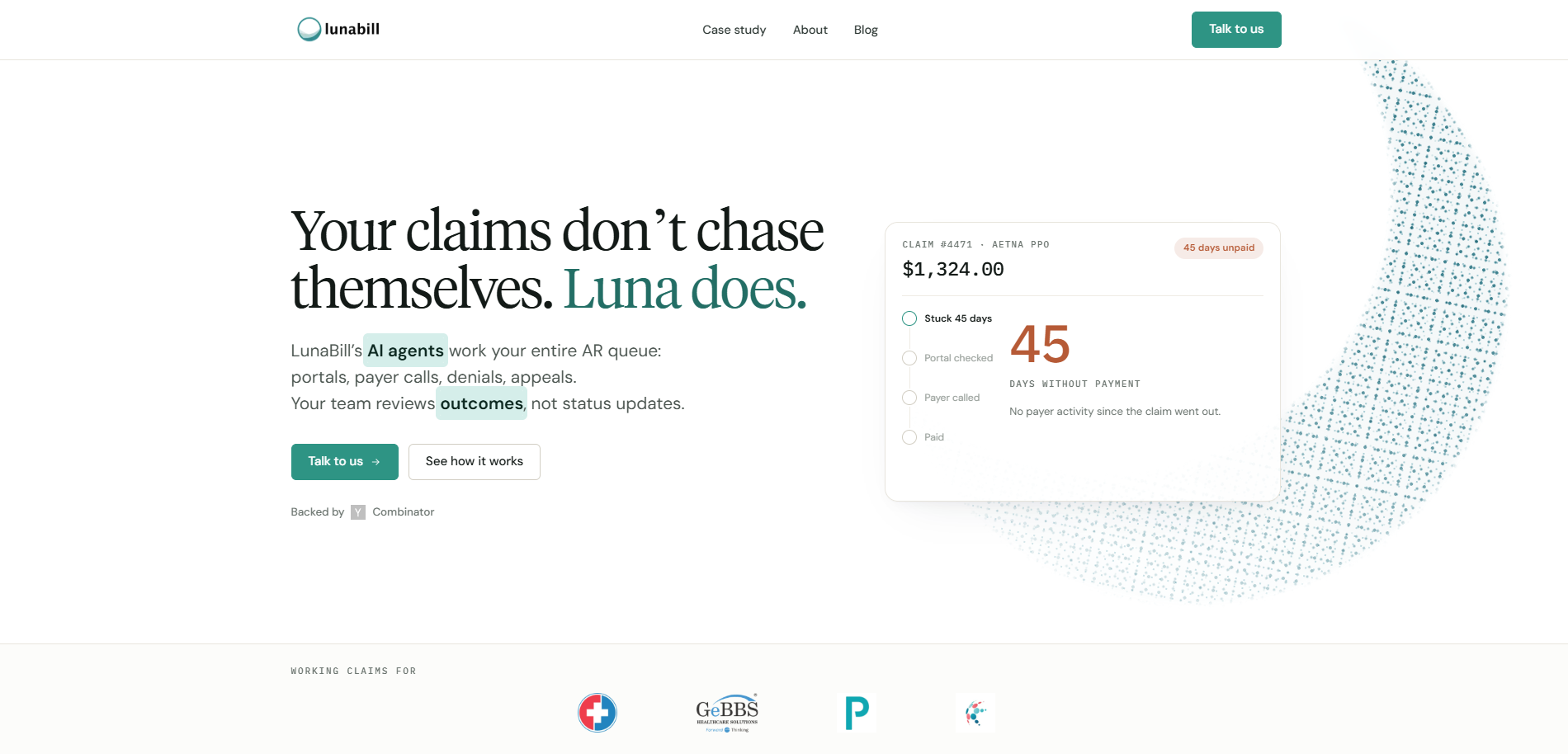
Score: 7.0/10. Highest marks for problem focus (9/10) and reported traction (8/10).
Scored lower on scope (3/10, one workflow) and governance breadth (3/10).
Product Overview
LunaBill builds AI voice callers for healthcare billing teams, attacking one brutal workflow: insurance claim follow-up calls, which the company notes consume about 80 percent of a billing team's day at roughly 30 minutes per call.
LunaBill reports more than 50,000 automated calls, $764K in contracted ARR within months of launch, and partnerships including UC health systems, Mayo, and Experian Health.
Pros and Cons
Pros:
- Laser focus on the highest-volume manual task in billing.
- Strong reported early traction and marquee partnerships.
- Fast time to value on a single measurable workflow.
Cons:
- Single-workflow scope; everything else stays manual.
- Early-stage vendor, custom pricing.
- Voice-first design does not cover the surrounding data workflows.
Pricing
Custom. Contact LunaBill.
Setup
Days to weeks: connect billing systems and go live on follow-up queues.
Tradeoffs
Choose LunaBill when claim follow-up calls are the bottleneck and you want them gone fast.
Choose Cair Health for broader RCM agent coverage.
Choose Keragon when the calls are one piece of a wider automation program you want to run on one governed platform.
#8. Adentris: Best Wedge Alternative for AI Claims Compliance
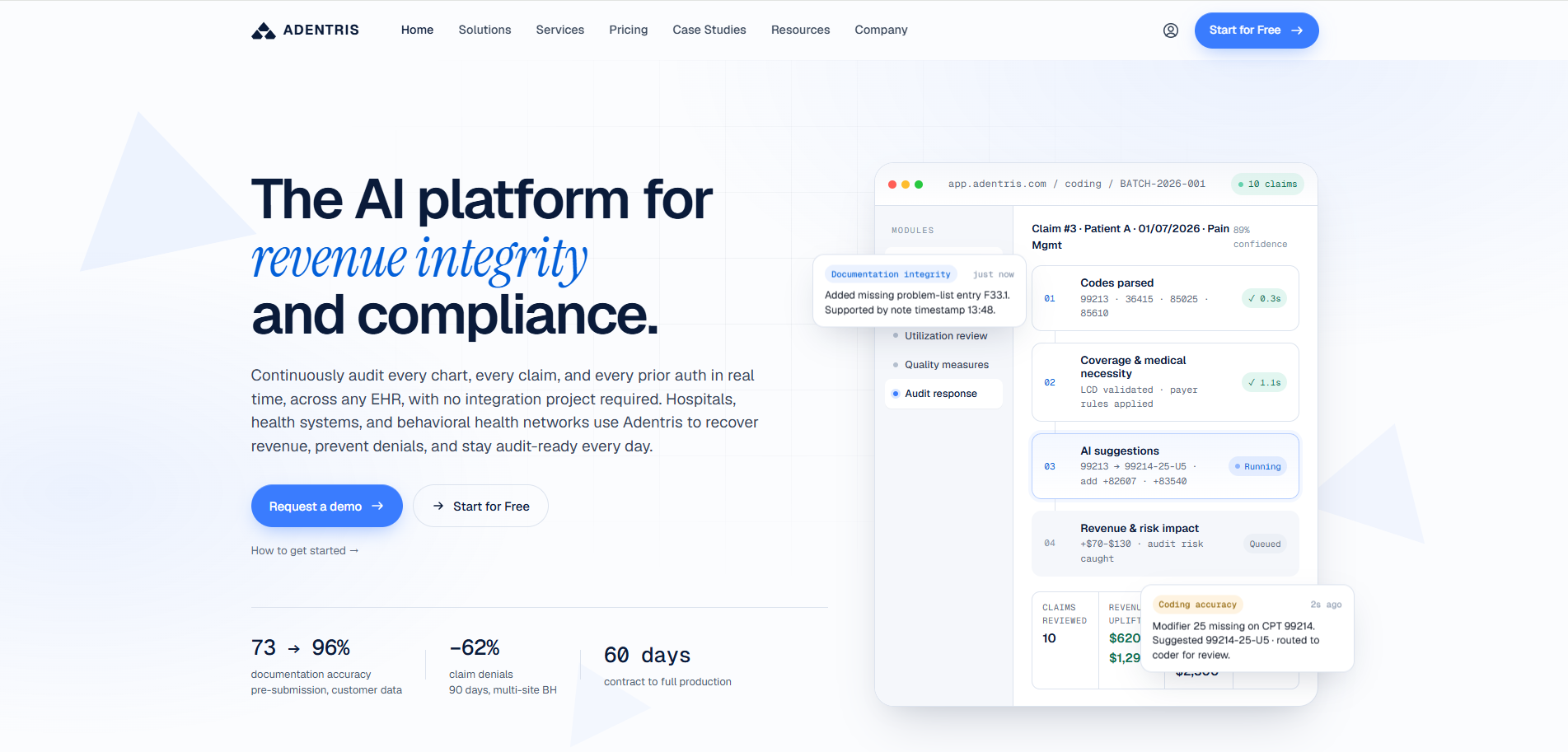
Score: 6.8/10. Highest marks for problem clarity (8/10) and compliance framing (7/10).
Scored lower on scope (3/10) and maturity (4/10).
Product Overview
Adentris is an AI compliance copilot for hospitals and clinics, described in its own launch as "Grammarly for doctors": it finds and fixes the documentation mistakes that lead to denied insurance claims or patient lawsuits, a job the industry spends an estimated $40 billion a year doing manually per the company.
It overlaps with the governance corner of Wedge's roster from the documentation-quality angle.
Pros and Cons
Pros:
- Attacks denials at the root cause: documentation errors.
- A compliance framing clinicians can adopt without workflow change.
- Clear, measurable value in prevented denials.
Cons:
- Narrow scope: documentation checking, not automation or platform governance.
- Early-stage with custom pricing.
- Not a substitute for organizational AI oversight.
Pricing
Custom. Contact Adentris.
Setup
EHR-adjacent deployment; weeks.
Tradeoffs
Choose Adentris when denial-driving documentation errors are the acute problem.
Choose Cair Health or LunaBill for the downstream claims workflows.
Choose Keragon when you want the denial-prevention workflow (eligibility checks, clean intake, documentation routing) automated across your stack rather than checked at the end.
Why Choose Wedge Alternatives
Here are the top reasons to choose Wedge alternatives.
Product ownership instead of embedded services
Wedge's forward-deployed model means another company's engineers build and permanently maintain your AI.
Organizations that want the capability in-house choose platforms their own teams operate: Keragon for self-serve automation, Qualified Health for enterprise infrastructure.
Vendor maturity for risk-averse buyers
Healthcare procurement weighs vendor viability heavily.
Wedge launched in 2025 on a pre-seed; Qualified Health closed a $125 million Series B, Credo AI carries Forrester and Gartner recognition, Palantir is public, and Keragon is trusted by 500+ healthcare companies.
Stage is a legitimate selection criterion when PHI and clinical operations are involved.
Governance that is enforceable, not advisory
The trust-layer promise only matters if controls actually gate what AI does.
Look for enforcement primitives: human-review checkpoints and scope-locked tools (Keragon), platform-level oversight and monitoring (Qualified Health), and policy enforcement with audit-ready evidence (Credo AI).
Published pricing and self-serve evaluation
Custom-services models cannot be trialed.
Keragon's published tiers and 14-day free trial let a team validate the fit on real workflows before any commitment, which the quoted end of this market structurally cannot offer.
Fit to your organization type
Wedge targets hospitals, health plans, and multi-physician groups with c-suite sales.
Specialty practices (Plena), billing operations (Cair Health, LunaBill), and lean digital health teams (Keragon) are better served by tools shaped for them.
The automation itself, not just the oversight
Back-office burden is the reason this category exists: prior authorization alone consumes roughly 13 hours of staff time per physician per week, per the AMA (AMA).
A governance layer with nothing to govern returns nothing; the automation doing the work is where the ROI lives.
How to Choose the Right Wedge Alternative
You can take these steps to help you choose the right Wedge alternative for your organization.
Step 1: Decide whether you are buying automation, governance, or both
Wedge bundles them, but they’re separable.
If the job is running back-office agents, evaluate Keragon, Cair Health, LunaBill, and Plena.
If the job is governing an enterprise AI estate including third-party models, evaluate Qualified Health and Credo AI.
Many organizations need one of each, not one of everything.
Step 2: Choose your ownership model
Embedded engineers (Wedge, Palantir) versus enterprise platform program (Qualified Health) versus self-serve product (Keragon).
The right answer follows from who will own the capability in three years, your team or your vendor's.
Step 3: Verify compliance posture in writing
Require a signed business associate agreement (see the HHS sample BAA provisions), encryption, role-based access, and audit logs from any vendor touching PHI, plus SOC 2 Type II where available, and ask specifically how AI-generated actions are logged and replayable.
Step 4: Test the governance primitives on a real workflow
In a trial or pilot, verify you can preview an agent's actions before publish, require human sign-off on a sensitive step, restrict an agent's tool access, and pull the audit trail afterward.
If the controls are slideware, this is where it shows.
Step 5: Model cost against scope, then pilot narrow
Custom engagements price by scope you cannot see yet; platforms price by volume you can.
Model both at your real workflow volume, then pilot one high-value workflow end-to-end before standardizing.
Key Features to Look for in Wedge Competitors
Look out for these key features when evaluating Wedge competitors.
Human-in-the-loop controls
Review checkpoints on sensitive actions, with the agent waiting for sign-off rather than proceeding.
Scope-locked agent permissions
Each agent restricted to the tools and data explicitly granted, nothing more.
Test-before-publish environments
Preview exactly what an agent will do on real cases before it touches live systems.
HIPAA audit logging and replayability
Every AI action logged, attributable, and reviewable step by step.
Zero AI data retention
PHI never used to train or improve models, stated contractually.
Healthcare integration depth
Native EHR, scheduling, billing, and communication connectors, so governance does not come at the price of connectivity.
Cost Comparison: Wedge vs. Alternatives
Most of this category is quoted; the structural comparison is pricing model and evaluability.
- Wedge: unpublished; forward-deployed engineering engagements priced by scope.
- Keragon: published tiers from $149/month (Starter), $399/month (Professional), $1,499/month (Scale Up), Enterprise custom; 14-day free trial; BAA on every paid plan.
- Qualified Health: enterprise custom, organization-wide platform programs.
- Credo AI: enterprise custom, scoped to AI estate size.
- Palantir: enterprise custom at the top of the market.
- Cair Health: custom, scoped to RCM volume.
- Plena: custom, per-practice.
- LunaBill: custom, scoped to call volume.
- Adentris: custom.
Which of the Wedge Alternatives Is Right for Your Organization?
- Health system governing its entire AI estate on one platform: Qualified Health.
- Enterprise needing an AI governance system of record across built, bought, and shadow AI: Credo AI.
- Organization wanting the forward-deployed model with maximum enterprise proof: Palantir.
- Billing operation automating revenue cycle with agents: Cair Health.
- Team drowning specifically in claim follow-up calls: LunaBill.
- Specialty practice wanting its admin workflows run as a managed layer: Plena.
- Hospital attacking denial-driving documentation errors: Adentris.
- Any healthcare team that wants to deploy, govern, and scale its own AI agents this week, with guardrails built in and published pricing: Keragon.
Deploy Governed Healthcare AI Agents with Keragon
The trust layer shouldn’t be a separate purchase.
Keragon is a HIPAA-compliant, SOC 2 Type II healthcare automation platform where AI agents run inside guardrails you set: test runs before publish, human-review checkpoints, scope-locked tools, a HIPAA audit log, and zero AI data retention, across 300+ integrations, with a signed BAA on every paid plan and a 14-day free trial.
See Keragon Agents, or review the HIPAA compliance details.
FAQs
What is the best Wedge alternative in 2026?
It depends on what you are buying.
Qualified Health is the strongest enterprise alternative for health systems wanting a governed AI platform, Credo AI for a governance system of record, and Palantir for the forward-deployed model at proven scale.
For teams that want self-serve healthcare AI automation with governance built in, Keragon is the best fit.
What does Wedge actually do?
Wedge, a Y Combinator Summer 2025 company, calls itself the trust layer for healthcare AI.
It forward-deploys engineers inside hospitals, health plans, and physician organizations to custom-build agentic AI, then monitors and maintains those deployments, with five agent products covering records, claims, coding, payments, and governance.
Is this the same Wedge as the HR interviewing software?
No. Several companies share the name. This guide covers Wedge, the healthcare AI company (YC S25, the "trust layer for healthcare AI").
Wedge, the video-interviewing tool, serves HR and recruiting teams, and there’s also a consumer payments product by the name; alternatives to those are entirely different categories.
What is a trust layer for healthcare AI?
It’s the oversight infrastructure that makes AI safe to run in a healthcare organization: evaluating tools before deployment, enforcing policy on what AI can do, monitoring behavior in production, and keeping auditable records.
Some vendors sell it as a separate platform (Credo AI, Qualified Health); others build the controls into the automation itself (Keragon).
Wedge vs Qualified Health: what is the difference?
Both sell the governed-AI thesis to healthcare organizations.
Qualified Health is an enterprise platform with $125 million in fresh funding, 500,000+ users, and flagship systems like Emory and the University of Texas System; Wedge is a 2025 pre-seed startup executing the idea through forward-deployed engineering.
Maturity and delivery model are the practical differences.
Can Keragon and Wedge work together?
In principle, yes: an organization could run self-serve automation on Keragon while Wedge's engineers build custom deployments elsewhere in the enterprise.
In practice, they answer the same need with opposite models (product versus embedded services), so most teams pick the ownership model first, and one vendor follows from it.
How is Keragon's governance different from an AI governance platform?
Keragon governs the agents it runs: test-before-publish, human-review checkpoints, scope-locked tools, a HIPAA audit log, and zero AI data retention, enforced by the platform executing the work.
Governance platforms like Credo AI oversee AI that the organization runs anywhere, including third-party and shadow AI, without executing workflows themselves. Enforcement versus oversight.
Are Wedge alternatives HIPAA compliant?
The credible ones are, but verify each in writing: a signed business associate agreement, encryption in transit and at rest, role-based access, and audit logs, ideally with SOC 2 Type II.
Keragon includes a signed BAA on every paid plan; enterprise platforms negotiate BAAs in their contracts.
What governance features should healthcare AI automation include?
Five primitives: preview or test runs before an agent touches live systems, human-review checkpoints on sensitive actions, scope-locked permissions per agent, complete and replayable audit logs, and contractual zero data retention for AI.
If a vendor cannot demonstrate all five on a live workflow, the trust layer is marketing.
What is the best option for smaller healthcare organizations?
Enterprise governance platforms and forward-deployed engagements are priced and shaped for health systems.
Practices, clinics, and digital health teams get further with self-serve tools: Keragon from $149 per month with a 14-day free trial for governed automation, or Plena for specialty practices wanting a managed workflow layer.
Why not just wait for Wedge to mature?
Waiting has a cost: the back-office burden AI agents remove accrues every week, and governance expectations from regulators and boards are rising now.
The practical path most organizations take is deploying governed automation on a mature platform today, and revisiting services-led models if a custom need emerges that product cannot cover.
Related Articles


Related Articles