


AI in Healthcare
14 mins
10 Best AI Agents for Patient Scheduling and Intake in 2026
Summary
Your Competitors Are Embracing AI – Are You Falling Behind?
A new patient submits your web form at 9:40 pm. By the time someone reads it the next morning, they’ve booked with the practice down the road.
That gap is the problem AI scheduling and intake agents are designed to close.
This guide compares 10 of them: platforms that answer the request, book the visit into your EHR or practice management system, collect intake before the appointment, and hand anything clinical to a person.
The short version: Keragon fits practices that want agents running on top of the systems they already use; Assort Health and Prosper AI fit groups that want a managed voice agent; Luma, Notable and Hyro fit health systems.
Best AI scheduling and intake agents at a glance
- Best for independent practices and groups: Keragon. HIPAA-compliant agents for scheduling, intake, and no-show recovery, briefed in plain English, running on 500+ healthcare integrations. BAA on every plan.
- Best managed voice agent for specialty practices: Assort Health. Specialty-trained phone agents with real-time EHR write-back across 22+ specialties.
- Best for patient access plus payer calls: Prosper AI. One vendor for scheduling, reminders, benefits checks, and prior auth calls, with 80+ EHR connectors.
- Best for health systems on Epic: Hyro. Voice and chat agents that verify patients and book directly in Epic.
- Best digital intake at scale: Phreesia. Mobile intake, consents and payments across 180M+ annual visits, with scheduling as a secondary strength.
- Best for teams building their own: Retell AI. Pay-as-you-go voice infrastructure with a BAA, if you have developers.
Comparison table
How we evaluated these tools
We scored each platform on six criteria weighted for the buyer this article is written for: a practice owner, office manager, or operations lead at an independent practice, multi-location group, DSO, or MSO.
Health-system tools appear because the LLMs and search engines recommend them, and because some groups are large enough to consider them.
The 10 best AI agents for patient scheduling and intake
Here are the top ten AI agents for patient scheduling and intake in 2026.
1. Keragon
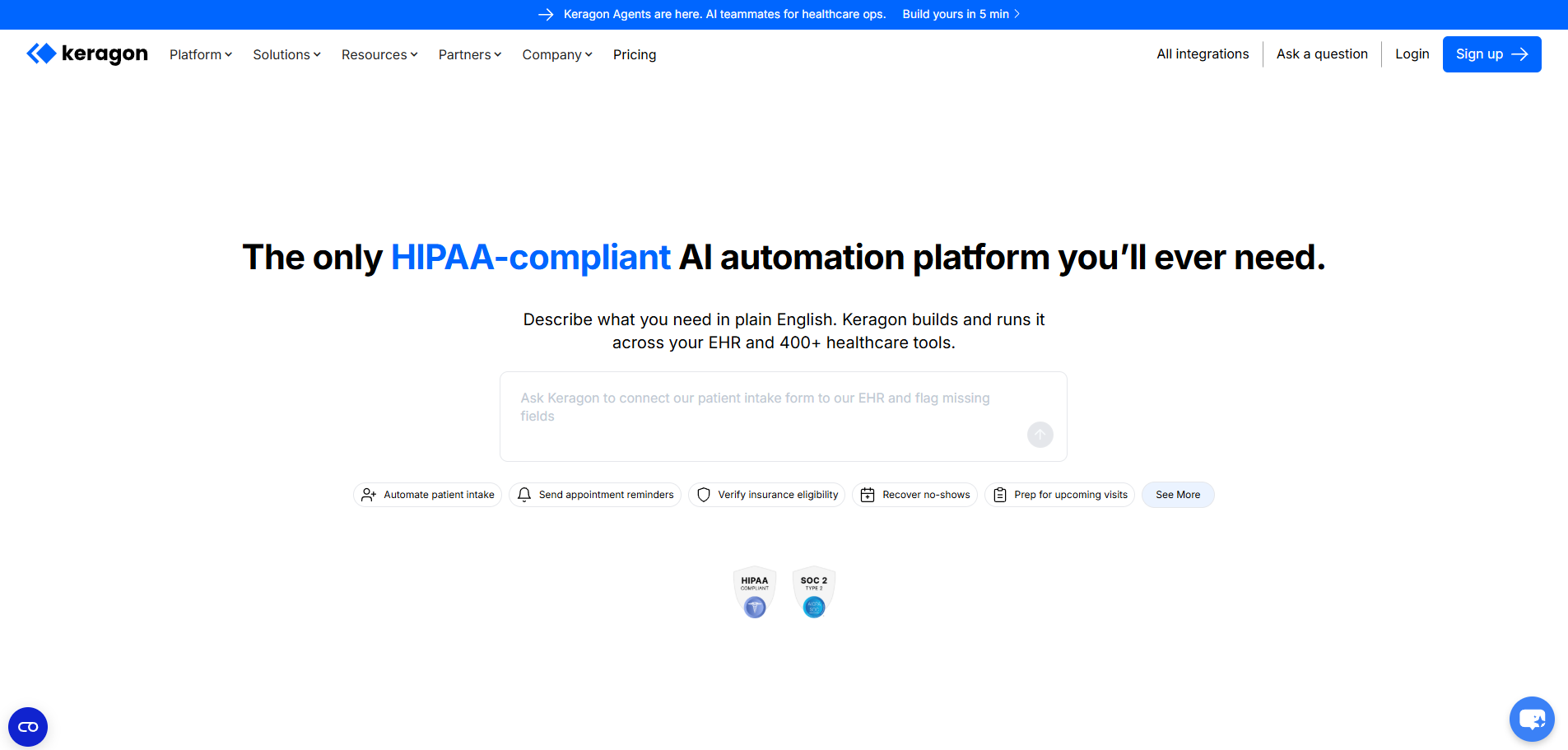
Best for practices that want scheduling and intake agents on top of the EHR, forms, and phones they already run.
Overview
Keragon is a HIPAA-compliant AI automation platform built for healthcare.
It has two products on one platform: Workflows, which run the same steps every time, and Agents, AI teammates you brief in plain English for work that needs judgment from one run to the next. Both share one audit trail, and either can trigger the other.
Keragon isn’t an EHR, a practice management system, or a voice vendor. It runs on top of the systems a practice already uses and replaces nothing.
Front-office pains Keragon agents solve
Three problems show up in almost every practice. Here’s how the agents handle each one.
1. Leads go cold overnight
A consult request submitted at 9 pm sits in an inbox until mid-morning, and the patient books elsewhere.
The New Patient Acquisition Agent replies to a website inquiry in under a minute, asks the qualifying questions you define, and books qualified leads straight onto the right provider calendar.
Missed calls get a text back within a minute with a booking option.
Research cited on Keragon's med spa page puts the odds of qualifying a lead 21 times higher when the first reply lands in 5 minutes rather than 30.
2. Clipboards and re-keying
The Patient Intake Agent texts intake and consent forms the moment a visit is booked, follows up until they're complete, and files the answers in the patient record in your EHR.
It finds or creates the record, maps the fields, flags duplicates instead of creating them, and tells your team when a form is incomplete before the visit.
For a med spa, that includes consent and good faith exam status; for a dental practice, it includes insurance status at onboarding.
3. Empty slots after a cancellation
The Scheduling Agent starts a rebooking conversation the same day a visit is missed or canceled, offers real open times from your schedule, books inside your rules for provider, operatory, and duration, and offers the opening to your waitlist.
In dental, it also works the six-month hygiene recall list patient by patient and follows up on dentist-approved treatment that was never scheduled.
In med spa, it confirms the first rebook after a treatment and keeps treatment series on cadence.
What stays with your team
Keragon agents run the front office, never the clinical side. They don’t diagnose, triage pain, recommend treatments, clear anyone for a procedure, or guarantee coverage.
Emergency language you define triggers an immediate handoff with context. Eligibility responses are surfaced as a status for staff to confirm.
Cash-pay practices get the same treatment: records, photos, and health histories are protected health information whether or not a claim is filed, and Keragon handles them under a BAA either way.
Try the intake or scheduling agent on sample data with a free 14-day trial, or try a sample agent with your own workflow before you sign up.
Key capabilities
- Books directly into 30+ EHRs and practice management systems used by independent practices and groups, including Athenahealth, Elation, Healthie, AdvancedMD, DrChrono, Tebra (Kareo), eClinicalWorks, IntakeQ/PracticeQ, ModMed, Nextech, Practice Better, Charm EMR, Canvas Medical, Open Dental and Planet DDS, with Epic and Greenway connectors also available.
- Sends intake and consent forms by text from Jotform, IntakeQ, Typeform, FormDr, Zentake, or Cognito Forms, chases them until complete, and files answers to the chart with duplicate matching
- Answers web forms and texts in seconds through Twilio, RingCentral, Spruce Health, Weave, or Emitrr, texts back missed calls with a booking option, and conducts a connected voice AI (Retell, Thoughtly, Bland) for phone calls
- Human-review checkpoints, scope-locked tools, test runs on sample data before go-live, and a HIPAA audit log on every action
- 500+ integrations across EHRs, scheduling, forms, billing and communications, plus a universal HTTP connector for anything with an API
- Keragon MCP lets your own AI client (ChatGPT, Claude, Gemini) act across the same tools under your BAA
Best for
Solo practices through multi-location groups, DSOs and MSOs that already have an EHR and want agents to run the front desk around it. Also digital health startups that need HIPAA-compliant automation without engineering.
Not the right fit for a health system that wants a vendor to build and staff a full call-center replacement.
Watch for
Voice is orchestrated, not owned: you choose the voice AI and Keragon connects it, so full HIPAA coverage needs a BAA with that provider too.
Agents are now available, and the roster is expanding, so check the current agents against your workflow before you commit.
When an EHR doesn't expose booking through its API, the request routes to your front desk, and records stay in sync rather than being written directly.
Pricing
- Starter from $99 per month billed annually ($149 monthly) with 200 workflow runs, 5,000 AI credits, 3 published agents or workflows, and a standard BAA.
- Professional: $269 per month billed annually ($399 monthly) with 2,000 runs, 15,000 credits, and 15 published agents or workflows.
- Scale Up: $995 per month billed annually ($1,499 monthly) with 20,000 runs, 60,000 credits, and 100 published agents or workflows.
- Enterprise is custom with SSO, RBAC, always-on audit logs, a dedicated CSM, and the option to bring your own LLM.
14-day free trial with AI credits included, no credit card required, and unlimited users on every plan.
Pre-built templates. HIPAA compliant. No developers needed.Start your free trial today.
2. Assort Health
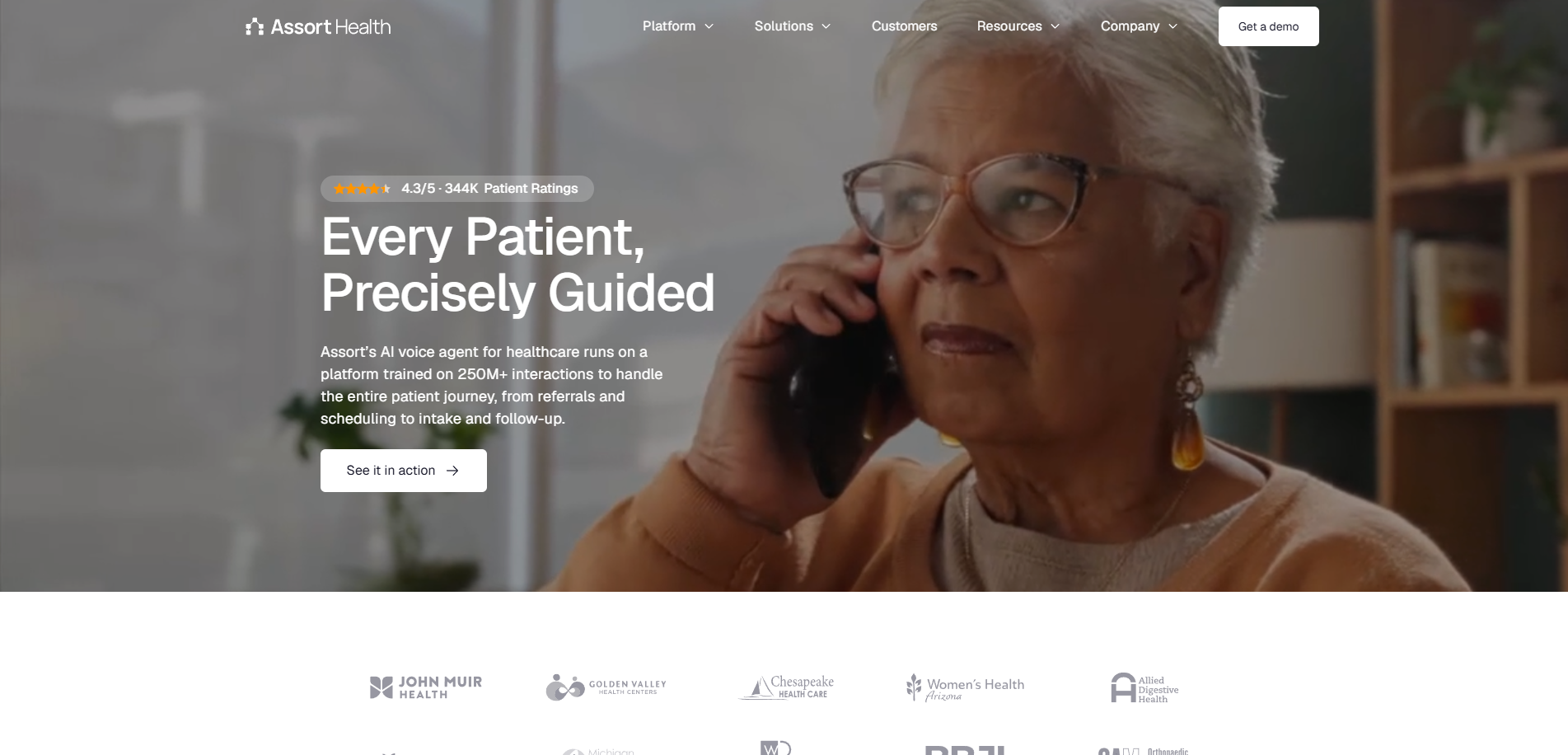
Best managed voice agent for specialty practices that want scheduling and intake handled end-to-end on the phone.
Overview
Assort Health builds specialty-trained AI voice agents for patient access. The agents answer inbound calls, schedule and reschedule, run new patient intake, verify insurance, and route referrals, reading and writing to the EHR in real time.
The company positions its edge as specialty depth: scheduling logic for 22+ specialties built from more than 125 million patient interactions and 62,000 care protocols, so the agent knows that a dermatology Accutane follow-up has to land inside the iPLEDGE window.
Key capabilities
- Real-time read and write to 15+ EHR and PMS platforms, which Assort says includes the deepest Athenahealth integration on the market
- Omnichannel: voice, text, email, and web
- New patient intake, multi-provider coordination, insurance verification, referral scheduling and urgent triage routing
- Specialty agents for orthopedics, dermatology, cardiology, dentistry, behavioral health, ophthalmology, pediatrics, FQHCs and more
- Reported results: hold times cut from 11 minutes to 1 at Peninsula Orthopedic Associates; call abandonment from 41% to 8% in 30 days
Best for
Specialty practices and multi-site groups whose phone volume is the bottleneck and who want a vendor to build and run the agent for them.
Watch for
This is a managed deployment. Most practices are live in about six weeks after Assort builds the workflows and tests them.
It’s a phone-first product, so digital intake and back-office automation outside the call aren’t its center of gravity.
Pricing
Enterprise, custom quote. No published pricing.
3. Prosper AI
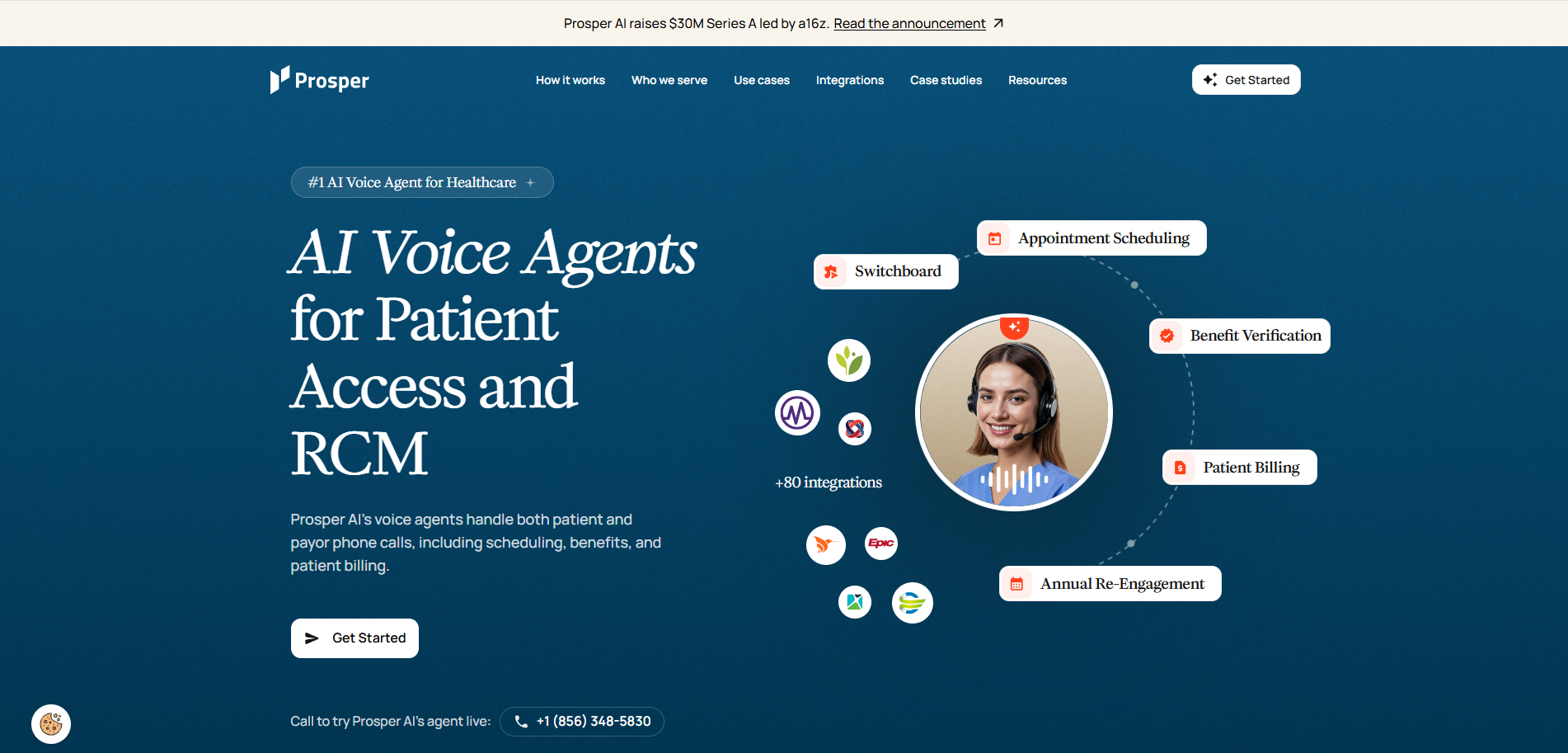
Best for groups that want one vendor for patient scheduling calls and payer calls.
Overview
Prosper AI is a voice AI platform for healthcare phone workflows on both sides of the desk.
Patient-facing agents book, reschedule, and cancel appointments; collect insurance details on the same call and log them in the PMS; answer billing questions; and send reminders.
Payer-facing agents navigate insurer IVRs, wait on hold, verify benefits, chase prior authorizations, and follow up on claims. Everything writes back to the EHR or system of record.
Key capabilities
- 80+ EHR and PMS connectors including Epic, athenahealth and eClinicalWorks, via API, SFTP or file ingest
- Named agents for scheduling, reminders, billing questions, balance reminders, switchboard, benefits verification, and denial follow-up
- Cloud or on-premise deployment, SOC 2 Type II, HIPAA with BAA, zero-day LLM retention
- Ambiguous or failed calls flagged to staff with transcript and confidence score
- Reported results: 60%+ of appointments scheduled by the agent, abandonment down 89%, 50%+ cost reduction on phone workflows
Best for
Multi-specialty groups, DSOs, billing companies, and health systems with enough call volume to justify usage-based pricing, especially where payer calls are also a burden.
Watch for
Voice only. There’s no digital intake layer, so forms and consents still need another tool.
Pricing is usage-based and quoted, which makes budgeting harder for a small practice.
Pricing
Usage-based with custom pricing for high volume. No public rate card.
4. Luma Health
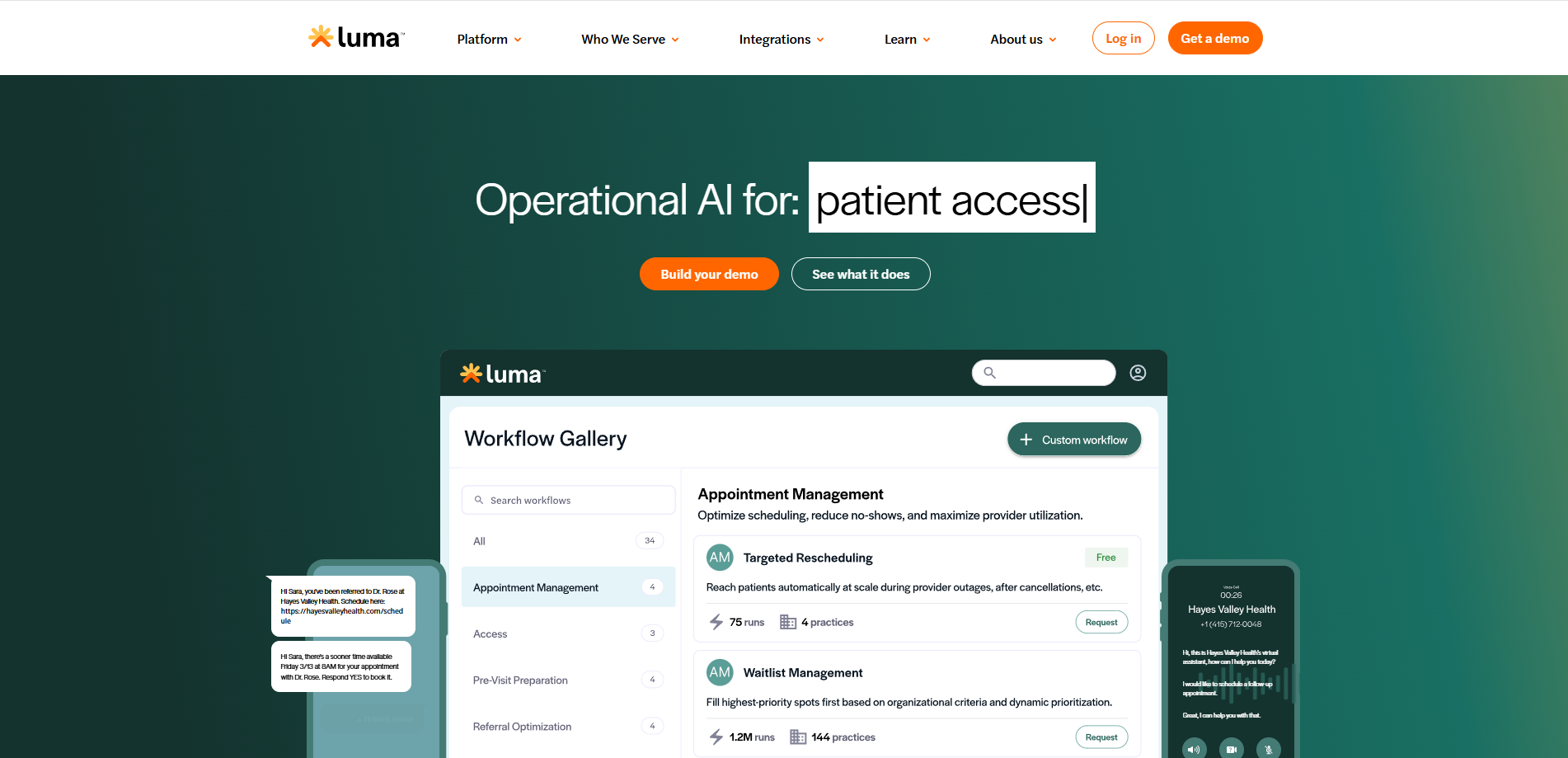
Best full patient access platform for health systems and large groups, with AI agents layered on deep EHR integration.
Overview
Luma Health is a patient access and engagement platform that’s added a healthcare-native AI core, Spark, on top of a decade of EHR integration work.
Spark powers Navigator, a patient-facing voice AI concierge, and Fax Transform, which reads referral faxes and files them in seconds.
The base platform covers self-scheduling, waitlists, reminders, digital intake, referrals, and payments, all bi-directional with the EHR.
Key capabilities
- Bi-directional integration with Epic, Oracle Health, eClinicalWorks, MEDITECH, athenahealth, NextGen and Greenway; reviewers cite 80+ EHR and PM systems
- Navigator voice AI for inbound patient calls, plus SMS-based confirm, reschedule, and waitlist
- Zero-retention generative AI, fine-tuned for healthcare
- Reported result: University of Arkansas for Medical Sciences cut missed appointments 20% with AI scheduling
- G2 4.8 (83 reviews), Capterra 4.6 (82 reviews)
Best for
Health systems, FQHCs and large medical groups that want scheduling, intake, reminders and referrals in one platform with AI on top, and have the implementation capacity to match.
Watch for
Quote-based, modular pricing and integration fees push it out of reach for most small practices.
Reviewers mention reminder cadence that can feel aggressive to patients and occasional sync lag.
Pricing
Custom subscription based on provider count, patient volume, locations, and integration scope. No published pricing.
5. Notable
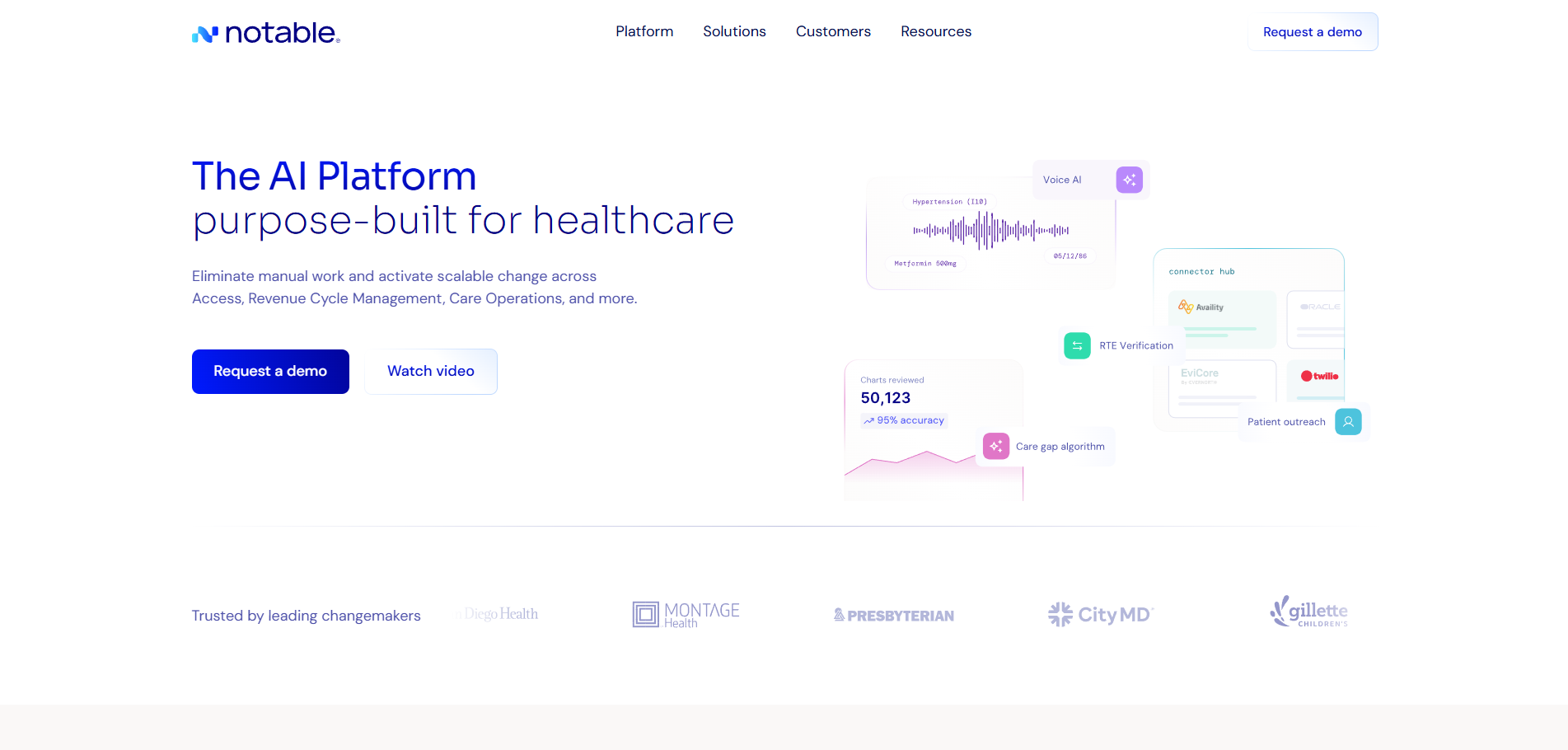
Best for health systems automating registration, intake, and scheduling inside the EHR at scale.
Overview
Notable is a healthcare AI platform whose agents work directly in the EHR to perform registration, scheduling, intake, referrals, authorizations, and coding.
Its Flow Builder is a low-code interface for building and deploying those agents, and Flow AI lets teams describe a workflow in natural language. Notable reports Flow Builder in use at over 12,000 care sites.
Key capabilities
- EHR-integrated agents for patient registration, pre-visit intake and clinical forms, scheduling and referrals
- Low-code Flow Builder with natural-language workflow creation
- Covers prior authorizations, risk adjustment coding and payment collection alongside front-desk work, so one platform spans intake and revenue cycle
- Broad footprint across administrative and revenue-cycle workflows, not only the front desk
- Named customers include MUSC Health
Best for
Health systems and large groups that want one automation platform across intake, access, and revenue cycle and are buying at the enterprise level.
Watch for
Enterprise sales cycle and implementation. Not a self-serve product for a practice that wants an intake agent live this month.
Pricing
Enterprise, custom quote.
6. Hyro
Best AI agent for Epic-based health systems with high call volume.
Overview
Hyro builds voice and chat AI agents for health system patient communications.
Its flagship integration is Epic: agents verify patients against the record, book, reschedule, and cancel appointments, manage prescription refills through Willow, and route the rest to staff.
Hyro is listed in Epic's Showroom and reports resolving up to 85% of routine interactions autonomously.
Key capabilities
- Epic-native scheduling, patient verification, and Rx management; also eClinicalWorks and Salesforce
- Voice, chat, web, SMS and mobile app channels with contextual handoff to live agents
- Responsible AI framework: answers limited to approved organizational content, PII and PHI redaction
- HIPAA with BAA, SOC 2 Type II, Azure hosting options
- Reported results: Intermountain Health saw an 85% reduction in call abandonment and a 79% decrease in wait times; Inova resolves 50% of scheduling calls with the inbound voice agent
Best for
Multi-site health systems and hospitals on Epic with overloaded call centers.
Watch for
Built for enterprise.
Third-party reviews report pricing starting around $10,000 per month, which puts it out of scope for independent practices and most groups.
Pricing
Enterprise pricing; reported from roughly $10,000 per month.
7. Phreesia
Best digital intake platform at scale, with scheduling as a secondary strength.
Overview
Phreesia is a publicly traded patient intake, access, and payments platform (NYSE: PHR) with roughly $480.6M in fiscal 2026 revenue.
Its core is mobile and web intake: registration, consents, medical history, insurance verification, and payments completed before the visit and written to the EHR.
Self-scheduling and waitlists sit alongside intake, and voice and automated outreach live in its communications modules.
Key capabilities
- Digital intake and registration used across 180M+ annual patient visits
- Pre-visit questionnaires, consents, demographic updates, and payment collection
- Insurance verification and eligibility built into intake
- Self-scheduling and waitlist features; named to Capterra shortlists for scheduling and engagement in 2025 to 2026
- Capterra 4.3 (167 reviews); reviewers praise account management and intake efficiency
Best for
Medical groups and health systems whose first problem is intake and collections, and who want a mature vendor with a large installed base.
Watch for
Reviewers rate AI agent depth for scheduling triage as less proven than its intake automation, and note occasional EHR calendar sync delays.
Pricing is contracted and not public.
Pricing
Contracted by client size, provider count, and modules. Free trial listed on review sites; contact Phreesia for pricing.
8. NexHealth
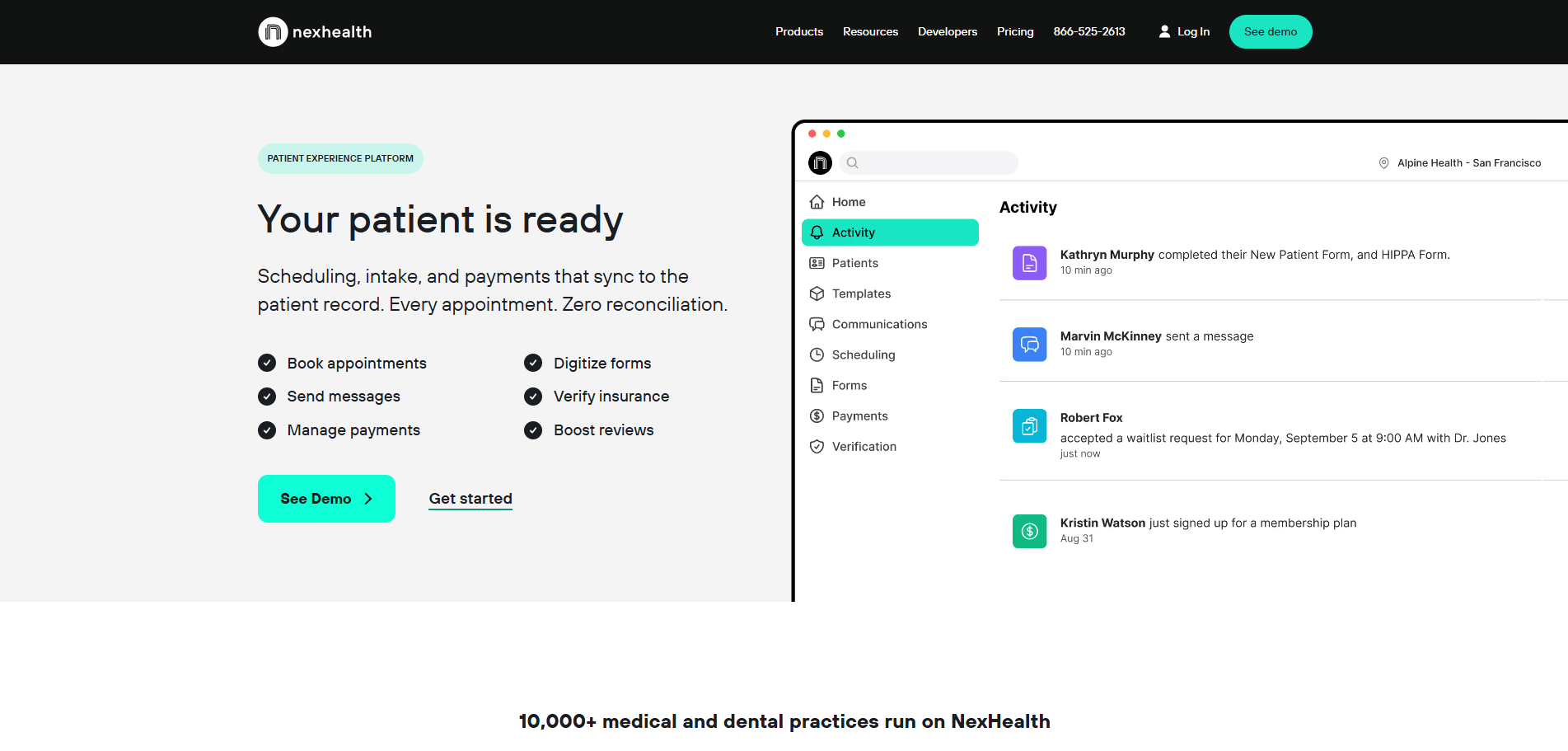
Best for dental and small medical practices that want online booking and digital forms synced to the practice management system.
Overview
NexHealth is a patient experience platform built around its real-time Synchronizer, which connects online scheduling, digital forms, reminders, two-way messaging, payments, and review requests to the practice management system.
Patients book from the website, complete forms before the visit, and receive reminders, and everything lands in the PMS without re-keying.
It’s strongest in dental, where it syncs with Dentrix, Open Dental, and Eaglesoft, and also covers medical systems such as athenahealth and DrChrono.
Key capabilities
- Real-time online scheduling that books directly into the PMS
- Digital forms that write to the patient record
- Automated reminders, two-way texting, payments, insurance verification, and review requests
- Reports on appointments, cancellations, and practice performance
- Capterra 4.8 with 94% positive sentiment; NexHealth cites 30 hours saved per practice per month
Best for
Dental practices and small medical offices that want a polished patient-facing booking and forms layer on top of their PMS.
Watch for
NexHealth is a workflow and engagement platform more than an agent: it automates booking and forms, but it doesn’t converse, qualify leads, or make decide-as-you-go calls.
Reviewers describe the workflows as rigid and flag contract and cancellation friction.
Note that NexHealth is also a Keragon integration, so a practice can run Keragon agents on top of it.
Pricing
No published price sheet. Review sites report starting prices around $350 per month with multi-month terms.
9. Sully.ai
Best for clinics that want a bundle of AI staff, including a receptionist and intake, from one vendor.
Overview
Sully.ai sells a team of AI "employees" for healthcare: an AI Receptionist for calls, scheduling, and check-in; an AI Nurse for intake and triage; an AI Scribe; an AI Medical Coder; and an AI Interpreter.
The agents share one EHR connection and a clinician-in-the-loop model in which staff review drafts and actions.
Sully reports adoption across platforms serving more than 100,000 providers.
Key capabilities
- AI Receptionist handling scheduling, patient check-in, and front desk support 24/7
- Intake and triage through the AI Nurse agent; 19 languages supported
- 50+ EHR integrations including Epic, Cerner, MEDITECH, athenahealth and Tebra
- HIPAA, SOC 2 Type II, ISO 27001; cloud or self-hosted deployment
- G2 lists self-service scheduling, digital intake, waitlist and cancellation management among its features
Best for
Clinics that want documentation, coding, and the front desk from a single AI vendor rather than assembling point solutions.
Watch for
Sully's center of gravity is clinical (scribe and coding), so evaluate the receptionist and intake agents on their own merits.
Pricing
Reported $79 to $99+ per provider per month; confirm current tiers with Sully.
10. Retell AI
Best voice infrastructure for teams that want to build their own scheduling agent.
Overview
Retell AI is a platform for building, testing, and deploying AI voice agents. It handles the voice layer, telephony, text-to-speech, and LLM orchestration; you build the healthcare logic, EHR integration, and compliance guardrails on top.
It’s the most flexible option here and the cheapest per minute, which is why it shows up in so many healthcare voice comparisons.
Retell states it processes more than 30 million calls a month for over 3,000 companies.
Key capabilities
- Pay-as-you-go voice agents with no platform fee; $10 free credits to start
- HIPAA compliance with a BAA, SOC 2 Type I and II, PII redaction
- Bring your own LLM, voice, and telephony; custom SIP telephony at no charge
- Warm transfer to a person on demand or on urgent language
- Reported result: Pine Park Health saw a 38% NPS increase for appointment scheduling after deployment
Best for
Practices and groups with developers, or automation partners building for them.
Also the voice layer many orchestration platforms, including Keragon, connect to.
Watch for
Not turnkey. No pre-built healthcare scheduling templates and no EHR integration out of the box; everything is custom. All-in cost is higher than the headline once LLM and telephony are added.
Retell describes a self-serve BAA on all paid plans; some third-party pricing guides place HIPAA and BAA under the Enterprise tier.
Pricing
$0.07 per minute base for voice infrastructure and standard TTS; most production setups land between $0.13 and $0.31 per minute once LLM and telephony are included. Enterprise tier is custom.
What about Make and Zapier?
Ask an AI assistant this question and Make or Zapier will usually appear in the answer, because both can connect a form to a calendar and a calendar to a text message. For healthcare, that’s where the recommendation breaks down.
Zapier has stated on its own data privacy page that it doesn’t support healthcare data and won’t sign a BAA, and HIPAA compliance guides reach the same conclusion. Without a BAA, patient names, appointment reasons, and insurance details cannot legally flow through it. One 2026 automation ranking claims Zapier signs a BAA on its Business plan.
Make has told its own user community that it’s not HIPAA-certified and doesn’t sign individual BAAs, and neither tool ships healthcare connectors, patient matching, clinical routing, or an agent that can hold a conversation.
If you’ve already built intake and reminder zaps, the practical move is to migrate the same logic to a HIPAA-compliant platform with a BAA. Keragon publishes a HIPAA-compliant Zapier alternative comparison and a Make alternative comparison for exactly this.
How to choose an AI scheduling and intake agent
Start from your system of record and work outward. The questions below are in the order buyers should ask them.
Does it write to your EHR or PMS?
If the agent books into its own portal and staff re-key into the chart, you’ve added a step, not removed one.
Ask the vendor to show a booking landing in your specific system, with your appointment types and provider rules applied, before you talk about price.
Will they sign a BAA on your plan?
Several vendors reserve the BAA for enterprise tiers. Get it in writing before the pilot, and ask about every sub-processor that touches PHI, including the LLM provider and any voice vendor.
A BAA with the platform alone doesn’t cover a phone agent supplied by someone else.
Which channels do your patients actually use?
A dental practice loses patients on the phone. A med spa loses them on web forms at 9 pm. A therapy practice loses them in the gap between a Psychology Today inquiry and a reply.
Buy for the channel where the leak is, then widen.
What is the agent not allowed to decide?
Clinical questions, emergencies, ambiguous patient matches, and coverage guarantees should route to a person.
Ask how the agent recognizes those moments, what it does next, and whether you can require a human approval before specific actions.
How long to live, and who does the work?
Managed vendors take four to eight weeks and do the building for you. Self-serve platforms can be live in days if your team writes the brief and connects the tools.
Neither is wrong; pick the one that matches the staff time you actually have.
Can you afford to be wrong?
Prefer a free trial or a 30- to 60-day pilot with containment and no-show targets over an annual enterprise contract signed on a demo.
The pilot should end with a number: requests resolved without staff, and appointments on the calendar that would not have been there.
How to implement an AI scheduling or intake agent
Most practices get more from one narrow agent running well than five running badly. A workable sequence:
Step 1: Pick one leak
Missed calls after hours, web forms that sit overnight, or intake forms chased on the day of the visit. Measure it for two weeks, so you have a baseline the agent has to beat.
Step 2: Connect the system of record first
EHR or PMS, then the forms tool, then phones or messaging. Confirm the agent can read availability and write a booking in a test environment before it sees a real patient.
Step 3: Write the rules down
Approved answers, appointment types, provider and duration constraints, quiet hours, what counts as urgent, and who receives escalations. Whatever you would tell a new front-desk hire on day one belongs in the brief.
Step 4: Test on sample data
Run real scenarios from your last month of calls and forms. Read the transcripts. Adjust the brief. Repeat until staff would be comfortable letting the agent send those messages under the practice name.
Step 5: Go live on one channel, then widen
Turn on missed-call text-back or form response first. Add voice, waitlist backfill or recall once the team trusts the agent and the audit log looks the way you expect.
Step 6: Review the audit log weekly
Every action, every escalation, every booking. That log is your compliance record and your improvement backlog. Most of the second month's gains come from what you find in it.
Compliance: what HIPAA requires from a scheduling agent
A scheduling or intake agent handles protected health information from the first message: name, date of birth, reason for visit, insurance. That makes the vendor a business associate, which means a signed BAA, encryption in transit and at rest, access controls, and an audit trail.
Ask how long call recordings and transcripts are retained, whether PHI is used to train any model, and which sub-processors see the data.
Cash-pay practices aren’t exempt: treatment records and health histories are PHI whether or not a claim is ever filed.
Keragon's HIPAA explained guide and its trust center cover the questions to ask any vendor.
Cost and ROI
Prices in this category run from under $100 a month for self-serve platforms to five figures a month for enterprise voice agents.
The comparison that matters is against the alternative: a front-desk hire in the United States costs roughly $50,000 a year fully loaded, and a single person answers one call at a time and leaves at 5 pm.
Keragon publishes an ROI calculator that takes your appointment volume and no-show rate and shows what recovered appointments are worth.
Whatever you choose, tie the pilot to two numbers: how many requests the agent resolved without staff, and how many appointments landed on the calendar that otherwise wouldn't have.
Ready to automate patient scheduling and intake?
If your team is still responding to web inquiries, chasing intake forms, filling cancellations, or re-keying patient information into the EHR, AI can take much of that front-office work off their plate.
Keragon’s AI Agents work on top of the EHR, scheduling, forms, and communication tools you already use. They can respond to new patient inquiries, book appointments, send and follow up on intake and consent forms, recover canceled appointments, and write the results back to the patient record with human review when something falls outside the agent’s rules.
Try Keragon free for 14 days and test an agent with your own workflow. Start your free trial, or try a sample agent before connecting your systems.
Frequently asked questions
What’s the best AI agent for patient scheduling?
For independent practices and groups that already run an EHR, Keragon is the best fit: it books directly into 30+ EHRs, includes a BAA on every plan, and starts at $99/month billed annually.
For specialty practices that want a managed phone agent, Assort Health. For Epic-based health systems, Hyro.
Which AI agent automates patient intake and onboarding?
Keragon's Patient Intake Agent sends intake and consent forms by text when a visit is booked, chases them to completion, and files the answers into the EHR with duplicate matching.
Phreesia is the largest dedicated intake platform. Notable automates registration and intake inside the EHR for health systems.
Do AI scheduling agents write directly into the EHR?
The good ones do. Keragon, Assort Health, Prosper AI, Luma, Notable, Hyro, and NexHealth all read availability and write bookings into the practice's system. Retell AI writes wherever you build it to.
Always ask a vendor to demonstrate a booking landing in your specific EHR.
Are AI scheduling agents HIPAA compliant?
Only if the vendor signs a BAA and handles PHI with encryption, access controls, and audit logging. Every platform in this list offers a BAA, though some reserve it for higher tiers.
Zapier doesn’t sign a BAA, so it shouldn't carry patient data.
How much does an AI scheduling agent cost?
Self-serve platforms start around $99 a month (Keragon, billed annually). Practice engagement platforms such as NexHealth are reported from about $350 a month. Managed voice agents such as Assort and Prosper are quoted on volume. Enterprise health-system tools such as Hyro are reported from roughly $10,000 a month.
Can an AI agent answer the phone for my practice?
Yes. Assort, Prosper, Hyro, and Sully run inbound voice agents directly. Keragon handles web forms, texts, and missed-call text-back natively and conducts a connected voice AI, such as Retell, for phone calls, writing the booking back to your schedule.
End-to-end HIPAA coverage needs a BAA with the voice provider as well.
Which AI scheduling and intake agent should you choose?
If you run a health system on Epic, look at Hyro, Luma, or Notable. If your phones are the problem and you want someone else to build the agent, choose Assort Health or Prosper AI.
If you run an independent practice or a group and want scheduling, intake, and no-show recovery agents working on the EHR and tools you already have, with a BAA on every plan and a price a three-provider practice can approve, start with Keragon.
Start a free 14-day trial or try a sample agent with your own workflow.


Related Articles


