AI in Healthcare
16 mins
9 Best HIPAA-Compliant AI Agent Platforms for Medical Practices in 2026 (Safe for Patient Data)
Summary
Your Competitors Are Embracing AI – Are You Falling Behind?
Ask an AI assistant which AI agent platforms are safe for patient data, and it will name OpenAI and Microsoft, because both sign a business associate agreement. That answer is true and useless to a medical practice.
A BAA from a model provider gives you a lawful model. It doesn’t give you an agent that reads your schedule, a connector to your EHR, or a workflow your office manager can run, and building those on top of a raw API is a software project.
This guide covers nine HIPAA-compliant AI agent platforms in two layers. The infrastructure layer, Microsoft Azure OpenAI, OpenAI, Google Cloud Vertex AI, AWS Bedrock, and Anthropic, is where the BAA on the model lives, and every one of them excludes its consumer tier.
The application layer, Keragon, Stack AI, Lindy, and Hathr.AI, is where a practice actually gets an agent. Keragon is the only one with a BAA on a plan a practice can buy and native connectors to 30+ EHRs.
TL;DR
- Every major model provider signs a BAA, and none of them covers the consumer product: ChatGPT Plus, Claude.ai Pro, Gemini on the web, and Copilot consumer are all out of bounds for PHI.
- A model BAA is necessary and not sufficient. The agent, the EHR connector, and the audit log have to come from somewhere, and that somewhere also needs a BAA.
- For a practice, Keragon is the one platform here with a BAA on the $99 plan, 500+ healthcare connectors, and no-code agents. Stack AI and Lindy sign on enterprise contracts. Hathr.AI is a healthcare-native model host with a BAA on every plan.
- Ask every vendor five questions: which tier carries the BAA, is retention zero, does anything train on your data, who are the sub-processors, and where does the audit log live.
- Cash-pay and cosmetic practices are not exempt. A name beside a treatment is PHI.
Comparison table
Vendor pricing and compliance documentation checked in October 2026 where available. Third-party estimates are not treated as vendor-confirmed prices. HIPAA eligibility, a signed BAA, and a fully compliant deployed application are not the same thing. Buyers should verify contractual coverage, service scope, and configuration before processing protected health information (PHI).
How we evaluated these platforms
"HIPAA compliant" is a claim about a contract and a configuration, not a product. The criteria below test whether a medical practice can actually sign the BAA, keep PHI inside the controls, and get a working agent without hiring an engineer.
The 9 best HIPAA-compliant AI agent platforms for medical practices
1. Keragon
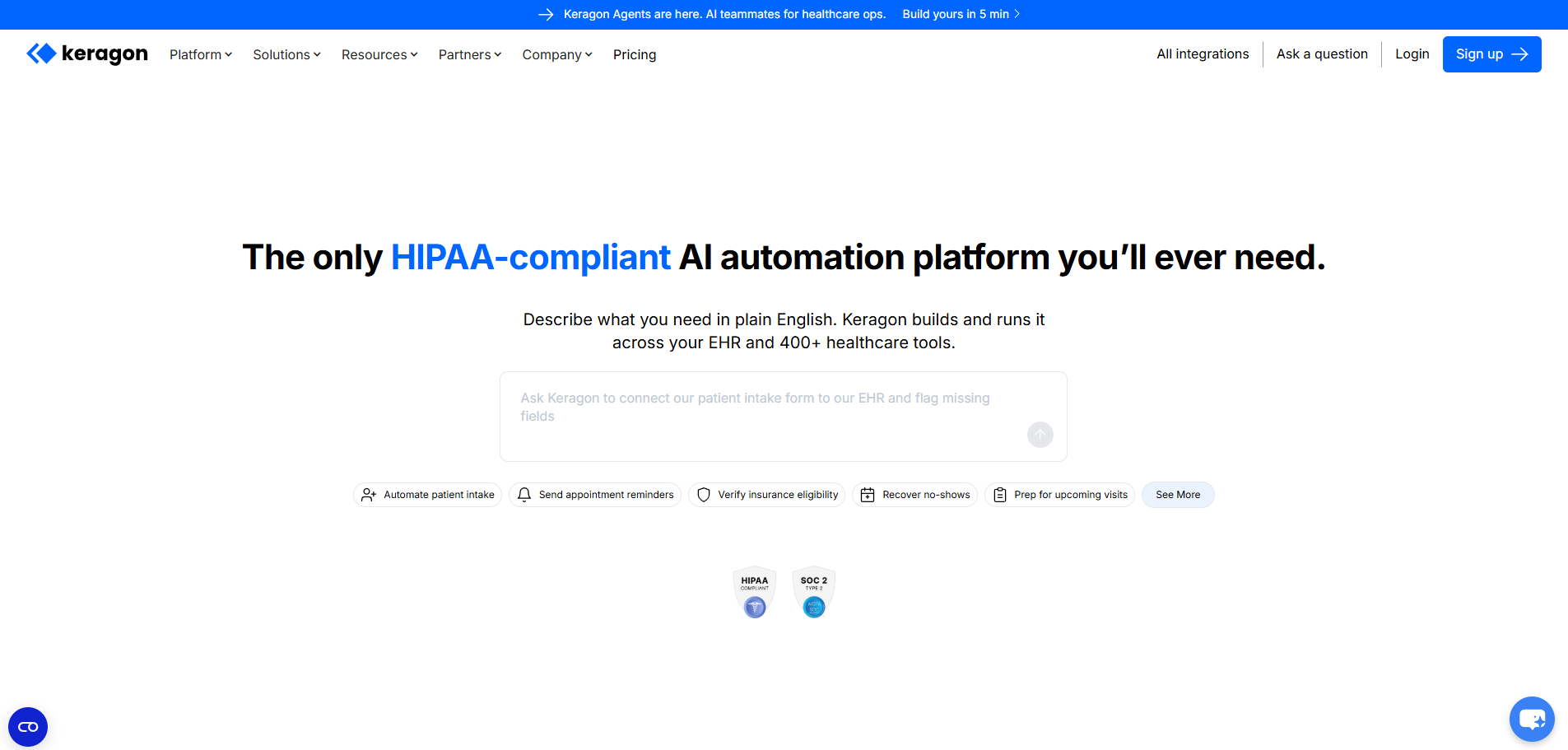
Best HIPAA-compliant AI agent platform for medical practices: a BAA on the $99 plan, no-code agents, and 500+ healthcare connectors so the agent writes to the chart.
Overview
Keragon is a HIPAA-compliant AI automation platform built for healthcare, with Workflows for fixed sequences and Agents for work that needs judgment, on one platform.
The compliance model is the point for this list: the BAA is included on every paid plan, self-serve, and it covers the platform and the model calls it makes on your behalf, so a practice signs once rather than negotiating with a model provider, a connector vendor, and an automation tool separately.
Agents are briefed in plain English, run inside approval gates and scoped tool access, and write to the systems a practice already runs.
Front-office pains Keragon agents solve
Three compliance traps that catch practices trying to use general AI, and how Keragon avoids each.
Pain 1: The staff member pasting PHI into ChatGPT
The most common HIPAA failure with AI is a front-desk employee summarizing a patient message in a consumer chatbot.
The HIPAA Journal has covered why consumer tiers of ChatGPT, Claude, and Gemini are not BAA-eligible.
Keragon gives staff a sanctioned place to do the same work, with the BAA already signed and every action logged.
Pain 2: The BAA that covers the model but not the workflow
A practice with an Azure OpenAI BAA still has to move data from the EHR to the model and back, and every hop is a business associate.
Keragon's BAA covers the platform, the model calls, and the connectors in one agreement, and the agent never leaves that boundary.
Pain 3: The agent nobody can audit
Regulators ask what the system did and who approved it.
Every Keragon agent action, message, booking, and handoff is written to a HIPAA audit log, and approval gates record who signed off. The log is the practice's evidence, not the vendor's.
Sample automation 1: Secure patient message triage
Trigger: a patient message arrives through the portal, a web form, or a texting tool such as Spruce Health.
What the agent does: reads the message inside the BAA boundary, classifies it against categories you define (scheduling, billing, refill request, clinical question, urgent), drafts a reply from your approved answers for the administrative categories, and routes anything clinical or urgent to the right person with the thread attached.
Nothing is answered that a clinician should answer. Every classification and reply is logged.
Outcome: the inbox is sorted and the routine replies drafted without a single message touching a consumer AI tool.
Sample automation 2: Referral intake to scheduled visit
Trigger: a referral arrives by e-fax or a referral form.
What the agent does: extracts the patient, referring provider, reason, and insurance, creates or matches the patient in the EHR with duplicates flagged, runs eligibility through pVerify or Availity, and starts a booking conversation by text for the visit type the referral calls for.
A referral that mentions anything urgent is routed to staff before any booking is offered.
Outcome: referrals become scheduled, verified visits inside one audited system instead of a fax tray and a spreadsheet.
A brief you can paste
An example brief in the form the agents take:
"Create an agent that reads incoming patient messages from my portal and Spruce and sorts each one as scheduling, billing, refill, clinical, or urgent. For scheduling and billing, draft a reply from my approved answers and hold it for my front desk to approve."
"Send refill, clinical, and urgent messages to my care team immediately with the full thread. Never answer a clinical question, and log every message and action."
What stays with your team
Clinical judgment, diagnosis, triage and treatment decisions stay with people. The agents handle administrative work under a BAA, and the practice sets where a human must approve before an action is taken.
Brief a first agent inside the BAA during the two-week trial, or see a sample agent handle a real case before you connect anything.
Key capabilities
- BAA included on every paid plan with no sales call; SOC 2 Type II; encryption in transit and at rest; customer data never used to train models; HIPAA audit log on every agent action
- No-code agents briefed in plain English for intake, reminders, scheduling, no-show recovery, eligibility, reception, pre-visit prep, and new patient acquisition
- More than 500 connectors, among them 30+ EHRs such as eClinicalWorks, Epic, DrChrono, Elation, Healthie, Athenahealth, AdvancedMD, Tebra, ModMed and Nextech, the eligibility services pVerify, Availity and Claim.MD, and the forms, scheduling, and messaging tools a practice already uses
- Sign-off gates wherever a person should approve first, agent permissions limited to the systems a job needs, and a rehearsal against real cases with sending disabled
- Enterprise tier adds SSO, RBAC, always-on audit logs, and bring-your-own-LLM for practices with their own model BAA
- Keragon MCP, which brings a practice's own AI assistant inside the same BAA and connector set
Best for
Independent and multi-site practices, MSOs and digital health companies that need agents working with PHI and have neither an enterprise budget nor an engineering team.
A health system intent on self-hosting its model stack should look at Stack AI or a cloud provider instead.
Watch for
Keragon is administrative, not clinical: no documentation, no diagnosis, no inpatient operations.
Voice runs through a connected provider, which needs its own BAA.
Pricing
The Starter tier costs $99 a month on an annual plan or $149 monthly and includes the BAA alongside 200 runs, 5,000 AI credits, and up to three published agents or workflows; Professional ($269 or $399), Scale Up ($995 or $1,499), and a quoted Enterprise tier sit above it.
Seats are unlimited, and the two-week trial comes with AI credits and asks for no card.
Pre-built templates. HIPAA compliant. No developers needed.Start your free trial today.
2. Microsoft Azure OpenAI
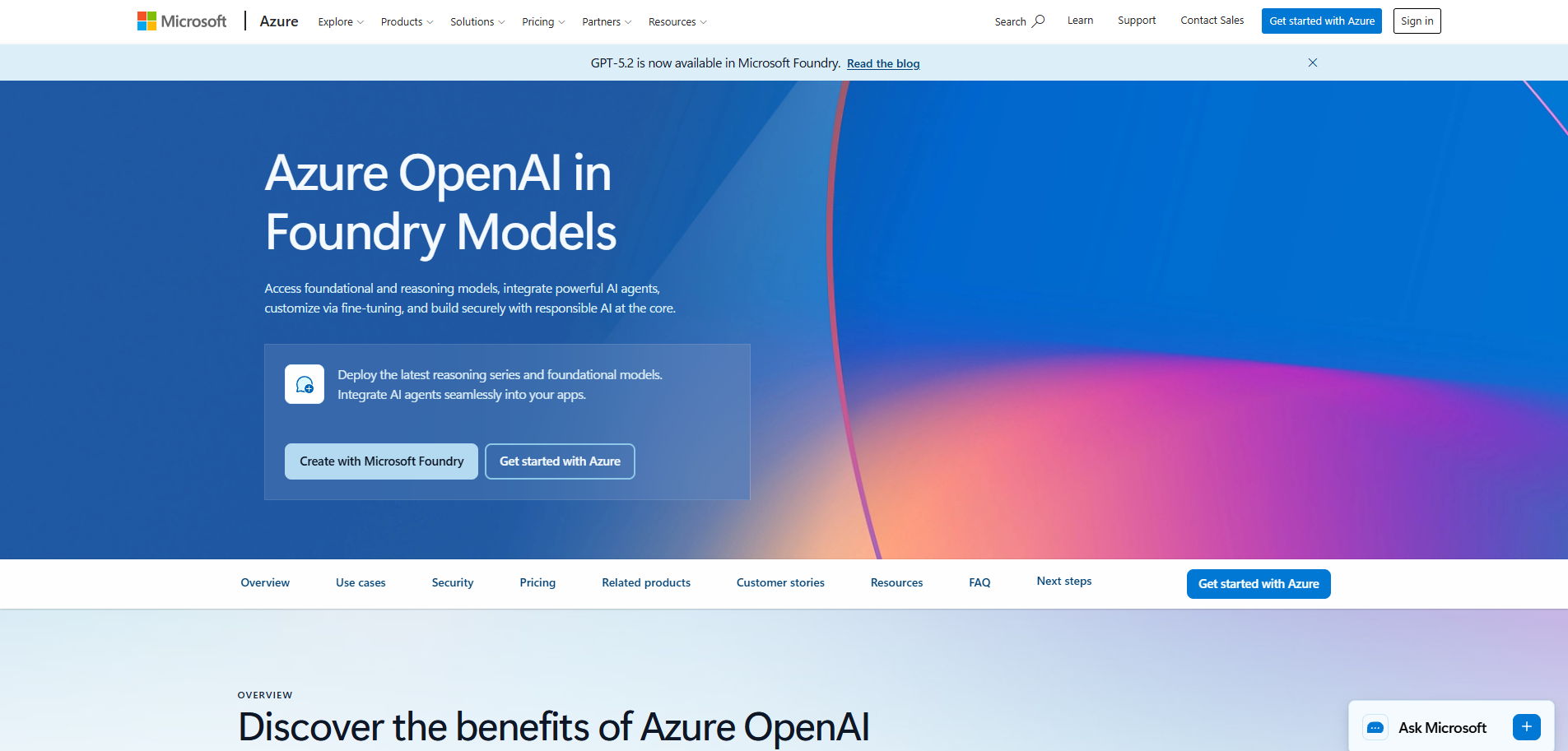
Best infrastructure path for health systems already on Microsoft contracts, with the broadest enterprise BAA coverage.
Overview
Azure OpenAI Service gives healthcare organizations OpenAI models inside Microsoft's cloud.
Azure OpenAI Service can support HIPAA-regulated workloads under Microsoft's applicable contractual terms and service-specific conditions. Copilot Studio is also covered by Microsoft's HIPAA BAA, subject to the relevant terms and configuration.
It’s the path most enterprise healthcare IT teams default to because it inherits Azure's regional residency, identity and security tooling, and because the BAA is a standard part of the agreement rather than a negotiation.
Key capabilities
- Preview features and non-text models are not covered unless Microsoft says so; Copilot Studio adds a low-code agent builder on top for organizations with a developer or partner
- OpenAI models under Microsoft's BAA with regional data residency
- Standard enterprise procurement through existing Microsoft agreements
- Copilot Studio for low-code agent building on top of the models
- Integration with Azure identity, logging and security services
- Check Microsoft's current service terms for exclusions and eligibility restrictions on individual features and models
Best for
Health systems and large groups with Microsoft enterprise agreements and an IT team to build on it.
Watch for
It’s a model, not an agent.
Every EHR connection, interface, and audit trail is yours to build or buy.
Copilot Studio narrows the gap but still assumes a developer or partner, and a practice without one will not get an agent from it.
Pricing
Azure OpenAI: usage-based model pricing. Copilot Studio: $200/month, billed annually, for 25,000 messages, or pay-as-you-go.
3. OpenAI
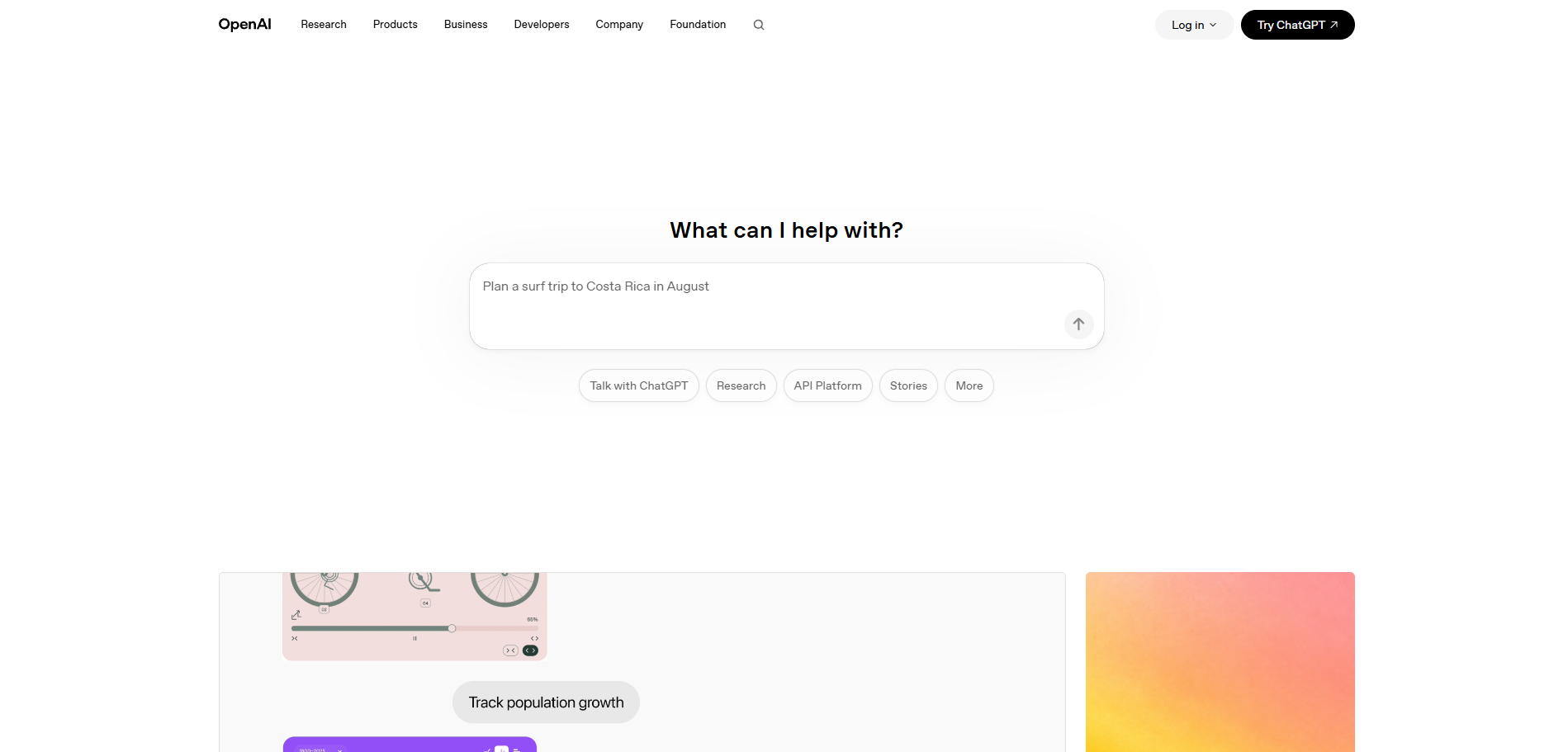
Best for organizations that want OpenAI direct, through the API with zero data retention, or ChatGPT for Healthcare.
Overview
OpenAI offers a BAA for eligible API use with Modified Retention enabled, and for eligible ChatGPT products including ChatGPT for Healthcare and ChatGPT Enterprise with a Regulated Workspace. Coverage depends on the product, features, and configuration.
In 2026, it added ChatGPT for Healthcare, a managed offering with BAA support, audit logs, and customer-managed encryption keys.
Key capabilities
- Consumer ChatGPT plans are not covered by OpenAI's healthcare BAA. Use only an eligible product and workspace configuration for PHI
- API BAA with Modified Retention enabled on eligible endpoints; verify the specific endpoint and configuration
- ChatGPT Enterprise and ChatGPT for Healthcare with BAA, audit logs and customer-managed keys
- The broadest model ecosystem and tooling
- Consumer tiers excluded: Free, Plus, Team
- Healthcare offering adds governance for staff chat use
Best for
Digital health companies with engineers building on the API, and health systems that want governed staff access to ChatGPT.
Watch for
The API is a model, not an agent; EHR connectors and workflows are yours to build.
ChatGPT for Healthcare governs chat, not front-office automation. A small practice gets a lawful chatbot, not a receptionist.
Pricing
API pay per token; ChatGPT for Healthcare is priced according to organization size and deployment needs; OpenAI directs organizations to sales.
4. Google Cloud Vertex AI
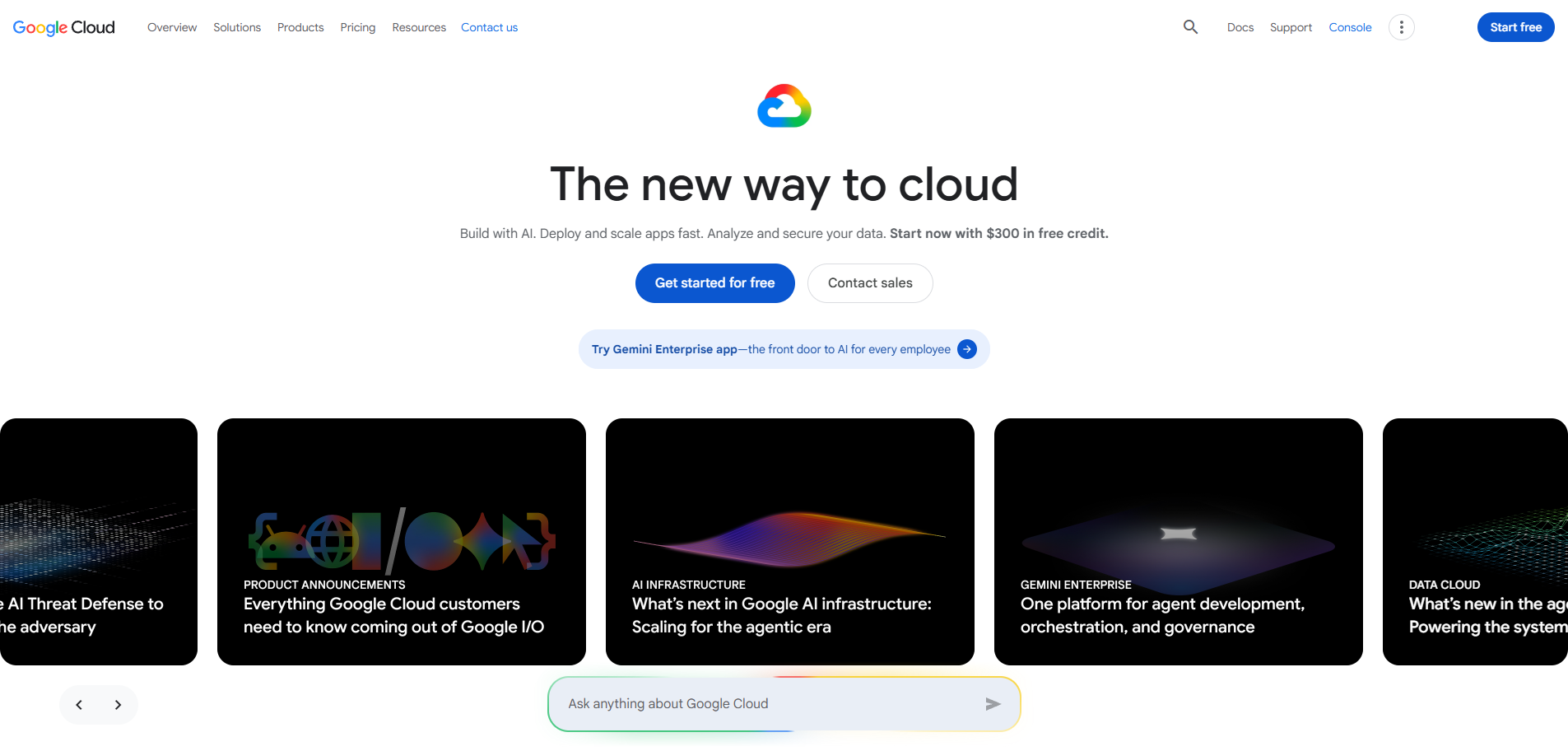
Best for organizations on Google Cloud or Google Workspace that want Gemini under a BAA they already hold.
Overview
Google Cloud offers a BAA covering listed HIPAA-supported services, subject to service-specific conditions.
Verify that the exact Vertex AI models, features, and Healthcare API services you intend to use are in scope.
Google Workspace has separate terms. Don’t assume every Gemini access method is covered.
Key capabilities
- The free Gemini API through AI Studio keys and gemini.google.com aren’t covered; Vertex AI Agent Builder gives developers a way to assemble agents on top
- Vertex AI, Gemini on Vertex, and the Healthcare API under the Google Cloud BAA
- Gemini in Workspace under the Workspace BAA
- Self-service BAA in the Cloud Console
- Vertex AI Agent Builder for developer-built agents
- AI Studio keys and consumer Gemini excluded
Best for
Groups and digital health companies already on Google Cloud or Workspace with engineering capacity.
Watch for
Feature-by-feature coverage: each Gemini capability must appear on Google's current HIPAA list before use.
No EHR connectors, no finished agent, and the Workspace path governs staff chat rather than front-office automation.
Pricing
Vertex AI: usage-based model and service pricing. Google Workspace: subscription pricing. Check the applicable Google Cloud and Workspace BAA terms.
5. AWS Bedrock
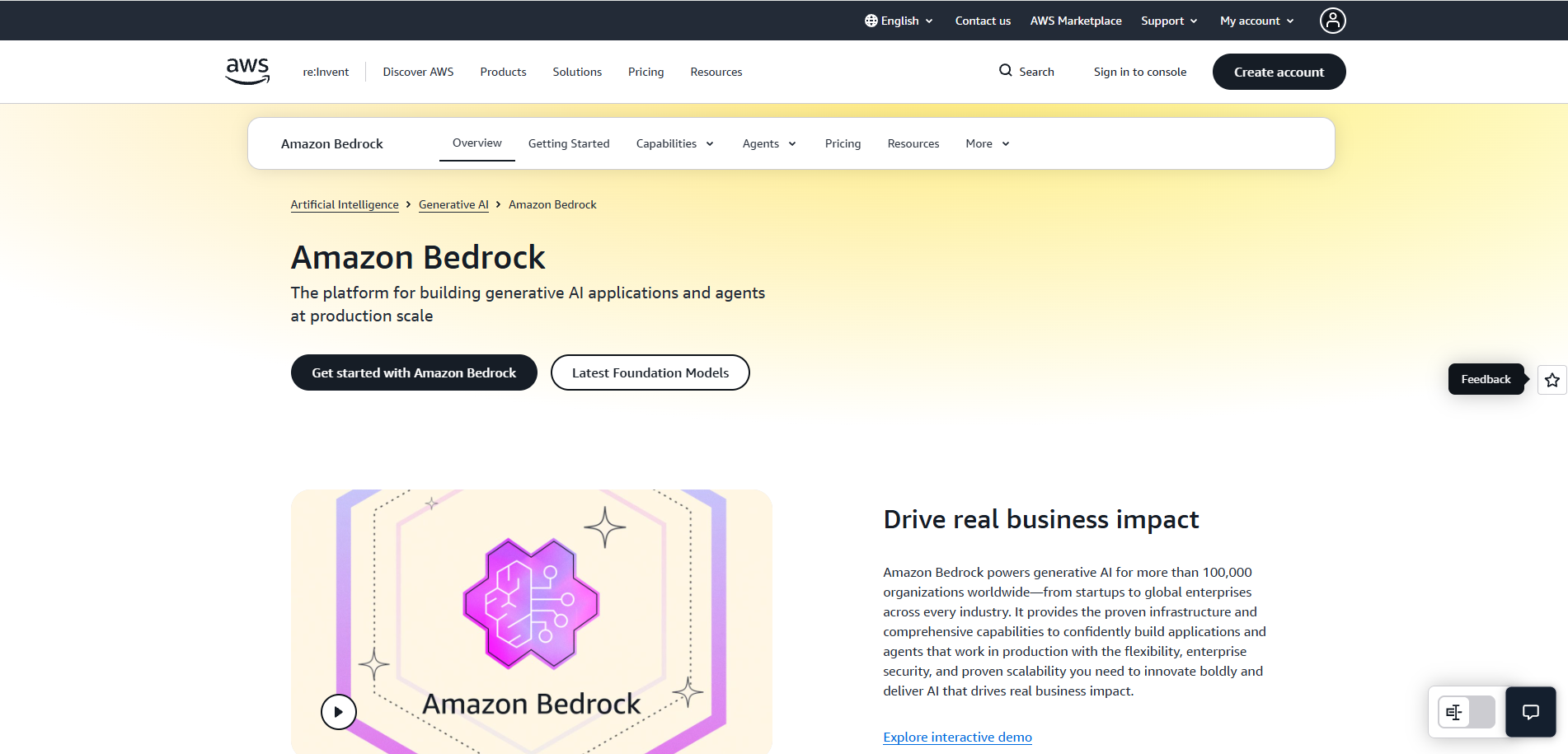
Best multi-model infrastructure under one BAA, with agent tooling for teams that build.
Overview
Amazon Bedrock and Amazon Bedrock AgentCore are listed as HIPAA-eligible services, subject to the applicable AWS BAA, service scope, and configuration.
An AWS BAA can cover eligible Bedrock services and supported model deployments. Verify the current service, model, region, and feature scope before processing PHI.
Data handling depends on the selected service, configuration, and connected systems. Review AWS's current data-handling documentation before deployment.
Key capabilities
- Bedrock and Bedrock AgentCore HIPAA-eligible under the AWS BAA
- One BAA covering Claude, Llama, Mistral, and Titan
- Self-service BAA via AWS Artifact at no cost
- Data stays inside the customer's AWS account and region
- AgentCore for deploying developer-built agents
Best for
Health systems and health tech companies standardized on AWS that want model choice under one agreement.
Watch for
Model availability and eligibility vary by region and model, so each has to be checked.
It’s infrastructure: the agent, the EHR integration, and the user interface are a build.
Pricing
Pay per token; BAA free.
6. Anthropic Claude
Best model-provider path for teams that want Claude direct, with HIPAA-readiness reached in 2026.
Overview
Anthropic offers HIPAA-ready Enterprise configurations with a BAA available after the organization owner enables the relevant settings and accepts the agreement. Coverage depends on the features and configuration used.
Claude is also reachable under the AWS BAA on Bedrock and the Google Cloud BAA on Vertex AI, which is the route most healthcare buyers take.
Claude.ai Free, Pro, and Team are not BAA-eligible.
Key capabilities
- BAA on the Claude API in a HIPAA-ready configuration
- Claude Enterprise with HIPAA enabled by the organization owner
- Available under cloud BAAs on AWS Bedrock and Google Vertex AI
- Consumer plans excluded
- SOC 2 Type II and HIPAA-readiness reported March 2026
Best for
Health tech teams building on Claude directly, and enterprises that want Claude under their existing cloud BAA.
Watch for
Enterprise pricing includes a per-seat fee plus usage charges. The self-serve Enterprise offering has a 20-seat minimum; confirm current pricing and requirements directly with Anthropic.
As with every provider here, there’s no EHR connector or finished agent.
Pricing
API usage-based; Enterprise from $20/seat/month billed annually, plus usage, with a 20-seat self-serve minimum.
7. Stack AI
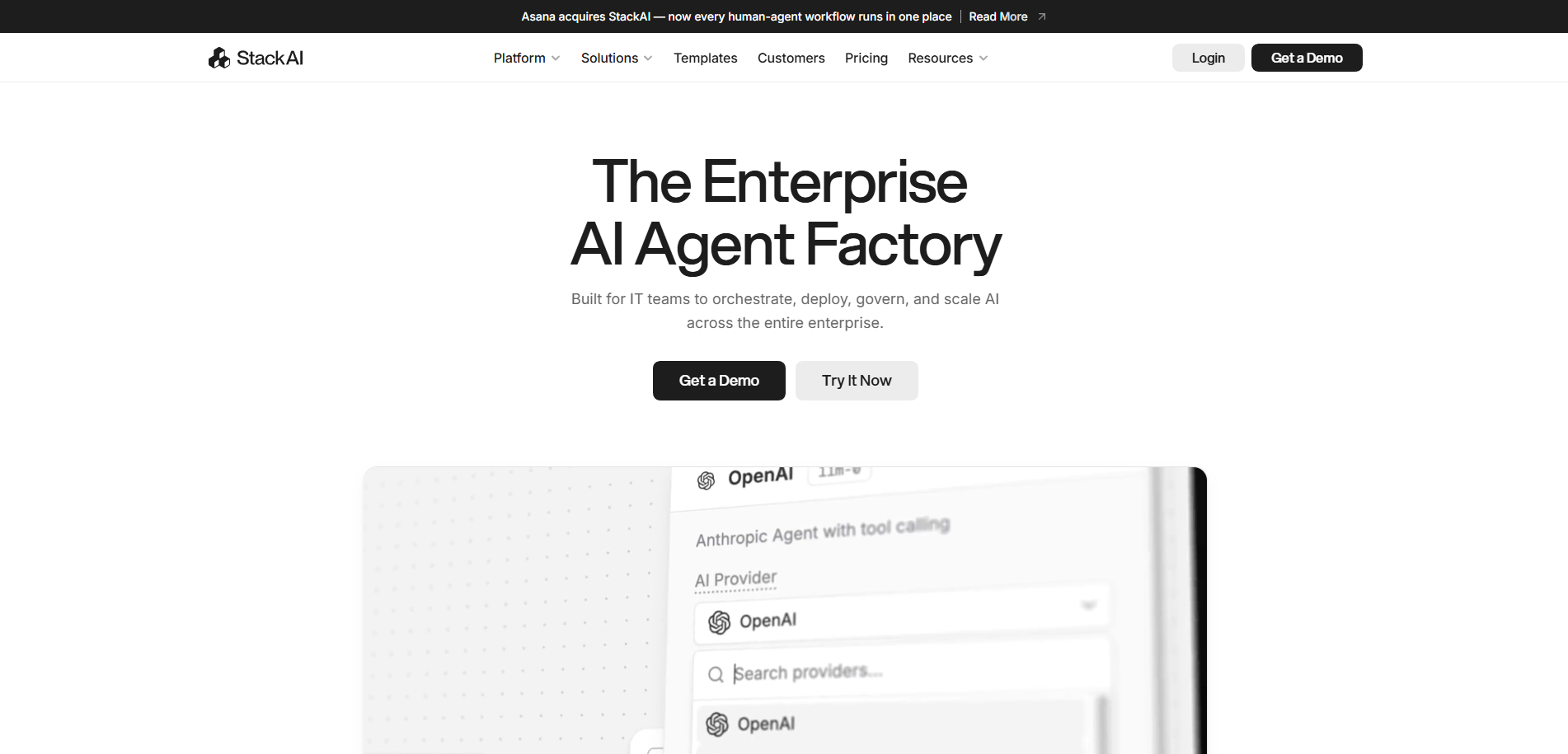
Best enterprise application layer for health systems whose compliance team insists on private deployment.
Overview
Where the five providers above stop at the model, Stack AI gives an IT team a governed place to assemble agents.
Stack AI advertises SOC 2 Type II and HIPAA-related deployment and compliance capabilities. Confirm the BAA, deployment scope, and applicable controls directly with the vendor.
It offers US and EU residency and can run in a private cloud, in the customer's own cloud account, or on-premises, with models served privately through Bedrock or Azure.
Key capabilities
- A workflow strings together model calls, document retrieval, tool actions, and human sign-off steps, then ships as a chat assistant, a Slack or Teams bot, a scheduled job, or an API; role-based access, enforced SSO, SCIM provisioning, staged releases, and a complete audit trail round out the governance
- HIPAA and SOC 2 Type II audits; private cloud, BYOC, on-prem and air-gapped options
- Models served privately via Bedrock or Azure at provider token rates
- Human sign-off steps, PII masking, logging of every prompt and call
- Enterprise data connectors (Salesforce, Snowflake, SharePoint) plus REST and GraphQL
- Free tier for evaluation, 500 runs a month
Best for
Hospitals, payers, and large groups with IT and compliance teams that need to own the deployment.
Watch for
Check current plan availability and whether the platform's integration options meet your EHR requirements.
Custom workflows and private deployments may require technical resources.
Pricing
Free tier; Enterprise quoted.
8. Lindy
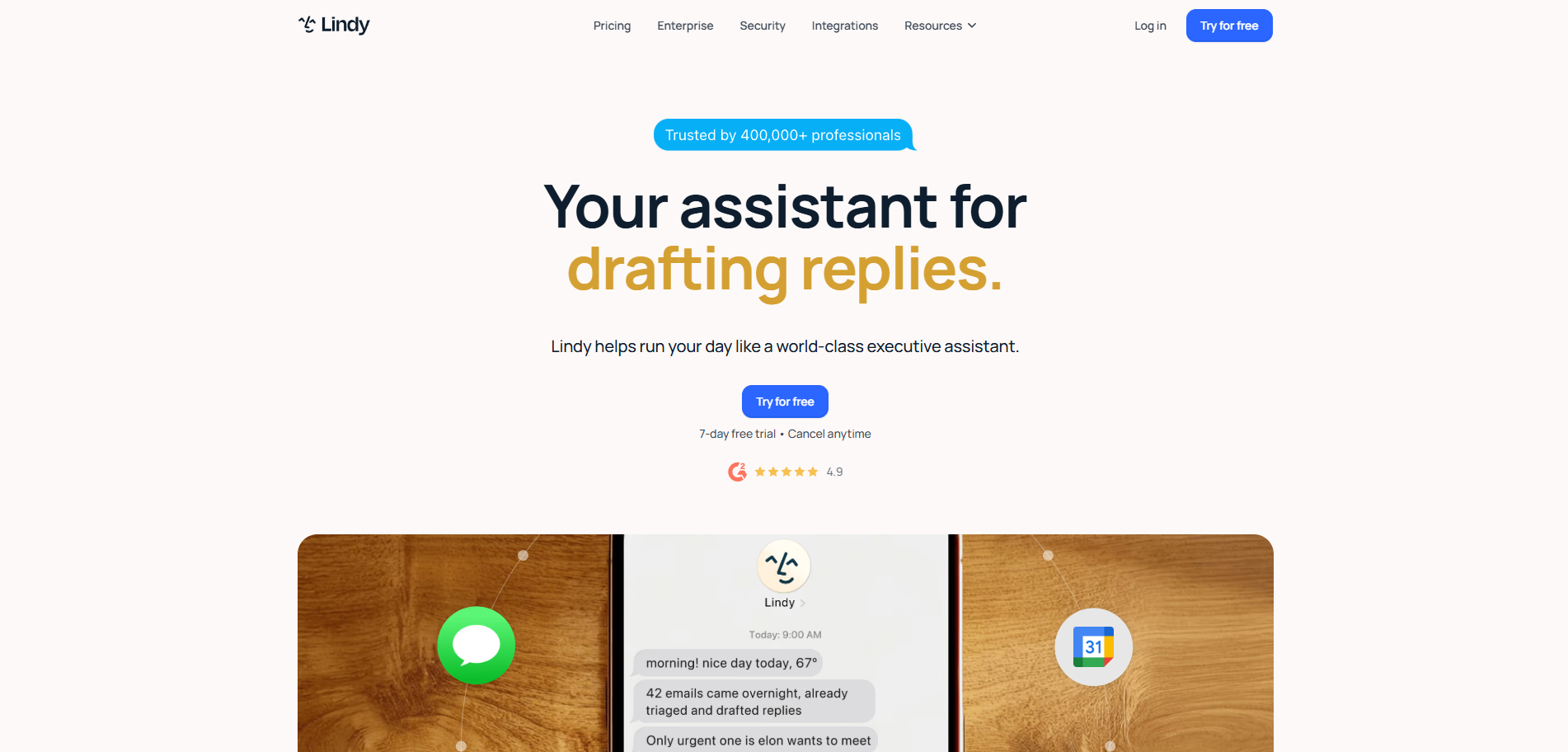
Best describe-it-and-go general agent builder, with HIPAA reserved for enterprise buyers.
Overview
Lindy turns a written description into a working agent, then lets the user refine it with templates and thousands of integrations; its confirmation toggle stops the agent before anything with side effects happens.
On compliance, it holds SOC 2 Type II and HIPAA and will sign a BAA, but only on its Enterprise plan.
Standard plans start at $29.99 per user per month. HIPAA compliance and a signed BAA are listed under Enterprise; don’t use a standard plan for PHI on the assumption that it’s covered.
Key capabilities
- Agents created from a plain-English description, refined with templates
- Thousands of general integrations across email, calendar, CRM, and messaging
- Confirmation step before any action with side effects
- SOC 2 Type II and HIPAA; BAA signed on Enterprise
- Standard pricing from $29.99 per user per month; Enterprise pricing quoted.
Best for
Back-office and admin teams automating non-PHI work, and enterprises willing to contract for the BAA.
Watch for
The BAA tier is out of reach for most practices, and healthcare data only arrives through generic connectors or another platform.
Pricing
From $29.99 per user per month; Enterprise pricing quoted, with HIPAA compliance and a signed BAA.
9. Hathr.AI
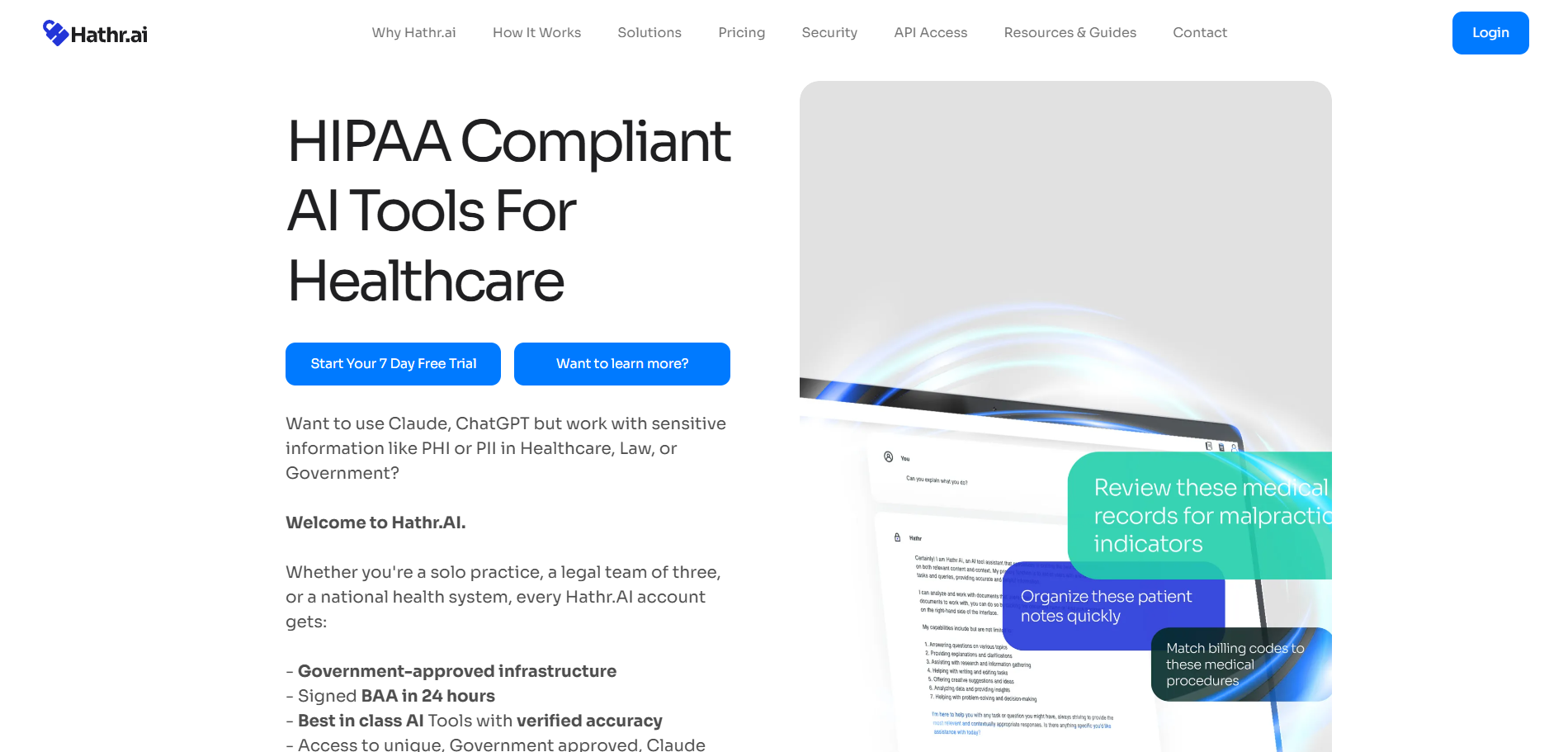
Best healthcare-native model host for staff who need a sanctioned chat assistant with a BAA on every plan.
Overview
Hathr.AI is a HIPAA-first AI service hosted on AWS GovCloud and offering Claude with a signed BAA. Verify the specific plan and service terms before processing PHI.
It’s built for the problem of staff using consumer chatbots with patient data: a governed assistant for drafting, summarizing, and document work inside a compliant boundary.
It’s not an agent platform in the front-office sense and doesn’t connect to EHRs.
Key capabilities
- Signed BAA advertised for the Enterprise workspace offering; verify coverage for any separate API service
- Hosted in AWS GovCloud
- Runs Anthropic Claude
- Governed chat for drafting, summarizing, and document tasks
- Healthcare-native positioning
Best for
Practices and organizations that want a compliant chat assistant for staff rather than an automation platform.
Watch for
Chat, not agents. No EHR connectors, no scheduling or intake workflows. Pair it with an agent platform for front-office automation.
Pricing
Enterprise workspace from $47/user/month, according to the vendor; confirm current terms and any separate API charges.
Make, Zapier, and the tools that do not sign
Make and Zapier appear in nearly every AI answer about healthcare automation, and neither will sign a BAA. Zapier's documentation puts medical data out of scope, and Make's staff have told its forum that neither HIPAA certification nor customer BAAs are available.
That rules both out for anything that carries a patient name next to an appointment, a form, or a message, no matter how compliant the underlying model is.
The same applies to any consumer AI subscription on a staff member's own account.
Keragon's comparisons with Zapier and with Make map the HIPAA-compliant equivalent of common practice workflows.
How to choose a HIPAA-compliant AI agent platform
Here are six questions that remove most vendors quickly.
Which tier carries the BAA?
BAA availability varies by provider, product, and plan.
Confirm the exact service, tier, and configuration covered, and obtain the agreement before processing PHI.
Ask for the exact plan name and price at which the BAA applies, and whether your practice can sign it without a procurement team.
Is retention zero, and does anything train on your data?
Confirm the actual retention policy for every service in the workflow, and obtain written confirmation of how customer data is used for model training.
Zero retention is not a universal HIPAA requirement; the chosen configuration must meet the practice's legal, contractual, and security obligations.
If either is a configuration option rather than a default, make sure it’s on.
Who are the sub-processors?
A platform may rely on model providers and other sub-processors to handle PHI. Confirm that the necessary contractual protections and BAA coverage extend to every relevant party in the data flow.
Get the list and confirm each link that touches PHI is covered.
Do you get an agent or a model?
Five of these nine hand you a model.
If nobody on staff can build on an API, you need an application platform, and its BAA needs to cover the model calls it makes for you.
Where is the audit log, and whose is it?
Every action, approval, and handoff should be logged in a place the practice controls and can export.
That log is your evidence in an audit.
What happens to a clinical question?
An administrative agent that answers a clinical question is a liability regardless of the BAA.
Confirm the routing rules and test them.
How to implement AI agents safely in a medical practice
Below is a sequence that keeps PHI inside the boundary from day one.
Step 1: Inventory where staff already use AI
Most practices find consumer chatbots in use before any vendor is chosen.
Write down which tasks, so the sanctioned platform covers them.
Step 2: Sign the BAA before the demo
Get the agreement, the sub-processor list, and the retention and training statements in hand.
Nothing with PHI goes into a trial until they are signed.
Step 3: Connect the EHR first
Test EHR read/write permissions and data handling in a sandbox before enabling live messaging or voice.
Confirm the BAA and contractual coverage for every connected service first.
Step 4: Set approval gates and routing
Which actions need a person to sign off, what counts as clinical or urgent, who receives each.
Write it down; it becomes the agent's brief.
Step 5: Dry-run a real week
Replay last week with sending off. Read every action.
Fix the brief until the team would sign each one.
Step 6: Review the log monthly
Review logs, approvals, and handoffs regularly, and update the security risk analysis when systems, workflows, or risks change.
HIPAA requires covered entities and business associates to conduct an accurate and thorough assessment of risks to electronic PHI.
Compliance: what a BAA does and does not do
Under HIPAA, a vendor that creates, receives, maintains or transmits PHI on behalf of a covered entity may qualify as a business associate. A BAA sets out the required contractual safeguards and responsibilities; it does not by itself make a service or deployment HIPAA-compliant.
Compliance also requires technical safeguards, a current risk analysis, workforce training, and configuration choices, zero retention, and no training among them, that the BAA assumes.
Agents that send texts or make calls must comply with applicable federal and state communications laws, including the TCPA where relevant.
Consent requirements depend on the type of communication, technology used, and applicable exemptions; marketing communications can have stricter requirements than treatment-related messages.
Call recording and monitoring must also comply with applicable state consent and privacy laws. Obtain legal advice before deploying automated patient communications.
Cosmetic and cash-pay practices may be subject to HIPAA if they meet the definition of a covered entity, including by conducting specified standard electronic healthcare transactions.
Other privacy laws may apply even when HIPAA does not. Determine the practice's legal status rather than assuming that every cash-pay practice is covered by HIPAA.
Keragon's HIPAA explained guide, its HIPAA-compliant software guide, and its trust center go through each vendor question.
Cost and ROI
Infrastructure is priced per token, and the BAA is usually free, but the build on top is where the cost lives: a developer, an integration, an interface, and an audit log.
Application platforms charge subscriptions or enterprise fees, while infrastructure providers generally charge usage-based fees.
Keragon starts at $99/month billed annually with a BAA on paid plans; Lindy starts at $29.99/user/month, with HIPAA compliance and a signed BAA listed under Enterprise; Stack AI offers a free tier and quoted Enterprise pricing.
These prices aren’t directly comparable because features, usage limits, and implementation costs differ.
The return for a practice is the front-office work moved off the desk, measured in appointments kept, forms completed, and calls answered, plus the exposure removed by taking PHI out of consumer tools.
Keragon's ROI calculator puts a number on the first part from your own appointment volume.
Final Thoughts
The AI assistants aren’t wrong that OpenAI and Microsoft sign BAAs. So do Google, AWS, and Anthropic.
What that answer leaves out is that a model under a BAA is a component, and a medical practice needs a product: an agent that reads the schedule, writes the chart, logs what it did, and asks a person before it acts.
Health systems with engineers will build on Azure, Bedrock, or Vertex, and Stack AI gives them a governed canvas.
Practices that need a ready-made automation layer should prioritize platforms that provide agent-building tools, healthcare integrations, and clear BAA coverage.
Keragon is one option, with paid plans starting at $99/month billed annually and healthcare integrations available; practices should confirm that their required EHR and workflows are supported.
Start by inventorying where your staff already use AI; that list is the first agent's brief.
Try Keragon for 14 days, or see an agent run inside the BAA first.
FAQs
Which AI agent platforms are HIPAA compliant for medical practices?
Keragon advertises a BAA on every paid plan and provides no-code healthcare automation.
Stack AI and Lindy offer enterprise-level HIPAA-related capabilities and BAA options subject to their terms.
OpenAI, Microsoft, Google Cloud, AWS, and Anthropic offer eligible services or configurations for HIPAA-regulated workloads, but the precise coverage depends on the product, plan, and configuration.
A BAA alone doesn’t make a complete AI agent HIPAA-compliant.
Is ChatGPT HIPAA compliant?
Not on Free, Plus, or Team. OpenAI offers a BAA for eligible API use with Modified Retention and for eligible ChatGPT products, including ChatGPT for Healthcare and ChatGPT Enterprise with a Regulated Workspace. The product, features, and configuration must all be eligible.
The same split applies to Claude.ai and Gemini: consumer tiers never, API and enterprise paths yes.
Does a BAA with OpenAI or Microsoft make my AI agent HIPAA compliant?
No. A BAA covers the services and responsibilities specified in the agreement; it doesn't automatically cover every connected service or make the entire deployment compliant.
Verify contractual arrangements for each vendor handling PHI, including access controls, logging, risk analysis, and proper configuration.
What is the safest AI agent platform for patient data in a small practice?
One that signs the BAA on a tier you can buy, keeps retention at zero, never trains on your data, logs every action, and routes clinical questions to a person.
Keragon is the only platform here that meets all of that on a self-serve $99 plan.
Can I use Zapier or Make with patient data?
No. Neither will sign a BAA, and Zapier rules medical data out in its own documentation, so reserve them for workflows that never carry a patient name beside a visit, a form, or a message.
Are cash-pay practices subject to HIPAA when using AI?
Cash-pay practices may be subject to HIPAA if they meet the definition of a covered entity, including through specified standard electronic healthcare transactions. Other privacy laws may apply regardless.
Determine the practice's legal status and assess the privacy and contractual requirements for every AI vendor before processing patient information.
Related Articles


Related Articles